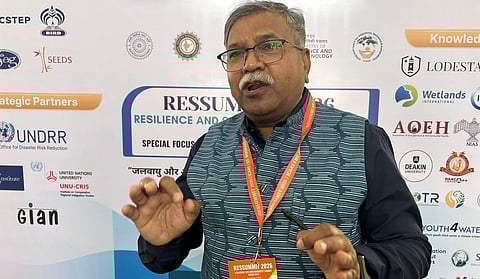


Dr Anil Kumar Gupta, Professor (WRDM) at Indian Institute of Technology-Roorkee, is a resilience and sustainability strategist and a global leader on disaster risk reduction. He spoke to Nidhi Jamwal on climate change, industrial safety, adaptation, and localised forecasting.
You recently organised The Resilience and Sustainability Summit (RESSUMMIT) 2026 with a focus on climate resilience and disaster risk reduction. What is the importance of such a Summit and what are you trying to achieve through it?
The story of RESSUMMIT is a story of the evolution of our work at ICARS [Integrated Centre for Adaptation, Resilience and Sustainability], IIT-Roorkee’s Greater Noida campus. We focus on science, policy, and practice interface. There is a lot of good science in our country, but there is a huge disconnect between researchers, policy makers, and practitioners. They don’t share their work, their strengths and their weaknesses with each other. The Government of India recognises this gap. Bridging it will also ensure optimisation of resource benefits.
Under the National Mission on Strategic Knowledge on Climate Change, we have been working on Climate Adaptive Planning for Resilience and Sustainability, popularly known as CAP-RES, in multi-hazard environments. RESSUMMIT is an initiative to bring policy makers, scientists, and practitioners on a common platform. Its first edition was held in 2023 and this year in March 2026 we organised its second edition. RESSUMIIT is not an event, it is an evolutionary process.
As part of the RESSUMMIT 2026, you also had a full-day symposium on industrial safety. What is the link between climate change and industrial disasters?
Many times, we think chemical or industrial accidents are related to just chemicals and their use. No, they are also related to climate change because if the threshold temperature is going to increase, and the safety systems are the same, then there is a huge problem. Changes in the climate means an industry’s requirement of water, requirement of energy, fire hazard—everything will change!
For instance, if industries are built for 45-degree Celsius temperature and the mercury is going to rise to 49 degree C, there are high chances of fire and an industrial disaster. Climate change is putting industrial safety under threat. Even human precision gets affected during high heat conditions. There are new things emerging and we have to start working on industrial safety in an era of climate change.
So how do we address industrial safety?
Industries have to adapt to the new situation. Whether it is production, supply chain, or occupational safety. COVID pandemic was a major setback and many industries shut down. Climate change is a huge threat. We need to think and plan how industries will face cyclones and rising heatwaves? How will ports and the shipping sector respond to the rising sea levels and coastal erosion? How will our packaging industry change?
Industry needs to foresee what will happen 10-15 years from now and start adapting. Adaption cannot happen in two days. Industries have to first understand the climate challenge and then adapt accordingly. Adaptation is just about human beings, it is also about industry survival.
Our industrial infrastructure needs to adapt because all major financial investment is the industrial sector, and it is all public money. Our entire regime is changing and understanding these issues and adapting fast is required. There are huge challenges and a lot of questions. We are trying to bring people together through RESSUMMIT so that there are discussions and possible solutions.
You are also working on a compendium of case studies on climate adaptation. Can you tell us more about it?
We are putting together such a compendium of adaptation practices from across the country. Earlier we used to call it a compendium of good practices. But then, I said that case studies can also be failure stories because we learn from our failures and can warn others not to make the same mistakes. In research, we often say that if someone fails, don’t let that person feel ashamed because then no one will attempt innovation. Also, innovation is not limited to technology alone. Innovation can be in governance, or in education and in other sectors.
For the compendium, we have received a lot of abstracts from across the country and we are putting them together. In the next step, we will also include international examples that suit our situations. We won’t just end with case studies. Based on these case studies of climate adaptation, we will make training toolkits and use them to train NGOs, district administration, private players, etc through role plays and other activities.
Climate-induced extreme events are on a rise. Almost daily we hear of some or the other disaster. Will it not affect the Viksit Bharat 2047 vision? What do we need to do?
The government has realised that we have to shift from a centralised approach to a decentralised approach. In the last 5-8 years, the government has trained Aapda Mitra, community volunteers in disaster-prone districts across India. We started with the NDRF [National Disaster Response Force], which is our pride. It was necessary and back then we did not have local capacities, and the NDRF has done brilliant work.
But it takes time for the NDRF to reach a site of disaster. And why should we let a disaster happen and then save people. If we build local capacity, then people will work during a disaster and also after the event to prevent disasters and prepare the community. We now have SDRFs, and there is also a discussion of district level DDRF. It should not be just a response force, but should also work on mitigation and prevention.
We should also remember that these disasters have climatic and non-climatic factors. For instance, a GLOF or an extremely heavy rainfall event is linked to climatic factors. But, in a disaster like Dharali in Uttarakhand, there were non-climatic factors also. In Dharali, there were landslide lakes upstream, which can be described as a geological phenomenon. But, there was also an entire town that had been settled downstream of it and no one cared about it. Now the agencies and researchers are showing maps saying they knew about these landslide lakes upstream. If you knew, then what was the benefit of it if it was not shared in advance and used for preventive measures?
We want that such knowledge gets pre-positioned and helps in disaster prevention and mitigation, and community preparedness. We are trying to bring together climate science, geology, environment, ecology, and planning agencies.
How do we protect our Himalayan region which is facing an onslaught of climate disasters?
Regional vulnerability must be understood. Even within the Himalayan region, there is eastern Himalaya and western Himalaya, and then there are individual Himalayan states. For instance, in Uttarakhand, Kumaon is different and Garhwal is different. In the hills, things change within 15 kms, so we need a localised approach. The model being implemented in the plains will not work in the Himalaya.
In the Himalaya, there is a constant conflict between tourism and environmental protection. Local communities depend on tourism and if we curtail that, there is a loss of livelihoods and out migration. But, to promote tourism, if we build infrastructure that is not climate resilient, then there are heavy damages during extreme events. So what is the win-win situation? What is that balanced approach and a mid-path development model?
We cannot develop a model just by talking. We need to show 1-2 models in action so that people believe it can happen. We have to convince the state governments and district administrations to take risks with us and try a new model of development in the hill region. If those 1-2 models are successful, then we have a way forward. That is why at ICARS, we are working on a localisation prototype—how a new area can be developed by pre-thinking about factors and planning accordingly.
Lastly, Jammu & Kashmir has been facing a lot of extreme weather events. It is also highly climate vulnerable. How do we protect that region and its people?
In the case of J&K, there are long-term and short-term issues. The long-term challenge is land use changes. At vulnerable sites, if people build homes, then it is a problem. If construction activities block natural drainage, then a disaster is likely to strike. We have seen that if it does not rain enough in 2-3 years, then people build houses on the path of seasonal rivers and forget there ever existed a river. But, a river finds its way.
We have to understand Nature and plan our development around it. We have to slightly compromise —build homes away from water channels, build smaller houses, make some structural changes, and integrate modern technology with traditional wisdom.
In the short-term and immediate scenario, we need more localised forecasting. IMD’s Mausam App gives these forecasts but they are still not site specific. We are working with some developers on a customised and precise forecast. We are exploring how we use AI/ML [artificial intelligence and machine learning] to improve forecasting by integrating local factors. We are already discussing with NDMA if we can work with 2-3 state governments on this and do an experiment. At climate vulnerable sites in J&K, we should do such experiments at 2-3 sites, and based on their success expand further for awareness and preparedness of people.
Things are so uncertain everywhere. We have to increase our capacity to anticipate things. We need to train local people as local climate volunteers who work on response and information dissemination. At every village level, we need to have five such local trained experts, who guide the villagers—where to build a house, what structural changes to make, what local materials to use, etc. Such grassroots expertise is missing, and we want to build it.
Have you liked the news article?
Support us now:
https://www.gofundme.com/manage/jammu-kashmirs-sole-independent-voice-under-threat