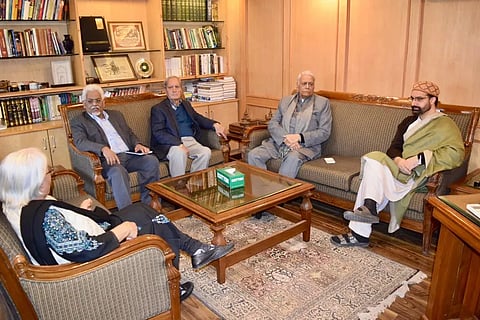


NEW DELHI: The Concerned Citizens Group (CCG), led by senior political, civil service, and military veterans, released its 11th report on Jammu and Kashmir after a detailed visit to the region between October 28 and 31, 2025. The group, comprising Yashwant Sinha, Sushobha Barve, Air Vice Marshal (Retd.) Kapil Kak and journalist Bharat Bhushan toured both Kashmir and Jammu to assess the ground situation in the aftermath of key political, security, and environmental developments.
Formed in 2016 after mass protests in the Valley, the CCG said its mission has always been to act as a bridge between J&K and the rest of India. The group emphasised that it has no affiliation with any political party or government and finances its visits independently.
The latest report paints a stark picture: Kashmir is “sullen and silent,” dissent is dangerous, alienation is deeper than at any point since 2019, and anger is rising in Jammu as well. The report concludes that the situation on the ground is “much further from the truth than the one presented by the Government of India or its media in Delhi.”
A climate of fear: “We have been silenced”
Across meetings with political leaders, civil society groups, traders, journalists, students and clerics, the group said the most overwhelming sentiment in the Valley was fear.
One senior Srinagar-based doctor told the CCG, “We have been silenced. But the eerie silence does not mean all is hunky-dory.” He warned that the “volcano of suppressed anger and frustration bordering on hatred could erupt any time, as all it needs is a trigger.”
A retired professor echoed concerns about identity erosion, saying there was “no protection for Kashmiri identity today” alongside a growing sense of economic dispossession. Others described being abused and stereotyped. One civil society member pointed to the controversial Bollywood singer event, calling it a “cultural invasion” and saying locals saw it as an act of disrespect to Kashmiri culture.
The CCG found that anti-India sentiment has grown, particularly after Operation Sindoor and the November terror attack. Youth, the group observed, are torn between two dangerous paths: drug addiction or radicalisation.
A senior editor summed up the mood starkly: “This silence of the Kashmiri society is unsustainable. It has to explode… and when it does, it would be dangerous.” Another political leader said, “Kuch bada hone wala hai.”
Political paralysis despite an elected government
The report says democracy remains nominal. A year after Omar Abdullah’s government took office, real authority remains concentrated with the Lieutenant Governor (LG).
Omar Abdullah described himself to the CCG as “half a CM”, arguing that despite having an overwhelming mandate (41 of 47 Valley seats), “the LG exercises meaningful and effective power while the elected government is helpless.”
Key decisions, including postings of civil servants and police officers, remain out of the government’s control. This has bred enormous public frustration. Citizens complained to the CCG that few Kashmiri officers are posted as district heads, and officers from outside the UT “neither understand the language nor the local situation,” deepening mistrust.
Internal strains within the National Conference (NC), particularly public disagreements between Abdullah and the party’s Budgam MP, have also weakened the government politically. The MP resigned, triggering a by-poll that the NC eventually lost to the PDP.
Meanwhile, Mehbooba Mufti’s political revival—through protests and a Public Interest Litigation demanding local jails for Kashmiri detainees—has struck a chord with families whose sons remain imprisoned in far-off states.
Mirwaiz Umar Farooq told the group that parents “come pleading that something be done” for the release of jailed youth. He also detailed the “intimidation and surveillance” he faces, including sudden restrictions on Friday sermons and demands for police scrutiny of sermon texts and even Nikahnama records.
Non-restoration of statehood: a deep wound
If one issue united Kashmir and Jammu during CCG’s visit, it was the continued denial of statehood.
The report calls resentment on this issue “massive and overwhelming.” A senior political leader told the group the root cause was simple:
“Elections happened but the results were not to the expectations of the BJP government at the Centre. They could not get a BJP-led or BJP-dependent government in Srinagar… the Centre has not been able to digest it.”
The group pointed out that:
The J&K Assembly passed a resolution demanding early restoration of statehood in October 2024.
More than a year later, there has been no progress.
Without statehood, human rights commissions, consumer redress authorities and appellate bodies cannot function, depriving citizens of institutional justice.
Many Kashmiris told the CCG that losses since August 2019 still feel raw. People spoke of the “loss of identity, honour and dignity” following the abrogation of Article 370 and 35A and the breakup of the state into two Union Territories.
Omar Abdullah, the group noted, was categorical: “No political entity… in the rest of India has any sympathy for the people of J&K.” He questioned why, despite repeated promises by the Prime Minister and Home Minister, no all-party meeting has been called on J&K in years.
The CCG pointed out that the Supreme Court itself had been given an assurance by the Centre that statehood would be restored. A separate judicial note from then-Justice Sanjiv Khanna held that the demotion of a state into two UTs was “unconstitutional and should be summarily reversed.”
But recent terror attacks in Pahalgam and the alleged Red Fort plot, the group fears, may be used to delay the decision further.
Reservation turmoil: Young Kashmiris see shrinking opportunities
One of the most explosive issues during the visit was the new reservation policy, which students described as a “time bomb.”
Students told the CCG that Kashmiris are being squeezed out of educational and job opportunities because reservations have risen to almost 60 percent, one of the highest in India, well above the constitutional ceiling of 50 percent.
The trigger was the 10 percent Scheduled Tribe (ST) quota for Pahari-speaking people, granted by Parliament. Students said they had “nothing against Paharis” but that this was the first time ST status had been given on linguistic basis. They described it as a “political appeasement measure” aimed at gaining votes for the BJP.
According to 2011 Census data, students argued, 69 percent of J&K’s population falls in the general category, but open merit seats have now shrunk to less than 40 percent.
Reservation certificates issued in the past two years show a stark regional imbalance: Jammu received 99 percent of SC, 87 percent of ST, 57 percent of OBC, 88 percent of EWS, 85 percent of ALC/IB, and 100 percent of “other” certificates. Kashmiris told the CCG they see this as systematic exclusion.
Other groups are upset too:
Hindu Pahari refugees of 1947,48 settled in Jammu say they were excluded despite being Pahari speaking.
Paharis in Ramban have also been left out.
Gujjars, while retaining their 10 percent quota, told the CCG they were being sidelined in administrative postings. A Gujjar public intellectual noted that “not one Gujjar is SHO in the 10 districts of Jammu division.”
Students want a rationalisation of reservations, revision of the creamy layer criteria, J&K-specific EWS rules, and a unified Backward Classes Commission.
Media under pressure: “Freedoms have not returned”
Despite the 2024 Assembly elections, the report says media autonomy has not improved.
Journalists told the group that:
Censorship, intimidation, and surveillance continue.
Accreditation for major national organisations, including The Hindu, NDTV, The Times of India, and Economic Times, has been denied or revoked.
During Operation Sindoor, local journalists could not report freely, and several were summoned by the police.
One journalist said not being allowed to cover government events was like “deliberately sabotaging their careers.”
A new government directive asks journalists to submit six months of salary slips and detailed background information to prove they are “real journalists”. The administration cites complaints of impersonation and misuse of credentials, but journalists call it intrusive and intimidating.
The report highlights concern that the LG frequently speaks of cracking down on “over-ground workers” of terror groups, leading reporters to fear that any of them could be branded part of a ‘terror ecosystem’.
They cited the prolonged detention of journalist Irfan Mehraj, held in Delhi’s Rohini Jail for over 100 days, with hearings repeatedly delayed.
Economic distress: Tourism collapse and horticulture losses
Tourism wiped out after Pahalgam attack
One of Kashmir’s biggest economic lifelines, tourism, was devastated after the Pahalgam attack. “Kashmir was emptied of tourists overnight,” the report notes. Thousands of hoteliers, taxi drivers, shopkeepers and others lost their primary earnings just before winter.
During Diwali, occupancy rose to only 10,30 percent, depending on hotel category.
Adding to the distress is the controversial New Land Policy for hotels, especially in Gulmarg, where expiring leases are to be auctioned rather than renewed.
Hoteliers say they should be given preference since they built properties with their own capital. They also ask why the same rules are not applied to expired leases in Delhi, also a Union Territory.
Horticulture hit by landslides and highway collapse
The apple economy, central to south Kashmir, suffered massive losses as rains in Jammu caused landslides that shut the Srinagar-Jammu highway for more than 20 days. Over 4,000 fruit trucks remained stranded; harvested apples rotted in orchards and storage facilities were insufficient.
The Pulwama Fruit Mandi alone loads 50 trucks a day, each valued at ₹7 lakh, amounting to ₹3.5 crore daily revenue in the season. Losses this year crossed ₹2,000 crore, the mandi president told the group.
Though the Centre and UT government later deployed goods trains, the relief was too late for most growers. Meanwhile, the move sparked anger among Jammu traders and transporters who fear loss of livelihood.
One Jammu Chamber of Commerce member said bitterly, “The government is not consulting traders here before implementing decisions that affect trade.”
Jammu’s anger grows: “We also feel like an occupied colony”
The CCG found that alienation in Jammu has also grown sharply, especially after Operation Sindoor brought shelling close to Jammu city. Many families temporarily migrated to Himachal Pradesh and Delhi.
Polarisation has increased in the plains; reports of social boycotts of Muslims have emerged. A Jammu public intellectual told the team, “We in Jammu also feel like an occupied colony. We are nowhere in the scheme of things. Only Kashmir is talked about.”
The Darbar Move’s resumption did help bring the administration physically closer to Jammu, but the group concluded it was symbolic relief, not substantive change.
After four days of travel and dozens of meetings, the group concludes that the situation in Jammu and Kashmir is volatile, distressed, and misrepresented.
They write:
“We found that the situation on the ground, especially in the Kashmir Valley, is much further from the truth than the one presented by the Government of India or its media in Delhi.”
The CCG’s 12th report ends on a warning: unless political dialogue, restoration of statehood, administrative reforms, and economic safeguards begin quickly, the silence blanketing Jammu and Kashmir will not last much longer.
The XIth Concerned Citizens Group Report:
Have you liked the news article?
Support us now:
https://www.gofundme.com/manage/jammu-kashmirs-sole-independent-voice-under-threat