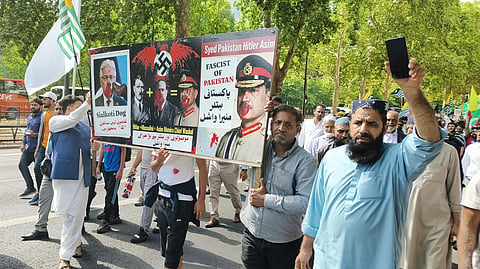


LONDON: Defiant chants of azadi echoed through central London on Thursday as more than 5,000 British Kashmiris — men, women, the elderly, and toddlers perched on shoulders — converged on the Pakistan High Commission to demand an end to what they described as a deadly crackdown in their homeland.
Organised in less than 36 hours and on a working day, the demonstration saw families shut their businesses, take leave from work, and travel for hours to raise their voices for relatives trapped under what protesters called a brutal military siege in Pakistan-administered Jammu and Kashmir (PaJK). One family travelled from West Sussex, commuting for an hour and a half with a toddler to join the march.
The latest massacres at Rawalakot and Mirpur that galvanised the weekday protest was represented by a coffin that was carried all the way through the procession with the flag of the PaJK (also called Azad Jammu and Kashmir) draped over it.
A few yards down the procession, a large banner showed Pakistan’s all-powerful military chief, General Asim Munir, with blood splattered across his face. The banner read “Fascist of Pakistan” in English, followed by the detail “Pakistani Hitler… Muneera Washal”. In the centre of the banner, the nazi swastika symbol at the top centre, with the gushing blood showed Hitler and Mussolini that equalled to General Munir. The bottom of the display read in Urdu: “The bigger bastard than Mussolini and Hitler is Munira Washal”. Washal is the Urdu iteration of washer, the essential component in plumbing, typically made of rubber to create watertight seals. This refers to Munir’s background in the Army’s technical wing.
Around 600 women led the procession from Hyde Park’s Speakers’ Corner to the High Commission — a three‑kilometre walk — carrying placards condemning the killings, many of them clutching babies as they marched.
For Lubna, originally from Rawalakot and now living in London, attending the protest was not a choice. It was an obligation.
“Our people are being martyred at the hands of Pakistani forces,” she said, her voice heavy with grief. “We’ve had no contact with our families because of the communication blackout. The last time I spoke to my mum was for a few seconds. She said, ‘There is blood everywhere.’ Since then, nothing. I can’t sleep. I can’t live normally while thinking constantly about my parents and everyone back home.”
Videos of protest demonstrations in Pakistan, Pakistan administered Jammu and Kashmir and London on July 30, 2026, shared on X.
‘White flags met with bullets’
The anguish on London’s streets mirrors a catastrophe unfolding more than 3,000 miles away.
Protesters supporting the Joint Awami Action Committee (JAAC) — banned by Islamabad under anti‑terrorism laws — alleged that Pakistani forces were firing on civilians carrying white flags while transporting the injured. Many described the crackdown as more brutal than anything they had witnessed on the Indian side of the divided region.
Zahida Begum, also from Rawalakot, said her son and grandchildren were trapped in the city.
“They have no food left. Supplies across PaJK have run out, and there’s been no electricity for days. Whatever was in the freezer is spoiled,” she said. “Because of the blackout, I have no contact with my family. I’m here to raise my voice for them. Our innocent families are being victimised.”
Nasreen Khan, another Rawalakot native, said she joined the protest “to stand with my people of Kashmir,” describing the killings as genocide and urging international intervention.
A wedding season of tears
The military crackdown has been especially devastating because it struck at the height of the wedding season, which runs from April to September.
Protesters shared grainy mobile footage that appeared to show soldiers ransacking homes, looting shops, and seizing valuables. One woman, who said she witnessed the raids firsthand, described families preparing for weddings having their jewellery and cash taken. “Where soldiers couldn’t find valuables, they destroyed property,” she said.
She also reported incidents of molestation and the use of obscene language against women, including those inside their homes.
Even the dead have not been spared. In Rawalakot, army personnel reportedly refused to allow a funeral for a man who died of natural causes. Mourners were turned back at gunpoint from Allah Wali Masjid, leaving the family unable to hold a proper janaza.
The youngest voice
Among the thousands marching was 20‑month‑old Zaraan, perched on his father’s shoulders. The toddler spent nearly three weeks under siege in Rawalakot when the agitation began. Now back in the UK, his parents travelled more than 70 kilometres and closed their business for the day to show solidarity.
Throughout the march, groups of families spanning four generations walked together — those born in PaJK and those born in Britain. Anger was palpable. I walked nearly a quarter of a kilometre with one such group led by a grandfather. A younger relative told me he was in shock when the first killings occurred. “We never imagined this could happen on the Pakistani side,” he said. “We thought it only happened on the Indian side. Now I’m convinced the Pakistani army is the most bay‑ghairat in the world.”
Among the crowd was Sajid Janjua, in his mid‑50s, wearing a traditional Kashmiri pheran emblazoned with the PaJK flag. His face carried a mix of rage and resolve. A regular at the London protests since they began last month, he marched with a large PaJK flag, its colours mirrored on the front and back of his garment.
Ershad Malik, a British Kashmiri political activist, solicitor and poet, posed a larger question, pointing to the hypocrisy of two powerful states. “If, as Pakistan's official narrative claims, the Kashmir Action Committee is "pro-India", and if the majority of the people of Azad Jammu and Kashmir support the Action Committee, then does that not amount to a political expression of the people's will? If so, why continue to demand a referendum while simultaneously dismissing that majority as "pro-India"?” he asked.
And then added, “Likewise, India has consistently maintained that Pakistan-administered Kashmir is legally an integral part of India. If that is India's official position, then why does it remain largely silent when violence against people in that territory emerge? If those people are regarded as its own citizens, should their rights, safety and dignity not receive the same attention and concern?”
These are not accusations. They are legitimate political questions that deserve thoughtful and democratic answers, he said.
A diaspora’s desperate plea
Around one million people of West Kashmiri (PaJK) heritage live in the UK, making it one of the largest Kashmiri diaspora communities in the world.
“We can’t even talk to our families back home,” one protester shouted. Women have been threatened, he said. Families are terrified.
International calls for action
Amnesty International has called for a “prompt, independent, and transparent investigation” into the security forces’ use of force against protesters.
“Tensions around this election are being heightened by the unlawful ban on the Jammu and Kashmir Joint Awami Action Committee,” said Isabelle Lassee, Amnesty’s Acting Regional Director for South Asia. “The ban cannot be used as an excuse to mete out deadly violence.”
The UN Human Rights Office has also urged “prompt, thorough and impartial investigations into all deaths caused by the unrest.”
But for the thousands on London’s streets — and the millions trapped in PaJK — statements are not enough.
As one protester cried into the London sky, his voice cracking: “Blood of Kashmiris is on the roads. How many more must die before the world wakes up?”
Lowndes Square: The new address for defiance
Lowndes Square, the road that leads up to the Pakistan embassy, was filled with protestors who shouted slogans of defiance, condemnation and, of course, azadi. Although the initial protests were mainly about the fulfilment of basic local demands, today’s demonstration was overwhelmingly filled by the calls for azadi. Many believed that it was time to separate from Pakistan. But when asked how, there were no answers.
The protestors remained in the street for over an hour while the rumours circulated that the Pakistani embassy was unofficially closed for the day. The two embassy buildings showed a ghostly silence.
Some people at the parking lot of area said the locals were fed up by the regular protests and that it was disturbing the peace in the area. In anticipation of the crowds, the Royal Borough of Kensington and Chelsea, the local council, has placed parking suspension notices in the area from 12.00-7.00 for all the residents’ bays.
Even the nearby businesses, particularly the restaurants were beginning to feel the disturbance by the regular demonstrations and had reportedly approached their councillors to find a solution to the growing problem.
(This news article has been updated with some more additional information.)
Have you liked the news article?
Support us now:
https://www.gofundme.com/manage/jammu-kashmirs-sole-independent-voice-under-threat
