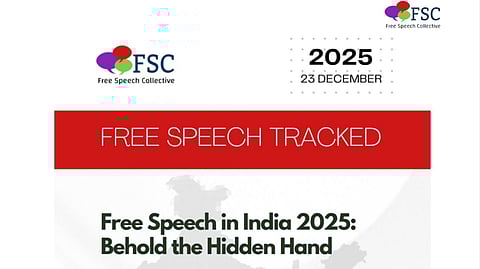


NEW DELHI: India witnessed a dramatic escalation in free speech violations throughout 2025, with a staggering 14,875 documented instances including nine killings, mass censorship targeting thousands of social media accounts, and the return of colonial-era sedition charges against journalists and satirists, according to a comprehensive report released by the Free Speech Collective (FSC).
The report notes that year began ominously with the death of journalist Mukesh Chandrakar, whose body was discovered in a septic tank in Bastar on January 3, days after he reported on poor road construction quality. His death set the tone for what would become one of the darkest years for press freedom in India's recent history.
Unprecedented Scale of Censorship
The most striking finding in the FSC report is the explosion in censorship cases, with 11,385 documented instances representing what the organization characterizes as "mass" censorship. The figures include the Indian government's requests to withhold over 8,000 accounts on X (formerly Twitter) in May and another 2,354 accounts in July. According to X's own submission to the Karnataka High Court, the platform received 29,118 government requests to remove content between January and June 2025, complying with 26,641 of them.
Internet controls extended beyond social media, with 3,070 additional instances including shutdowns, app blocking, and 785 blocking orders issued by the IT Ministry to various online intermediaries in January and February alone.
Among the prominent accounts withheld in India were those of news outlets The Wire and Maktoob Media, Kashmir Times editor Anuradha Bhasin, Indian Express Deputy Editor Muzameel Jaleel, and even Reuters.
Journalists Under Attack
The report documents 40 attacks during the year, with 33 targeting journalists specifically. Eight journalists were among the nine people killed, with rural reporters bearing the brunt of violence for their coverage of local corruption, maladministration, and illegal activities.
Beyond Chandrakar's killing, the body of Rajeev Pratap, who ran the YouTube channel Delhi Uttarakhand Live, was found in the Bhagirathi river days after he aired a video about liquor consumption in a local hospital. Police attributed his death to drunk driving, a claim disputed by colleagues.
Two journalists continue to languish in jail under the draconian Unlawful Activities (Prevention) Act: Irfan Mehraj of Kashmir since March 2023 and Rupesh Kumar of Jharkhand since July 2022.
The report recorded 117 arrests of citizens throughout the year, including eight journalists, along with 208 instances of lawfare—criminal cases lodged against multiple persons.
In November 2025, the State Investigation Agency of Jammu & Kashmir Police raided the offices of the Kashmir Times in Jammu to investigate its alleged activities inimical to the country, prompting the newspaper—founded in 1954—to describe the action as another attempt to silence "one of the few independent outlets willing to speak truth to power."
Sedition for Social Media posts
In a significant setback for free expression, the colonial-era sedition law made a comeback in April, less than a year after new criminal codes were notified. Satirists Neha Singh Rathore, Madri Kakoti (known as Dr. Medusa), and Shamita Yadav (Ranting Gola) were charged with sedition for social media posts questioning administrative failures following the Pahalgam attack. In December, the Allahabad High Court rejected Rathore's anticipatory bail plea, marking a departure from previous judicial approaches.
In August, Assam police registered sedition cases against at least 12 columnists and editors of The Wire, including founding editor Siddharth Varadarajan and consulting editor Karan Thapar, over articles published after the Pahalgam attack. Journalist Abhisar Sharma faced similar charges for his YouTube content.
Gag Orders
A key development in 2025 was the deployment of the Sahyog portal, which empowered state agencies, district-level officers, and local police to issue takedown notices to social media platforms. On September 24, a Karnataka High Court single-judge bench upheld the portal as "an instrument of public good" in a 351-page judgment, rejecting X's legal challenge.
According to an RTI filed by Al Jazeera, Indian government officials sought the removal of 3,465 URLs, with 294 takedowns between October 2024 and June 2025.
The year saw unprecedented coordination between major corporations and the government to suppress critical coverage. In September, corporate giant Adani obtained an ex-parte injunction from a Delhi civil court restraining nine journalists and news platforms from publishing allegedly "defamatory" content. The court ordered immediate takedown of 138 YouTube videos and over 80 Instagram posts before the order was removed two days later by a lower court.
Similar attempts to curb coverage emerged around Vantara, the private zoo run by Anant Ambani of Reliance Industries, with multiple legal maneuvers aimed at suppressing investigative reporting on how the facility acquired endangered animals.
Self-Censorship and the "Hidden Hand"
The report highlights growing self-censorship by media organizations and documents unofficial government directives shaping news agendas. The alleged removal of Hiren Joshi, an officer on special duty to Prime Minister Modi widely believed to helm the PM's communication strategy, sparked reports about his daily calls to media houses.
Senior journalist Patricia Mukhim announced she stopped her column in Assam Tribune after her article on the plight of Muslims targeted by eviction drives was denied publication. In December, The Wire condemned Jammu and Kashmir police for seizing their correspondent Jehangir Ali's mobile phone while he worked on an investigative report about alleged nepotism and corruption in a hydropower project.
Academic Freedom Under Siege
The report documents at least 16 serious instances of censorship in academia. In August, the Jammu and Kashmir Home department banned 25 scholarly books on Kashmir's history and politics by respected scholars including A.G. Noorani, Christopher Snedden, Angana Chatterjee, and writer Arundhati Roy. Police subsequently raided bookstores and seized books on Islam.
Visiting academics continued facing visa difficulties and deportations. In October, UK-based scholar Francesca Orsini, Professor Emerita at the School of Oriental and African Studies known for her work on Hindi, was deported without explanation. The government also cancelled the Overseas Citizenship of India status of UK-based academic Nitasha Kaul, citing alleged "anti-India activities."
In August, the Delhi High Court banned shadow library sites Sci-Hub and Sci-Net, restricting free access to academic research for students and researchers.
Film Censorship Intensifies
Film censorship reached new extremes. In December, the Union Ministry of Information and Broadcasting denied the International Film Festival of Kerala permission to screen 19 films, including the century-old classic Battleship Potemkin. Filmmaker Neeraj Ghaywan's "Homebound" received certification only after 11 cuts.
The award-winning film "Santosh" by British filmmaker Sandhya Suri, the UK's official Oscar submission, was denied a CBFC certificate and could not be released in India. The film dealt with the rape and murder of a Dalit girl and police cover-up.
When CBFC Watch, an open-source database, revealed over 100,000 cuts made to nearly 20,000 films over seven years, the Central Board of Film Certification quickly restricted public access to certification details on its portal.
New Regulatory Threats
The Digital Personal Data Protection Act Rules, notified in November, classified reporters and media organizations as "data fiduciaries," while a crucial amendment to the RTI Act removed provisions for exemption in the "public interest." The DIGIPUB News India Foundation warned the framework "endangers journalism" with penalties reaching up to Rs 250 crore for violations.
In December, the Department of Telecommunications mandated continuous SIM-device binding for messaging platforms like WhatsApp, Telegram, and Signal, raising privacy and surveillance concerns.
Judicial Inconsistency
The judiciary delivered mixed signals on free speech protections. While the Supreme Court quashed an FIR against MP Imran Pratapgarhi for reciting an Urdu poem, stating courts must protect "poetry, dramas, films, stage shows including stand-up comedy, satire and art," another bench directed a Special Investigation Team to interpret the "hidden meaning" behind social media posts by Ashoka University Professor Ali Khan Mahmudabad and imposed gag orders as bail conditions.
Grim Outlook
The Free Speech Collective warns that prospects for free expression in India look increasingly dire. The report concludes that the "muscular state" is pushing restrictive regulatory mechanisms with active support from major corporations, both as media owners and social media influencers. The intensification of crackdowns on independent voices threatens to further pollute the climate for free information flow and stifle the fundamental right to think and express freely.
India's ranking in global press freedom indices has been in freefall for several years, with the downslide continuing unabated in 2025, cementing concerns about the state of democratic freedoms in the world's largest democracy.
The complete Free Speech Tracker database is available at the Free Speech Collective website, documenting violations across categories, states, and years. It can be accessed here.
Free Speech Collective report can be downloaded.
Have you liked the news article?
Support us now:
https://www.gofundme.com/manage/jammu-kashmirs-sole-independent-voice-under-threat