

JAMMU: Javed Choudhary (35), visibly distressed and wearied by helplessness, is busy packing the few household items left in his home after his family was displaced. Continuous rainfall in September 2025 triggered land subsidence, leaving nearly 20 families homeless.
"This place is unsafe. The Geology Department has declared it uninhabitable. We cannot live here anymore, which is why I am emptying the house we built with our hard-earned money. Now, we are left with nothing," Javed said in quiet resignation.
Javed’s family is among the twenty from Kheri village, 20 kilometres from Jammu city, winter capital of Jammu and Kashmir, in the Bhalwal block, that were evacuated after the rains and floods in September washed away the land on which their houses stood.
Ring Road, Tunnels and Fragile Lands
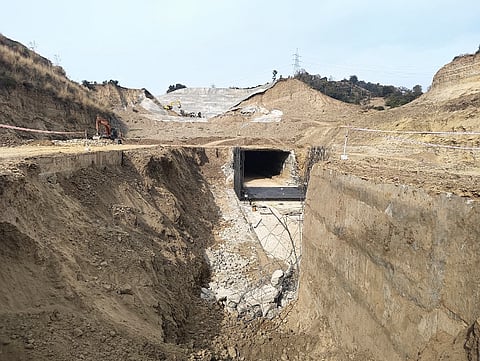
A 58-kilometre long four-lane Ring Road project from Raya Morh to Jagti was initiated in 2018 with major work awarded to Gayatri Project and was scheduled for completion in 2022. However, due to the area being ecologically fragile, the project remains incomplete.
"Three surveys were conducted for this Ring Road. First two surveys that did not benefit certain influential people were rejected, and the current one was selected. Unfortunately, it has proven fatal for nearby villages," Javed alleged.
The current project required tunnels at intervals of about 500 metres.
Javed explained how and why the tunnel construction triggered the disaster.
“Two tunnels were constructed, one affecting Kheri village and the other Kangar village. Had the road been constructed according to the earlier alternative plan, there would have been no need for tunnels”.
"When tunnel construction began, we felt strong vibrations. This is a fragile zone; it disturbed the natural balance. Our houses developed cracks, and we paid the price during last year's heavy rainfall. In August and September 2025, nearly 15 houses were severely damaged," he added.
The Ring Road project has also taken away land from local inhabitants. While some residents received compensation, many are still fighting legal battles, with cases pending in the offices of the Sub-Divisional Magistrate (SDM), Javed said.
Javed and other villagers are sure that the devastation was linked to tunnel construction. "We have been living here for decades, since 1947. Heavy rains occurred earlier as well, but we never witnessed such destruction,” he told the Kashmir Times.
Homeless, Displaced and Landless
Kheri village has around 250 families, most of them uneducated and unaware of the possible repercussions of the project when it started.
"I spent nearly ₹50–60 lakh building my house. For the past six months, we have been living in tents provided by the Deputy Commissioner of Jammu. We lack basic facilities—there is no water supply, and we have to walk three to four kilometres just to fetch drinking water," he said.
Regarding compensation, Javed stated that affected families received immediate relief of rupees 1.20 lakh, which he described as grossly inadequate. Not only have they lost their houses, but they have also lost the land to subsidence.
"That amount is not enough to build even a thatched hut. What about our land? Where are we supposed to go? Are we expected to live in tents forever?" he asked.
The residents are demanding relocation to a safer area.
“After the devastation, not only houses but roads were also severely damaged. Several political leaders, including the local MLA, visited the site. We told them that tunnel construction was the main reason behind this disaster. A team from the Geological Survey of India (GSI) collected samples, but six months have passed, and the report has still not been made public. We visited their office several times; they told us the report was submitted. But no one is releasing it,” Javed said.
Naseema (65) carried one grandchild in her arms while the other followed her with a bucket in search of water, and wandered helplessly through the village. Pointing toward what was once her home, now reduced to bare walls and partly rubble, she broke down in tears. Tears rolled down her cheeks, settling into its deep wrinkles.
"All that we built through years of hard work and dreams, has been destroyed because of this project. We are uneducated and did not know that the road project would leave us homeless. Had we known, we would have protested at that time," she said.
Speaking about her family's future, she spoke about her immediate and long-term worries: "Where will we go now with our family, young children, and livestock, which is our only source of livelihood?” Her woes multiplied after her son landed in a hospital with a fracture. While her husband is attending to him, she’s left alone to deal with the daily routines.
The village road has been destroyed, and residents say they are left with no hope.
"Every day we hear the cracking sound of the sinking land. We live in constant fear of losing more and more," she added.
For Naseema, the land and their ruined homes no longer hold meaning. “The government can take this broken house and sinking land, and instead relocate us to a safer place,” she says as she resigns to the prospect of incremental loss due to the tunnel.
She elaborates, “We are trapped between two tunnels—one on the right and one on the left—and we’re sandwiched in the middle.”
Nawab Din, a sixty-year-old resident, describes the area as an ecologically fragile zone now scarred by development. His house, built below the road, was buried when the hillside gave way.
"In my youth, this place was beautiful and untouched," he says, his voice heavy with loss. "But development has ruined it. When the road collapsed, it slid directly over my house, burying it. We barely escaped with our lives."
Everything they owned was destroyed. For months, Nawab Din and his family lived in tents, surviving on food rations and clothing donated by neighbors and relatives from nearby villages.
"After several days, the administration finally sent a JCB to clear the debris," he recalls. "Only then could we see parts of our house again."
Now, authorities are reconstructing the road using gabion crates (wire mesh boxes filled with stone) in an attempt to stabilize the unstable slope.
Geological Sensitivity of Area Overlooked
Did the project bypass scientific assessments and environmental clearances, as the villagers allege?
A civil engineer, speaking to Kashmir Times on the condition of anonymity, said that for tunnel construction or mountain cutting, engineers use the RMR (Rock Mass Rating) system along with the USCS (Unified Soil Classification System) to classify weak rock masses and soil-like materials.
He explained that the assessment involves six parameters, including the scope of excavation, the dip of the mountain, and the downslope direction, which is identified through specific geological lines. “If even one parameter fails, the project should not proceed,” he said. “However, in this case, not all parameters were qualified.”
According to the engineer, the authorities used the NATM (New Austrian Tunneling Method), which also classifies rocks into three categories—A, B, and C. Category A consists of hard rock that requires no reinforcement. Category B has three grades and requires lattice reinforcement, which is relatively lightweight and inexpensive. Category C has five grades, and the site in question falls under the fourth grade of Category C, which is among the weakest.
He added that the area where the tunnel is currently under construction is considered one of the five weakest geological zones in Asia. Due to the weak rock structure, the tunnel has developed cavities twice, as the rockslides whenever it rains.
The engineer further stated that the authorities did not consider alternative methods to cut costs, but this decision ultimately prolonged the construction process.
“This raises serious questions,” he said. “How did the departments responsible for environmental clearance and related approvals grant NOCs to such projects?”
Two environmental sciences experts from the University of Jammu, requesting anonymity, agreed that there is a 100 per cent chance of disasters if the rock and soil fall under the weakest category. However, they hastened to add that it would be premature to say anything conclusively without visiting the site.
However, environment activist, Anmol Ohri, said that he had visited the area and seen the destruction firsthand, heard the testimonies of the locals and had sufficient reason to believe that there was a link between the excessive tunneling of the area and the land subsidence.
“Prior to the project, this area had not witnessed any landslides,” he added.
The Kashmir Times tried to contact the Geological Survey of India officials in their Jammu office, but they refused to speak.
Speaking to Kashmir Times, Roopchand Makhnotra, Jammu based activist associated with the Nature Human Centric People’s Movement, termed the project as business-centric and capital-driven rather than people or environment-centric.
Makhnotra further pointed out that under the earlier land acquisition laws, construction was prohibited on fertile land where three crops were grown annually, except for construction of essential facilities such as schools or hospitals.
Criticising the erosion of environmental safeguards, Makhnotra remarked, "Once upon a time, there were Environment Impact Assessment authorities who issued No Objection Certificates. But after 2020, they've become neither visible nor functional." He paused, his tone turning sardonic. "That's why I say, 'once upon a time', like a fairy tale."
Have you liked the news article?
Support us now:
https://www.gofundme.com/manage/jammu-kashmirs-sole-independent-voice-under-threat