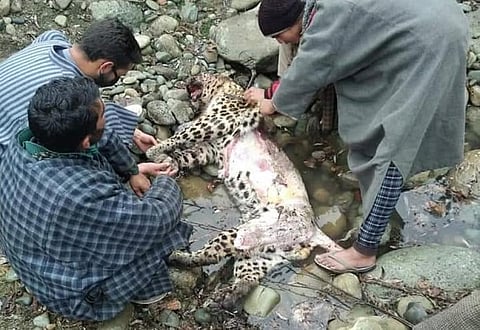

SRINAGAR: A four-year-old boy, Mir, was playing at his maternal uncle's home in Rajpora, Zachaldara, in Kupwara district, when a leopard snatched him and dragged him into a nearby forest. Locals found him nearly thirty minutes later with critical injuries. He was pronounced dead on arrival at a nearby health facility.
That was 2022. Three years later, little has changed for rural communities living on the edges of forests across Jammu and Kashmir.
On August 30, 2025, Ghulam Mohammad was working in his fields in Chitterpora, Kulgam, when a bear attacked him, leaving him critically injured. Locals rushed him to a nearby hospital, from where he was referred to Srinagar for advanced treatment.
In Uri, Baramulla, a mother named Parveena still carries the memory of the day a leopard killed her 14-year-old son. "His body was later found in pieces near our village, Turkaanjan," she said.
These are not isolated incidents. They are part of a widening pattern of human–wildlife conflict that is impacting daily life across Jammu and Kashmir, particularly in rural areas where families live in constant fear as predatory animals venture close to settlements, claiming lives and destroying livelihoods.
The Scale of the Crisis
Official data presented in the Legislative Assembly recently shows that between 2023 and 2025, at least 32 people lost their lives, and more than 350 others were injured in encounters with wild animals, with over 15,600 conflict incidents reported across the Union Territory in just two years.
The Jammu and Kashmir government has stated that there has been "no significant increase" in such incidents, but for rural communities, the figures tell a different story.
According to the data, Jammu district recorded the highest number of human–wildlife conflict incidents during the period. However, the hill districts of Kupwara and Doda registered the highest number of fatalities, a disparity that experts attribute to infrastructure and emergency response gaps.
"In remote hill districts, response time is often slower," said Khurshid Ahmad, a wildlife researcher who has been studying human–animal conflict in the region. "Victims may have to travel long distances to reach medical facilities. In many cases, delays in treatment can make injuries more severe or even fatal."
He says, better road connectivity and faster access to hospitals could be contributing to the lower fatality rate in Jammu as compared to the remote districts of Kupwara and Doda.
Residents of these districts confirm this reality. "If someone is attacked by a wild animal, the chances of survival depend on how quickly help arrives. In our area, even reaching the nearest hospital can take hours," said Jalaluddin, a local resident of Doda.
"Leopards and bears frequently enter villages, especially at night. Many people have stopped stepping out after dark, and children are not allowed to move around alone," said Irfan Ahmad, a resident of an affected area.
Livelihoods Under Threat
The crisis extends beyond physical danger. Farmers across the region say that crop damage, livestock attacks, and threats to human life have become part of daily life in many rural areas bordering forests.
Several villagers pointed out that sightings of wild animals near residential areas have become increasingly common in recent years.
"Last year, a leopard came down and ruined my corn field and my apple orchard. It felt like my hard work and hopes were wiped out in a single night," said Ghulam Hassan from Bandipora.
Farmers in J&K are increasingly facing the wrath of wildlife as leopards, bears, and other animals venture into villages and farmlands. Crops are being destroyed, orchards ruined, and livelihoods threatened, leaving many families in distress.
"Last spring, a wild bear entered our village and destroyed all our stored grains and vegetables. All the effort and savings of the year were lost in a matter of hours," said Farooq Ahmad, also from Bandipora.
Wild boars and monkeys have added to the burden. "They destroy our crops almost every season. After repeated losses, many farmers are thinking of leaving some fields uncultivated," said Ghulam Nabi, a farmer from Bandipora.
Pastoral Communities Most Vulnerable
Pastoral communities such as the Gujjar and Bakerwal tribes are particularly vulnerable. These nomadic groups move seasonally with their livestock through forest areas and mountain pastures, bringing them into frequent contact with wild animals.
"Our livestock is our only livelihood. When animals attack our cattle or sheep, it is a huge loss for our families," said Mohd Aaqib Gujjar Pathan, a member of the Gujjar-Bakerwal community.
Many herders report losing livestock to leopard and bear attacks during seasonal migrations. "We have to remain alert all the time. Sometimes wild animals appear suddenly. It is very dangerous, especially at night," said Mohd Rafiq, also a member of the Gujjar-Bakerwal community.
Why Animals Are Moving Closer
Experts say the causes behind increasing human–wildlife encounters are complex and interconnected. Chief among them is the shrinking of natural habitats due to urban expansion, infrastructure development, and growing human activity near forest areas.
"As forests shrink and human settlements expand, the boundaries between wildlife habitats and villages are becoming blurred. Animals that once stayed deep inside forests are now coming to human habitations," said Mehar un Nisa, a wildlife researcher.
Garbage dumps, livestock, and agricultural crops are also drawing animals such as bears, leopards, and wild boars into villages. Once animals become accustomed to these easy food sources, repeated encounters with humans become more likely.
"Garbage dumps, livestock and standing crops often become easy food sources for wild animals. Once they get used to these, animals begin returning repeatedly to human settlements," said Sheikh Saqib, a wildlife expert and sociologist from Bandipora.
Changing climate conditions are compounding the problem. Irregular snowfall, rising temperatures, and shifting rainfall patterns are affecting food and water availability inside forests. "Extreme weather and reduced food availability inside forests force wild animals to move closer to human settlements in search of food and water," said Haseeb Ahmad, a Kashmir-based environmentalist.
"Deforestation, urban expansion, and human encroachment into forest areas have disturbed natural wildlife habitats. Climate change has further altered food availability and migration patterns, forcing animals like bears and leopards to move towards human settlements. This often leads to attacks on people, crop damage, and the loss of livestock," said Tasaduq Maqbool Bhat, sociologist and environmentalist.
"We must work towards a common goal to rid our community of this menace by conserving forests, improving climate-sensitive wildlife management, and spreading awareness."
Experts Call for Long-Term Solutions
Experts believe that addressing the root causes of human–wildlife conflict will require long-term planning and stronger environmental protection policies.
"Habitat loss is one of the biggest issues," said wildlife researcher Khurshid Ahmad Bhat. "If forests continue to shrink and natural ecosystems are disturbed, animals will have fewer places to live and find food."
Environmentalists argue that better forest management, protection of wildlife corridors, and sustainable development policies are necessary to reduce conflicts in the long run. They also stress the need for faster compensation systems and improved support for rural communities that bear the brunt of wildlife encounters.
For villagers living on the edges of forests, however, the conflict is not merely a policy issue; it is a daily reality.
"The numbers may not show a dramatic spike, but the fear and impact on rural communities are very real," said Mir Haseeb, an environmentalist.
As Jammu and Kashmir continues to grapple with the challenge of balancing conservation with human safety, experts warn that the true scale of the conflict may not be fully captured in statistics alone.
Have you liked the news article?
Support us now:
https://www.gofundme.com/manage/jammu-kashmirs-sole-independent-voice-under-threat
