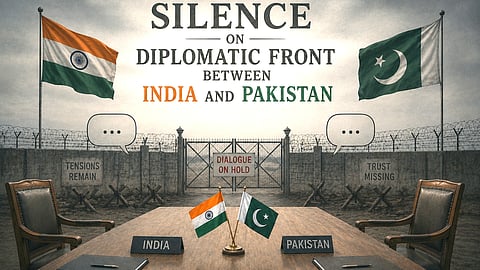


NEW DELHI: In a rare display of unity across Jammu and Kashmir's political spectrum, senior Kashmiri leaders, including Mirwaiz Umar Farooq, Farooq Abdullah and Mehbooba Mufti, have joined 117 eminent citizens from India and Pakistan in signing a joint appeal urging the prime ministers of the two countries to revive peace talks and restore normal bilateral relations.
The appeal, piloted by its chairman, O.P. Shah, who recently toured Srinagar to consult political and civil society leaders, was addressed to Prime Minister Narendra Modi and his Pakistani counterpart Shehbaz Sharif.
The letter says India and Pakistan, together home to "nearly one-fifth of humanity," cannot afford continued hostility. "A large proportion of our population is young. Continued hostility deprives millions of young people of opportunities, prosperity and a secure future," it states.
It argues that "the people of both countries deserve a future defined by peace, development, connectivity and cooperation, rather than perpetual mistrust and confrontation," adding that decades of estrangement have imposed high social, economic and human costs on both nations.
Calling sustained engagement "the only viable path to resolving differences and building a stable and prosperous region," the signatories have urged both governments to immediately restore full diplomatic relations, reinstate High Commissioners in New Delhi and Islamabad, resume normal visa services and reopen structured bilateral dialogue on all outstanding issues.
The appeal specifically calls for resuming discussions on Jammu and Kashmir, including revisiting the framework negotiated between 2004 and 2007, while taking steps towards demilitarisation, de-escalation and addressing the legitimate security concerns of both countries.
The citizens' initiative also recommends reopening trade channels, restoring normal commercial relations and reviving transport links, including the Attari-Wagah border for trade and travel, the Srinagar-Muzaffarabad and Delhi-Lahore bus services, the Samjhauta and Thar Express trains, the Kargil-Skardu route and commercial air connectivity.
It further seeks the reopening of the Kartarpur Sahib Corridor, access to Sharada Peeth, greater religious and cultural exchanges, and unrestricted travel for journalists, academics, artists, businesspersons and civil society groups. The letter also calls for lifting restrictions on media outlets and promoting professional exchanges between journalists to counter misinformation and strengthen public understanding.
In its concluding appeal, the letter urges both governments to "choose engagement over isolation, dialogue over hostility and cooperation over confrontation." It adds that "the future of South Asia should be shaped not by division and conflict, but by peace, prosperity and shared progress."
The signatories emphasise that the appeal "is not an endorsement of any political position" but "a call to place the welfare, aspirations and future of nearly two billion people above conflict, confrontation and division."
Besides the three senior Kashmiri leaders, the Indian signatories include Mani Shankar Aiyar, A. S. Dulat, Manoj Jha, Saifuddin Soz, Mohamad Yousuf Tarigami, Jawhar Sircar and Bilal Gani Lone. Pakistani signatories include Khurshid Mahmud Kasuri, Ashraf Jehangir Qazi, Pervez Hoodbhoy, Farhatullah Babar, Beena Sarwar and Imtiaz Alam, Maria Iqbal Tarana from Pakistan-administered Kashmir among other prominent figures from both countries.
Have you liked the news article?
Support us now:
https://www.gofundme.com/manage/jammu-kashmirs-sole-independent-voice-under-threat