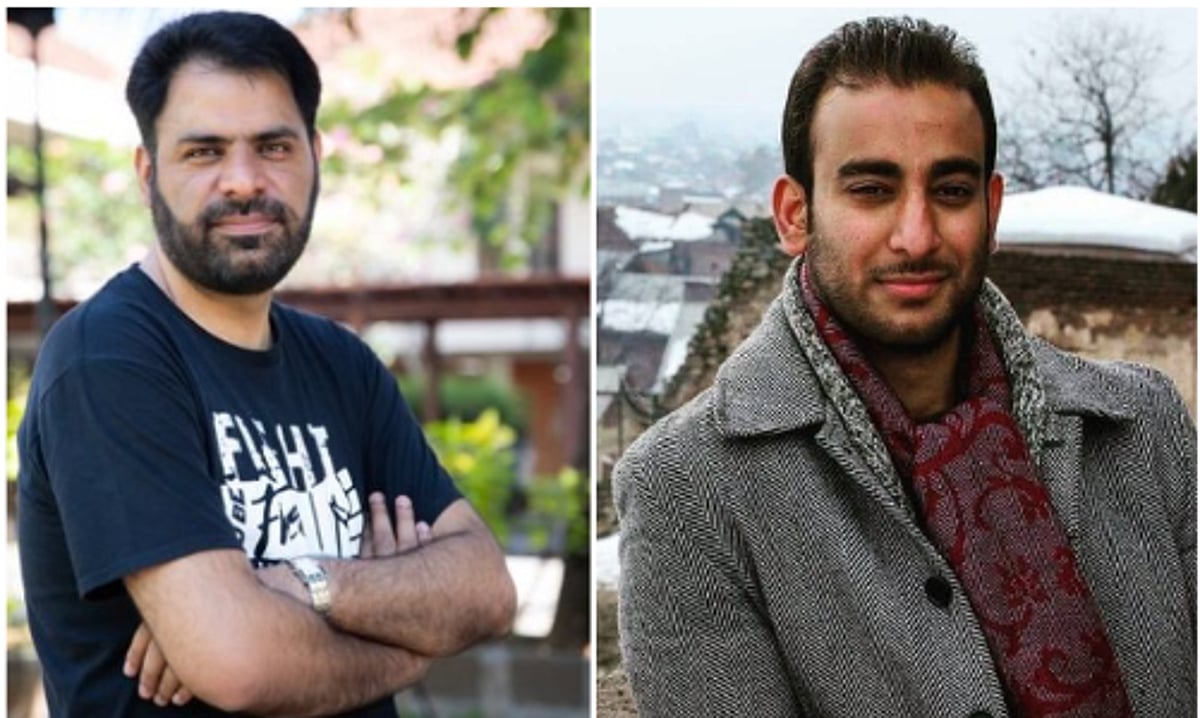


NEW DELHI: Kashmiri human rights defender Khurram Parvez and journalist-researcher Irfan Mehraj will remain out on bail in a National Investigation Agency (NIA) terror-funding case, but under a tighter set of restrictions ordered by the Delhi High Court on July 2, including a requirement that both men report in person to the agency's chief investigating officer twice every week.
Ruling on two appeals the NIA filed against trial court orders that had granted the men bail three days earlier, a division bench of Justices Prathiba M. Singh and Vikas Mahajan declined to stay their release. It left the original bail orders standing but layered six additional conditions on top of them.
The first requires Parvez and Mehraj to report to Prabhat Kumar Bajpai, the case's Chief Investigating Officer, at NIA headquarters on Lodhi Road every Tuesday and Friday at 11.00 AM, remaining there to complete formalities before being released by noon. The investigating officer has been directed to maintain a separate attendance register for the two men.
This comes on top of a fortnightly reporting requirement the trial court had already built into its own bail order - once released, the two men will have to check in with the NIA both every fortnight and twice within most individual weeks.
The other new conditions
Besides the reporting requirement, the high court barred Parvez and Mehraj from taking part in any activity resembling the conduct alleged in the FIR against them, or associating with any group or organisation connected to the case, "including but not limited to" the Jammu Kashmir Coalition of Civil Society (JKCCS); attending, addressing or taking part in any programme, rally or gathering on issues similar to the pending case, in person or virtually, until the trial concludes; circulating any post, literature, handbill, poster or banner, in electronic or physical form; and attempting to contact co-accused persons or anyone else named in the case record, or making international calls to anyone accused of similar conduct, through any mode of communication.
The bench did allow the two men to keep interacting with close relatives and family, so long as that does not extend to individuals or organisations named in the NIA's chargesheet. It added the fresh conditions citing the serious nature of the allegations against the two men, while making clear it was doing so "without opining on the merits of the matter."
The bail order
The high court's conditions were bolted onto near-identical bail orders passed on July 18 by Pitamber Dutt, Principal District and Sessions Judge at Delhi's Patiala House Courts, who allowed regular bail to both men in NIA case no. 8/2023, arising out of FIR RC No. 37/2020/NIA/DLI.
That order already carried a dozen conditions common to both accused, including that they execute a personal bond of Rs 2 lakh with two sureties of the same amount; surrender their passports, or file an affidavit if they hold none; not leave Delhi without the court's prior permission, disclosing the destination, duration and contact details for any travel; use only one mobile or landline number through the trial, kept switched on at all times, and give the investigating officer and the court seven days' notice before changing their address or contact details; appear at every hearing unless exempted, and do nothing to delay proceedings; neither contact nor influence prosecution or protected witnesses, nor tamper with evidence; and make no public statement in print, electronic media or on social media on the merits of the case, the evidence or the witnesses.
It also compels them to take no part in anything that could prejudice public order or the trial's integrity; not upload or circulate "anti-national material" on social media or otherwise; and report to the investigating officer once every fortnight, with a separate attendance register kept for that too.
A breach of any condition, both trial court orders note, would allow the prosecution to seek cancellation of bail. The NIA appealed almost immediately, as CRL.A. 663/2026 in Parvez's case and CRL.A. 664/2026 in Mehraj's, urgently mentioning the matter before the high court on July 20 and getting a hearing the same day. Because the appeals remain pending, the high court has directed that the July 18 orders "shall not be cited as a precedent in any other matter."
What the Conditions Entail
Read together with the trial court's existing bar on leaving the National Capital Territory of Delhi without prior court permission, the twice-a-week reporting condition leaves little practical room for either of them to actually be home.
Srinagar is roughly 800 kilometres from Delhi, and the gap between reporting days is just three days (Tuesday to Friday). Even a same-week flight there and back would consume much of that window, before factoring in the time it would take to seek the court's permission for the trip in the first place.
In effect, the conditions as they stand appear likely to keep Parvez and Mehraj based in Delhi for most of the trial, rather than at their homes and with their families in Kashmir.
The case
The FIR was registered on October 8, 2020, at the NIA police station in Delhi, under Sections 120B (criminal conspiracy) and 124A (sedition) of the Indian Penal Code, along with Sections 17, 18, 22A, 22C, 38, 39 and 40 of the Unlawful Activities (Prevention) Act, 1967.
A chargesheet followed on September 15, 2023, with a supplementary chargesheet filed in December 2024. It names Parvez as the first accused and Mehraj the second; a third man, Ghulam Hassan Bana, alleged to be a Hizbul Mujahideen commander, remains absconding and was declared a proclaimed offender in February 2024.
The NIA's case centres on JKCCS, which it describes as an unregistered NGO not registered under the Foreign Contribution (Regulation) Act. Parvez, JKCCS's programme coordinator and also chairperson of a Philippines-based body, the Asian Federation Against Involuntary Disappearances, is accused of using the organisation's human rights reporting as cover to organise "secessionist" programmes, publish one-sided narratives against the Indian state and working with Bana, Hizbul Mujahideen and Pakistan's Inter-Services Intelligence, to raise and route foreign funds to militants' families through what the chargesheet calls "financial support schemes," allegedly moved through Western Union transfers and an individual named Marjan Lucas.
He is also accused of facilitating the travel of two young Kashmiri men to a proscribed militant training camp under the pretext of medical education. Both were later killed in an encounter with security forces in the Keran sector, and prosecutors say Parvez arranged payments to their families afterwards, through Mehraj.
Separately, he is accused of meeting Hizbul Mujahideen's Pakistan-based chief Syed Salahuddin, who also heads the United Jihad Council, and figures linked to Lashkar-e-Toiba, Al-Badr and the Hurriyat Conference, during visits to Pakistan in 2007 and 2015.
Mehraj, who joined JKCCS as a researcher-volunteer in 2016 and became, in the chargesheet's telling, a close associate of Parvez, is accused of helping receive funds from the Kashmiri diaspora and from Bana, and of playing a role in "instigating" youth toward stone-pelting and channelling money to stone-pelters and Hizbul Mujahideen's over-ground workers.
Both men were arrested years apart - Mehraj in March 2023 and Parvez in October 2022 - and have denied the allegations. Parvez, an internationally recognised human rights campaigner and a recipient of the 2006 Reebok International Human Rights Award, lost a leg in a landmine blast in Kupwara during election-monitoring work in 2004.
His lawyers told the trial court that his Pakistan trips were open visits tied to landmine-ban advocacy and human rights work, and that material the NIA cites as evidence, including a report titled "Structure of Violence," which the agency says contains sensitive details of troop deployments in Jammu and Kashmir, has been publicly available on JKCCS's website since it was released in Srinagar in September 2015.
How the courts got here
Granting bail on July 18, Judge Dutt held that the case against both men rested mainly on the oral testimony of witnesses, whose reliability could only be tested at trial, and that with charges not yet framed more than three years into their custody, there was no prospect of an early conclusion.
His order leaned heavily on a separate, overlapping NIA case against Parvez (RC No. 30/2021/NIA/DLI), in which the Delhi High Court had granted him bail on June 10, 2026, weighing his prolonged incarceration and disability against the restrictions on bail under Section 43D(5) of the UAPA.
Appealing, the NIA argued that the trial court had never made the finding Section 43D(5) requires: a prima facie assessment of whether the accusations against the two men were true. The judge, it said, had pointed only to the trial's early stage and the oral nature of the evidence, without engaging with documentary material in the chargesheet, and releasing the two men would harm national security.
Appearing for the accused, senior advocate Tanveer Ahmed Mir and advocate Jawahar Raja argued that once a trial court grants bail and bonds are furnished, appellate courts should intervene only in exceptional cases where an order is "manifestly perverse and mechanical", which, they said, this was not.
The high court agreed, in part, with the NIA: it found that the trial court had indeed failed to record any finding on whether the allegations were prima facie true, and that documentary evidence in the chargesheet ought to have been discussed. But having noted that, it stopped short of staying the bail already granted, choosing instead to let the two men go free under the additional conditions.
The NIA's appeals remain pending. The high court has given Parvez and Mehraj two weeks to file their replies, with the NIA getting two more weeks after that for any rejoinder and has sought the electronic trial court record for its own reference. Proceedings before the trial court, including arguments on the framing of charges, are to continue in the meantime.
The case is next listed for August 24, 2026.
Have you liked the news article?
Support us now:
https://www.gofundme.com/manage/jammu-kashmirs-sole-independent-voice-under-threat