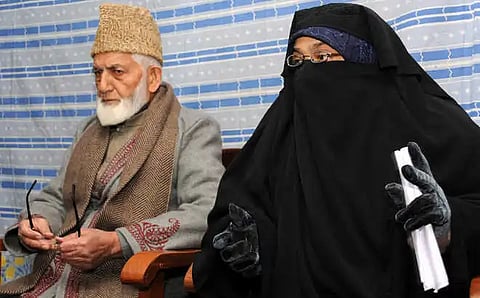


NEW DELHI: A Delhi court’s verdict in the National Investigation Agency case against Kashmiri separatist leader Asiya Andrabi has produced a striking legal paradox.
In the same judgment, the court acquitted Andrabi of committing any terrorist act, of financing terrorism, and of being a member of a terrorist organisation, yet convicted her on conspiracy and support-related charges largely based on her speeches, interviews, and social media activity.
Andrabi, the founder of the women’s group Dukhtaran-e-Millat, was arrested in April 2018 and has remained in custody for nearly eight years.
Additional Sessions Judge Chander Jit Singh held that the prosecution failed to establish the core elements of terrorism under the Unlawful Activities (Prevention) Act.
Andrabi was acquitted under Section 20 of the Act, which criminalises membership of a terrorist organisation, as well as under Section 17 relating to terror financing. The court also found no evidence to sustain the charge of waging war against the state under Section 121 of the Indian Penal Code.
This position was formally reaffirmed in a correction order dated January 15, clarifying that an earlier reference to “conviction” under Section 20 was a typographical error and that all the accused stood acquitted of that charge.
The judgment records that no witness testified to any actual terrorist act committed by Andrabi or at her instance. The court noted that the prosecution material was “limited regarding the speeches, videos, interviews, and posts on social media,” and that there was no evidence of the use of arms, violence, or direct participation in any terror incident.
Yet, despite these findings, the court went on to convict Andrabi under Section 18 of the Unlawful Activities (Prevention) Act for conspiracy to commit a terrorist act, Sections 38 and 39 for association with and support to a terrorist organisation, Section 121A of the Indian Penal Code for conspiracy to wage war, Section 120B for criminal conspiracy, and Sections 153A, 153B and 505 for promoting enmity and making statements prejudicial to national integration.
The reasoning for this outcome is set out most clearly in Paragraph 73 of the judgment, which becomes the pivot of the conviction. There, the court acknowledges the absence of proof of violence but holds that the cumulative effect of Andrabi’s public statements was sufficient to establish conspiracy and support.
As the court observed, “the material on record is limited regarding the speeches, videos, interviews, and posts on social media,” yet these, taken together, were seen as revealing a concerted design.
The court noted that the speeches and online material “reflect that the accused persons have been acting in concert,” and that their statements consistently projected Kashmir as being under “illegal occupation,” endorsed secession, praised militants, and encouraged resistance.
Support and Association
Although these expressions were described as “ordinarily post-incidence,” the court held that they nonetheless amounted to support and association within the meaning of Sections 38 and 39 of the Act.
Crucially, Paragraph 73 also records the evidentiary gap at the heart of the case.
“No witness is examined which could place on record the fact whereby such abetment is directly associated with any particular incidence involving use of force,” the court said, conceding that the prosecution had not linked Andrabi’s statements to any specific act of violence.
While discussing the charge of waging war against the state under Section 121 of the Indian Penal Code, the court relies on Supreme Court precedent to underline that “waging war” requires actual use of force or arms, violent uprising, or defiance of government troops.
It then concludes that none of these elements were proved in Andrabi’s case. As a result, she was acquitted of that charge, which carries the possibility of death or life imprisonment.
Similarly, the court acquitted Andrabi of terror financing under Section 17 of the Unlawful Activities (Prevention) Act. The prosecution had alleged that funds were raised through donations and jewellery, but the court found that the evidence did not meet the standard required to establish terror financing beyond a reasonable doubt.
Most significantly, the court acquitted Andrabi under Section 20, holding that the prosecution failed to prove that she was a member of a terrorist organisation in the legal sense. The judgment makes clear that ideological sympathy, advocacy, or association are not enough to constitute membership.
There was no evidence, the court noted, of any oath of allegiance, formal induction, or acts that could legally qualify as membership under the Act
The court convicted her under Sections 38 and 39, saying that holding a formal membership is not required to establish an association or support. The court reasons that even if Dukhtaran-e-Millat itself was not charge-sheeted as an organisation, individuals could still be held liable for associating with or supporting its activities.
The court concluded that direct proof of an executed terrorist act was not necessary to sustain a charge of conspiracy.
The court drew a sharp distinction between membership and association.
While rejecting the claim that Andrabi was a member of a terrorist organisation in the legal sense, it held that her continued public advocacy, leadership role, and ideological alignment amounted to association and support.
Mere ideological sympathy may not attract Section 20, the court reasoned, but persistent public endorsement and mobilisation could still fall within Sections 38 and 39.
Conviction Rests on Speeches
On the one hand, the court stresses that suspicion cannot substitute for proof when it comes to the gravest terror charges. On the other hand, it affirms convictions that rest almost entirely on speech, interviews, and social media content, without evidence of violence, arms, or operational planning.
Andrabi has spent nearly eight years in custody since her arrest in 2018. Her legal team is expected to challenge the conviction, arguing that a verdict which explicitly finds no terrorist act, no terror funding, and no membership of a terrorist organisation cannot logically sustain conspiracy and support convictions built solely on expression.
Taken as a whole, the judgment rejects the most serious allegations of terrorism, war, and financing, recognising the prosecution’s failure to prove violence or formal membership. Yet it upholds heavy convictions on conspiracy and support, relying almost entirely on speech, symbolism, and ideological positioning.
(This news article has been updated with minor corrections in the headline and text.)
Have you liked the news article?
Support us now:
https://www.gofundme.com/manage/jammu-kashmirs-sole-independent-voice-under-threat