

MUZAFFARABAD: Sharp differences have emerged among the political leadership of Pakistan-administered Jammu and Kashmir over the handling of the ongoing public agitation, with senior officials calling for dialogue while disagreeing over the causes of the unrest, the legitimacy of protesters' demands and the government's response.
President Dr Muhammad Najeeb Naqi has urged restraint and meaningful negotiations, warning that confrontation cannot resolve the region's political and administrative problems.
Prime Minister Barrister Syed Iftikhar Ali Gillani, meanwhile, has questioned the circumstances that plunged the region, particularly the Poonch division, into turmoil, leaving educational institutions closed, roads blocked and patients struggling to reach hospitals.
Assembly Speaker Chaudhry Tariq Farooq has rejected the use of force as a solution, insisting that the government remains willing to negotiate with all stakeholders within the constitutional framework.
Former Pakistani parliamentarian Sher Afzal Marwat has taken a more critical position, questioning why the authorities have failed to resolve public grievances despite five months of agitation. He maintained that none of the protesters' 12 demands was unreasonable.
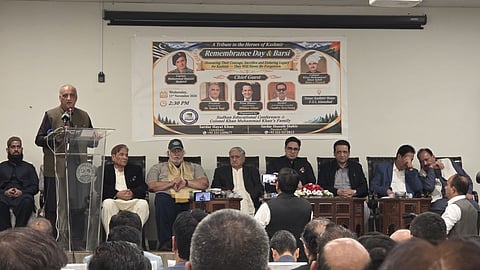
The contrasting positions emerged at a commemorative gathering organised by the Sudhan Educational Conference at Kashmir House in Islamabad to mark the death anniversaries of Colonel Khan Muhammad Khan, popularly known as Baba-e-Poonch, and Captain Muhammad Hussain Shaheed.
Although the gathering was intended to commemorate historical figures associated with education and the 1947 Kashmir movement, the continuing political crisis dominated the speeches.
PM Questions Prolonged Shutdown
Prime Minister Gillani acknowledged that the region, particularly Poonch, was experiencing extraordinary circumstances.
He questioned how the situation had deteriorated to the point where schools, colleges and universities remained closed, and patients faced difficulties accessing medical treatment.
Recalling Colonel Khan Muhammad Khan's efforts to promote education, Gillani asked why institutions established through decades of struggle were now unable to function.
He said female students had written letters asking when their educational institutions would reopen.
The prime minister maintained that no political demand could justify depriving children of education or preventing patients from reaching hospitals.
Referring to firing incidents in Rawalakot, Gillani claimed that 99 percent of residents wanted peace. He alleged that certain elements were exploiting public emotions and encouraging disruptive activities.
He called for identifying those responsible while criticising the continued obstruction of roads and restrictions on civilian movement.
Gillani also disclosed that a medical college had faced the possibility of losing its registration because of prolonged disruption. Authorities had consequently arranged classes at the Combined Military Hospital to prevent further interruption of medical education.
On financial constraints, the prime minister cited a budget figure of Rs 32 billion and argued that the region's development resources were severely limited.
He claimed that three flyovers in Islamabad had cost more than the region's entire development budget.
Gillani urged critics to consider financial limitations while raising questions about corruption and the implementation of development projects.
He also called for an open, factual debate on a proposed constitutional amendment, saying political leaders should distinguish between measures serving the public interest and those potentially harmful to the region.
President Urges Restraint
President Dr Muhammad Najeeb Naqi adopted a conciliatory position, emphasising that public grievances should be assessed against the region's economic and administrative realities.
He warned against demands or protest methods that disrupted healthcare and education, while acknowledging that no community should be deprived of development opportunities or representation in the legislative assembly.
Naqi urged the authorities and local leadership to maintain contact and pursue meaningful negotiations.
He expressed hope that dialogue and patience would produce a peaceful settlement.
The president also expressed concern about the influence of social media, arguing that misinformation had made it increasingly difficult for younger generations to distinguish historical facts from distorted narratives.
Recalling the sacrifices associated with the 1947 movement, he said the establishment of the government on October 24, 1947, reflected years of political mobilisation and struggle.
He particularly praised Captain Muhammad Hussain Shaheed for contributing personal resources to the movement.
Marwat Questions Government
Former Pakistani National Assembly member Sher Afzal Marwat delivered one of the gathering's strongest criticisms of the authorities.
He questioned why the government had been unable to address the protesters' grievances despite five months of unrest.
Marwat argued that the prime minister and political leadership possessed sufficient authority to resolve the dispute if they demonstrated the necessary political will.
He maintained that the protesters' 12 demands contained nothing unreasonable and should be addressed through negotiations rather than coercive measures.
Referring to an ongoing gathering in Kotli, Marwat described the situation as an important test of the government's willingness to engage with public representatives.
He also alleged widespread corruption in development projects, claiming that between 80 and 85 percent of schemes were affected.
Marwat did not provide documentary evidence for the estimate during the remarks reported from the gathering, and the figure could not be independently verified.
Assembly Speaker Chaudhry Tariq Farooq cautioned against attempts to resolve political disputes through force.
He said the government was prepared to negotiate with every stakeholder within the limits of the constitution and law.
Farooq also warned against assigning responsibility for the breakdown of previous negotiations without examining why the dialogue had failed.
He argued that understanding the region's constitutional and political position required an appreciation of the developments surrounding 1947.
The speaker additionally alleged that Pakistan's federal government had retained Rs 1 billion originally allocated for earthquake victims. The allegation was not independently substantiated in the material available.
Former President Seeks Solution
Former president Sardar Masood Khan urged the authorities to treat the unrest as a political crisis rather than merely a law-and-order problem.
He identified three areas requiring attention: administrative action, political engagement and effective public communication.
Khan called for consultations with all relevant stakeholders and said the performance of the new leadership would ultimately be judged by its actions.
He stressed that the government needed to address public concerns while communicating its decisions more effectively.
His remarks reflected growing concern among political figures that administrative measures alone would not restore public confidence.
The gathering also highlighted the historical contributions of Colonel Khan Muhammad Khan, whose educational initiatives transformed access to schooling in parts of Poonch.
Born in January 1882 in Chhechhan village, he joined the British Indian Army in 1902, served during the First World War and retired as a subedar major.
He began campaigning for education in 1930 and established the Sudhan Educational Conference in 1934.
Among his initiatives was the Muthi Bhar Atta scheme, under which households contributed small quantities of flour to support girls' education.
He also established educational institutions in Palandri and helped build a girls' school in Chhechhan in 1939.
After entering representative politics in 1934, he represented Bagh and Palandri until 1946 and subsequently held responsibilities during the 1947 movement.
He died on November 11, 1961.
Former president Masood Khan proposed that Colonel Khan Muhammad Khan should be recognised not only as Baba-e-Poonch but also as Baba-e-Kashmir in acknowledgement of his educational and political contributions.
Sudhan Educational Conference president Sardar Shahzaib Shabbir said the organisation served students across communities rather than exclusively members of the Sudhan tribe.
He said the organisation had distributed more than Rs 15 million in scholarships over the past decade, with 22 percent going to students from other communities.
Shabbir called on political leaders to provide direction to younger generations and contribute to resolving the present crisis.
Political Differences Remain
The speeches exposed significant differences over responsibility for the continuing unrest.
While the prime minister focused on disrupted public services, road blockades and alleged disruptive elements, Marwat emphasised the legitimacy of public demands and the government's failure to address them.
The president and assembly speaker stressed negotiations, restraint and constitutional procedures, while former president Masood Khan urged a broader political response.
Despite these differences, the speakers broadly acknowledged the need for dialogue.
The central question remains whether the government and protest leadership can agree on a credible negotiating process capable of restoring normal life without further confrontation.
The appeals for negotiations come amid fresh political pressure following the security operation in Rawalakot on November 5 and subsequent confrontations.
At least three civilian deaths and 18 injuries were reported in initial accounts. Subsequent reports suggested a higher death toll, but conflicting figures and restrictions on independent reporting have prevented reliable verification.
Police maintain that armed individuals fired on security personnel during operations to clear protest encampments and reopen roads. Protest representatives dispute that account and accuse security forces of opening fire on demonstrators.
On November 9, partial commercial shutdowns were reported in Muzaffarabad, Haveli, Neelum, Kotli, Mirpur and Bhimber. Business activity continued in several other districts, reflecting an uneven response to the Joint Awami Action Committee's protest call.
The committee has also appealed to Pakistan's army chief, Field Marshal Asim Munir, to intervene and halt security operations.
In a statement published on November 8, the committee's advisory council proposed negotiations at a neutral venue, with representatives authorised to reach binding agreements.
It also demanded an independent investigation into the Rawalakot deaths, disclosure of detainees' whereabouts, medical treatment for injured protesters and restoration of communications.
The council proposed that an impartial delegation visit affected areas and publish preliminary findings within 48 hours.
Pakistan's opposition alliance, Tehreek Tahaffuz-e-Ain Pakistan, has also condemned the reported use of force against civilians and called for immediate negotiations.
In a further development reported on November 10, police announced that Sindh Rangers personnel Naik Bostan Khan, injured during the November 5 violence, had died. The opposition alliance also reported that its delegation travelling towards the region had been stopped at Kahuta.
The Human Rights Commission of Pakistan has separately urged both the federal and regional governments to prevent further bloodshed, engage protesters in meaningful dialogue and allow journalists unrestricted access to affected areas.
The latest statements from the president, prime minister, speaker and other political figures suggest growing recognition that the crisis requires negotiations. However, a mutually accepted framework for talks, independent investigation of the killings and guarantees concerning detainees remain unresolved.
Have you liked the news article?
Support us now:
https://www.gofundme.com/manage/jammu-kashmirs-sole-independent-voice-under-threat