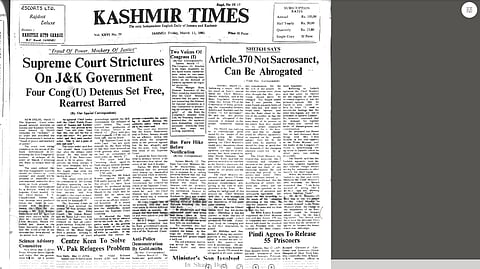


JAMMU: On March 13, 1981, The Kashmir Times carried a front-page headline that would echo across decades: “Article 370 Not Sacrosanct, Can Be Abrogated,” attributed to Sheikh Mohammad Abdullah.
The remarks came against the backdrop of an active Congress-backed Ladakh autonomy agitation, demanding a separate legislature, separate government, and regional autonomy for Ladakh.
Speaking in Jammu, the founding leader of the National Conference and then chief minister of Jammu and Kashmir was quoted as saying that any consideration of the special status provision “should never be changed.”
Yet he added that Article 370 of the Constitution of India, governing the relationship between Jammu and Kashmir and the Centre, “was not sacrosanct” and could be abrogated if the people of the state so desired or if the Constitution provided a mechanism to do so.
Sheikh’s Layered Politics
The remarks, reported in the March 13, 1981, edition of this newspaper, reflected the layered and often nuanced position that Sheikh Abdullah articulated in the later years of his political life.
Nearly four decades later, on August 5, 2019, the Union government led by Prime Minister Narendra Modi abrogated the provisions of Article 370 and reorganised the state into two Union Territories. The move, passed by Parliament, fundamentally altered Jammu and Kashmir’s constitutional status.
The National Conference, now led by Sheikh Abdullah’s son, Dr Farooq Abdullah, and grandson Omar Abdullah, has since emerged as one of the strongest political opponents of the 2019 decision.
The party has challenged the abrogation in court and continues to call for restoration of statehood and special constitutional safeguards.
The 1981 clipping may not diminish the profound political rupture of 2019.
Yet the archival record underscores that the discourse around Article 370 has never been static. It has evolved through phases of confrontation, compromise of Kashmiri leaders, central intervention, and regional assertion.
It is historically significant because it shows that the debate over Article 370's permanence was alive even in 1981, and that prominent voices within the Kashmir political establishment itself had publicly argued that the provision was neither permanent nor beyond abrogation.
Sheikh Abdullah's position here stands in stark contrast to his previous positions and the arguments later made by his party, National Conference, on Article 370.
Ladakh Question and 370
The report also reveals that the Ladakh question was a live fault line in 1981 within J&K's political geography. The debate in the assembly was addressed to a sustained agitation in Ladakh demanding autonomy. Ladakhis, particularly the Buddhist majority of Leh, had long felt that Article 370 primarily served Kashmiri political interests and offered them little protection or representation.
Nearly four decades later, Ladakh was carved out as a Union Territory without a legislature, arguably an even more powerless outcome than what the 1981 agitators were resisting against.
The report also reveals that as early as 1981, political actors understood that the fate of Article 370 and the fate of Ladakh within J&K were connected questions.
As March 13 returns on the calendar, the headline from 1981 offers a reminder that Kashmir’s constitutional question has long been shaped by shifting political compulsions and the enduring tension between autonomy and integration.
The full text of the report is reproduced from the Kashmir Times (Vol. XXVI, No. 59), dated Friday, March 13, 1981:
SHEIKH SAYS
Article 370 Not Sacrosanct, Can Be Abrogated
(From Our Correspondent)
JAMMU, March 12 — Indicating a major shift in his stand on State's special status the Chief Minister, Sheikh Abdullah, said in the Legislative Assembly here today that Article 370 of the Constitution of India, governing the relationship between Jammu and Kashmir and the Centre, "is not sacrosanct".
He said that this proviso could be abrogated if the situation so demanded or the people themselves wanted it.
The Sheikh was replying to a calling attention motion raised by the leader of the Janta group, Mr. Abdul Rashid Kabli. The member quoting the Chief Minister's recent press statements about Article 370 and Ladakh agitation said that a lot of misgivings had been created by what Sheikh Abdullah had said.
Mr. Kabli said that the position needed to be clarified as the Sheikh's assertions did not reflect the true sentiments of the people and the Assembly.
The Chief Minister explained that 370 was conceived and adopted under peculiar circumstances prevailing at the time of accession of the State. Recalling the background of this proviso, the Chief Minister added that it was brought on the statute in keeping with the imperatives of that particular situation.
He said that the Constitution itself was not permanent. Therefore, it was not correct to think that any of its provisions could remain unchanged. Conditions keep on changing and so do their imperatives, he added.
Mr. Abdullah said, instead of taking an extreme position, it was necessary to adopt a rationale attitude towards this question and view it accordingly. On the one hand, it was being demanded that Article 370 should be abrogated at all costs without any considerations for the will of the people. At the other extreme were those who thought that this provision should never be changed.
The Sheikh added that it was possible that some friends sincerely believe that time has now come to break these barriers and take the State closer to the rest of the country or that the State needed to transfer some more of its powers to the centre; then they should try to create conducive atmosphere for it.
He, however, made it clear that this could be effected unilaterally or thrust upon the people against their will. At the same time, he asserted, it should be kept in mind that the demands of the changing situation could not be ignored.
The Chief Minister reiterated that accession was "continuous and voluntary," a decision of the people of the State and not result of some emotional impulse. He said the decision has proved to be correct and sound. There was no pressure behind it.
The Sheikh said that the distribution of powers between the centre and the State was specified in the instrument of accession and subsequent agreement between the two according to the needs of the situation prevailing at that time. He said the situation never remained the same and we must accept this fact.
Mr. Rishi Kumar Kaushal also supported the Chief Minister and said that Article 370 was of temporary and transitional nature and could be revoked by the President with the consent of the State Constituent Assembly.
Referring to Ladakh agitation, the Chief Minister said that while he wanted all the regions of the State to remain together, it was his personal opinion that no region or area could be held by force. "I want to remove the feelings that the other two regions are out to dominate or enslave Ladakh". He, however, cautioned that the demand for regional autonomy has carried the seeds of disintegration and communalism.
He informed the House that he had discussed these things with Mrs Indira Gandhi in her dual capacity as the Prime Minister and the leader of the Congress (I) which is spearheading the agitation in Ladakh where no other party was existing officially.
The Sheikh said that the Ladakhi agitators were demanding separate legislature and separate government and asking for autonomy in other matters for their region.
When Mr. Kaushal interrupted to say that such words betrayed the Chief Minister's own weakness, the Sheikh explained, "I am being accused of acting like a dictator and not allowing others to function freely."
Mr. H.L. Bhagotra said that it was not proper for the Chief Minister to commit himself to the Prime Minister about the change in the status of the article which could be brought about only by the State legislature.
The Sheikh said these were his personal views and there was no intention to ignore or bypass the house which was sovereign.
Have you liked the news article?
Support us now:
https://www.gofundme.com/manage/jammu-kashmirs-sole-independent-voice-under-threat