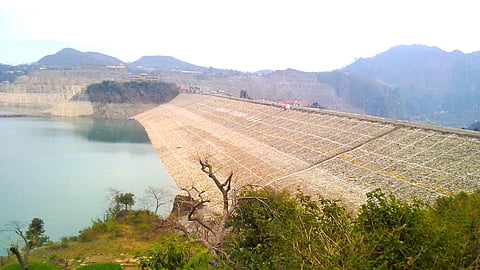


For nearly eight decades, Kashmir has been viewed principally through the lenses of territory and sovereignty. Wars have been fought, ceasefires negotiated, peace initiatives proposed, and diplomatic interventions attempted.
Today, Kashmir is increasingly becoming the centre of one of the most significant water security challenges of the 21st century. The glaciers, rivers, and mountain ecosystems of Jammu and Kashmir are assuming strategic importance far beyond the traditional political narrative.
Therefore, the next major crisis in South Asia may not be territorial alone, but water.
For more than six decades, the Indus Waters Treaty stood as one of the world's most successful examples of transboundary river cooperation. Even during periods of war and prolonged hostility, India and Pakistan continued to implement the treaty.
Water was deliberately insulated from political confrontation because both countries recognised that uninterrupted river flows were indispensable for agriculture, energy generation, and economic stability.
That assumption is beginning to weaken.
The growing debate over India's expanding hydropower projects on the western rivers, coupled with increasingly assertive political rhetoric regarding the Indus basin, indicates that water is gradually moving from the realm of technical cooperation into the domain of national security.
This transformation should concern not only New Delhi and Islamabad but also the wider international community.
Unlike territorial disputes, water insecurity directly affects food production, energy security, public health, and economic resilience. Once rivers become instruments of strategic competition, the consequences extend well beyond diplomatic disagreements.
Pakistan ranks among the world's most water-stressed countries. Its agriculture, industries, hydroelectric generation, and food security depend overwhelmingly upon the Indus river system, whose principal tributaries originate in Jammu and Kashmir.
Any perception that these lifelines could be disrupted or substantially altered would inevitably be viewed through the prism of national security rather than ordinary political disagreement.
This is not a prediction of inevitable conflict. Rather, it is an acknowledgement that nations respond differently when essential natural resources underpinning economic survival are perceived to be under pressure.
Climate Change
The Himalayan and Karakoram glaciers that feed the Indus basin are experiencing increasingly unpredictable patterns of melting and precipitation. Extreme weather events, prolonged droughts, and devastating floods are becoming more frequent across South Asia. Simultaneously, rising populations and growing demand for water are placing unprecedented stress on existing river systems.
These realities make cooperative river management more urgent than ever before.
The strategic significance of Kashmir, therefore, is evolving.
For decades, India and Pakistan have based their positions on Kashmir on legal and historical arguments. While Pakistan centres its argument on the right of self-determination, India describes it as an integral part, citing the accession by the last ruler, Maharaja Hari Singh. Those foundations continue to shape their diplomatic discourse.
Yet another equally compelling dimension deserves greater attention.
Kashmir is also the ecological heart of the Indus basin.
Its glaciers feed rivers that sustain millions of hectares of farmland, generate electricity, and support the livelihoods of nearly 300 million people across the region. As climate pressures intensify and water becomes increasingly scarce, the future of Kashmir can no longer be separated from the future of South Asia's water security.
Absence of J&K
One of the most striking shortcomings of the Indus Waters Treaty has been the absence of the people of Jammu and Kashmir from decisions concerning the rivers that originate in their homeland.
The treaty has always been treated as a bilateral arrangement between India and Pakistan. Yet the headwaters, watersheds, and fragile ecosystems lie within Jammu and Kashmir itself. Communities living along these rivers bear the environmental, economic, and social consequences of decisions taken elsewhere, while having virtually no voice in shaping those decisions.
If future negotiations become necessary, repeating this omission would be a historic mistake.
The people of Jammu and Kashmir are not merely inhabitants of a region. They are legitimate stakeholders in one of the world's most important transboundary river systems.
A durable and sustainable water-sharing arrangement cannot determine the future of Kashmir's rivers while excluding those who have lived alongside them for generations. Their participation would not weaken any negotiated settlement. On the contrary, it would enhance its legitimacy by recognising that effective environmental governance requires local ownership and community participation.
The changing strategic landscape also presents Pakistan with an important diplomatic opportunity.
The future of the Indus basin should be presented not merely as a bilateral issue but as a question of climate resilience, environmental sustainability, food security, and conflict prevention.
The international community has repeatedly mobilised diplomatic resources to manage crises after they erupt.
Far less attention has been devoted to preventing the next crisis before it materialises.
A forward-looking diplomatic framework should therefore rest upon three fundamental principles.
First, water security has become inseparable from regional security.
Second, preserving the ecological integrity of the Indus basin is an international concern because instability between two nuclear-armed neighbours inevitably affects wider regional and global interests.
Third, any future discussion on the governance of these rivers should include representatives of the people of Jammu and Kashmir, whose voices have remained absent despite their intimate connection with the basin.
The objective should not simply be to preserve an ageing treaty under mounting stress. It should be to develop a more inclusive and resilient framework capable of responding to the environmental and geopolitical realities of the twenty-first century.
Great diplomacy is measured not merely by resolving today's disputes but by preventing tomorrow's crises.
For decades, the world has debated who governs Kashmir.
It is now equally important to ask another question: who should help shape the future of the rivers that originate in Kashmir and sustain hundreds of millions of lives downstream?
That question cannot be answered by India and Pakistan alone.
The people of Jammu and Kashmir must no longer remain spectators while others determine the future of the waters that define their homeland.
The time to address that challenge is now, before the rivers that have long sustained the region become another battlefield instead of the shared lifeline they were always meant to be.
Have you liked the news article?
Support us now:
https://www.gofundme.com/manage/jammu-kashmirs-sole-independent-voice-under-threat