

In a season of record heat, hailstorms, and isolated rains that promise a near-drought in the days ahead, a quiet equation is being tested on the subcontinent's most fractious frontier. Peace, ecology, and tourism - divided by a common factor called fragility. The answer may lie not in a grand accord, but in a samosa or pakora passed through a fence at the Line of Control.
It is June in the Kashmir Valley, and the heat is doing what seven decades of diplomacy have failed to accomplish. It is melting the distance – only in terms of what is at stake.
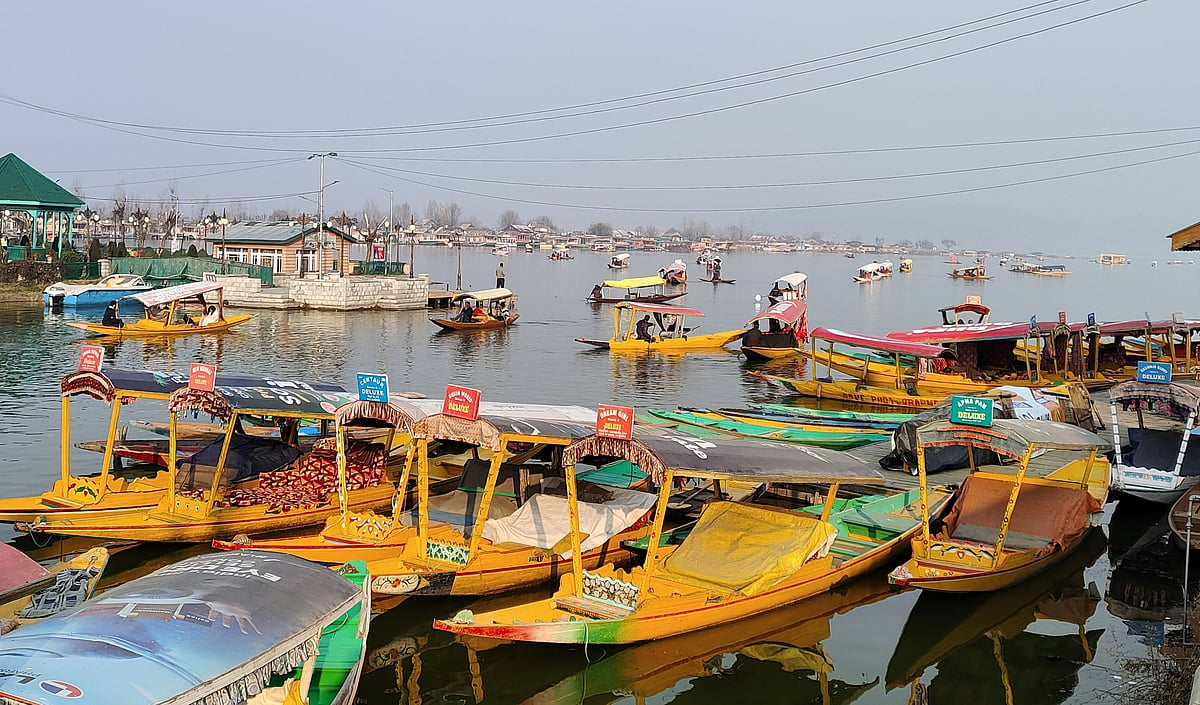
On the Indian-administered side, the saffron-roofed houseboats on Dal Lake sit heavy in the haze, their shikaras doing little of the business their owners had hoped for. On the Pakistani side, tourists from Lahore and Rawalpindi fan out across the lush meadows of Muzaffarabad's Neelam Valley. On the Indian side, visitors from New Delhi and mainland India push forward to areas along the LoC - Tulail in Gurez and Teetwal in Karnah - seeking relief from a heat wave that has broken or touched century-old records.
The merciless sun treats the 2003 ceasefire agreement as an afterthought. The real dialogue is happening elsewhere - in the melting water, in the meadows, and in a handful of unreported gestures across the barbed wire.
This complexity can be understood with what I call the PET: F framework. P for Peace. E for Ecology. T for Tourism. And the common factor F? Fragility. Also, possibly, Future.
Tourism's total contribution to Jammu and Kashmir's formal economy is a meagre 5 to 7 percent, a fraction of the Himalayan region's potential, and a statistical rounding error next to the combined military expenditure of the two countries that share this region. Yet, as the heat wave scorches apple orchards and dries up traditional springs, a single empirical truth is emerging from the mud and the melt: peace has enormous dividends, and those dividends are directly proportional to the movement of people who carry nothing but cameras, curiosity, and hope.
The question is no longer whether tourism can be a peace-building tool. Urgent, uncomfortable, and political, the question is how to stop it from becoming an instrument of erasure.
Researchers tracking distress migration from the valley to the plains of Jammu and Delhi have noted a brutal correlation across three decades. For every single armed violent incident that makes global headlines - one grenade thrown, one checkpoint attacked - the region loses approximately 23,000 tourist bookings within weeks. That translates to a loss of around ₹100 crore in informal sector wages that hit the shikara pullers, shawl and pheran sellers, kahwa vendors, pony-handlers of Pahalgam, Gulmarg, and Sonamarg, and the walnut-carvers of downtown Srinagar the most.
Conversely, look at the period following the abrogation of Article 370 in August 2019. As security appeared to normalise, tourist footfall rebounded with a vengeance. Three million visitors in 2023, by official count. A projected four million next year. But here is the inversion: local ecologies have been collapsing under unplanned concrete for years. Wetlands filled to make parking lots. Ancient spring channels buried under hotel foundations.
Tourism in Kashmir faces a twin threat: ecological and security driven. Push tourists in like a crowd, and one day the crowd will quietly be told not to come, because the very ecology that made the place worth visiting will have been consumed by the infrastructure built to receive it.
The security blow has already fallen. Since the April 22, 2025, Baisaran attack, which killed 26 civilians, mostly tourists, and triggered an 88-hour high-tech Indo-Pak war, scenic treks like Tarsar, Marsar, Sundarsar, Kolhoi Glacier, Foodsar, Armin, Nafran, and Hirbagwan remain closed. Strict surveillance and the shutdown of 4–6 night treks have collapsed the livelihoods of the guides, porters, ponywallas, and hoteliers who depend on them.
This is where the acronym CBM enters, not C for Conflict, but Confidence Building Measures. Tourism, if weaponised carelessly, becomes a parasite on the very culture that feeds it. The industry begins to consume the host.
Walking through the old lanes of Safakadal in Srinagar this June, a cultural conservationist, who refuses to be named, wary of both governments and their vigilant digital armies, points to a new heritage hotel that has replaced a century-old walnut-wood residence. The original facade remains. The interior is all glass and imported tile.
"We are selling Kashmiri culture like a fridge magnet," he says, wiping sweat from his brow. The heat is extraordinary - 30 degrees Celsius, with humidity turning the valley into a lung. "The pashmina you buy? Woven on a power loom in Ludhiana. The papier-mâché? Painted in a factory on the outskirts. Tourism here is at the expense of the fragile. We are burning the furniture to heat the house."
That is F. Fragility is not abstract when a walnut panel is replaced by a plastic blend.
If violence and counter-violence are ugly, rhythm-less, chaotic, a series of disjointed gunshots interrupting prayers and harvests, then peace is inherently romantic - rhythmic, musical, beautiful, and attractive.
"Peace is a slow raga," says a retired school principal from Sopore in Baramulla, who now runs an informal discussion group and meets regularly with young people from across the district. "Violence and counter-violence are the same ugly loop. Dialogue has the potential to obliterate hatred. But dialogue cannot happen in a vacuum. It needs a venue. A physical place where two people can sit and talk."
That venue already exists in blueprint. It is called the Peace Park at Siachen.
The Siachen region near the Kargil heights where 527 Indian soldiers died in 1999, with heavy casualties also reported on the Pakistani side, and where memory is still dressed in camouflage, is a no man's land of glaciers and silence. In 2007, both India and Pakistan proposed a Peace Park across the Siachen and Saltoro ridges: a demilitarised zone of scientific research and soft trekking. It never materialised. The glaciers, indifferent to memoranda, continued to melt. But the idea, like a hardy juniper, survives.
"Why not Siachen as the first CBM?" asks Dr Faesal Abbas, a conflict resolution expert on hydrology, speaking on background. "Not a grand summit. A baby step. A biannual environmental camp for trans-Kashmiris on permit. Let families divided by the LoC meet not in a military guesthouse, but on a glacier they both call home. That is not just tourism. That is truth-telling. Glacier melt does not recognise the LoC. If we cannot agree on peace, can we agree on hydrology? And is that not, in itself, peace?"
Water as the Unspoken CBM
No discussion of confidence-building measures between New Delhi and Islamabad can afford to ignore ecology and water. The heat wave is not an aberration. It is a pattern.
Across the valley, traditional naags (natural springs) are drying up at a rate that has alarmed the Public Health Engineering, Irrigation, and Flood Control departments alike. The Jhelum river, which rises from a spring at Verinag and meanders through both sides of the LoC before joining the Chenab at Domail in Pakistan-administered Kashmir, is running at 40 percent below its historical average.
The meltwater from the Pir Panjal range feeds both sides of the same watershed. And yet there is no joint water harvesting protocol. No shared early warning system for flash floods. No CBM for spring rejuvenation that crosses the LoC. Two nuclear-armed nations share a single Himalayan hydrology and have a ceasefire agreement, but they do not have a spring rejuvenation agreement.
"Water conservation and harvesting techniques need to be embedded within CBMs," says a retired professor and hydrologist from the University of Kashmir who has advised both the World Bank and the Indus Waters Treaty Permanent Indus Commission. He adds that the placing of the Indus Waters Treaty in abeyance in 2025 was unfortunate and unilateral. He speaks with the controlled frustration of a man who has attended many bilateral meetings and watched the minutes get filed away.
"You do not need a peace treaty to dig a recharge pit. You need a permit for a joint team. That is tourism of a different kind. It’s knowledge tourism. Fragility is the common factor. But so is future. And the future is dry."
Have you liked the news article?
Support us now:
https://www.gofundme.com/manage/jammu-kashmirs-sole-independent-voice-under-threat