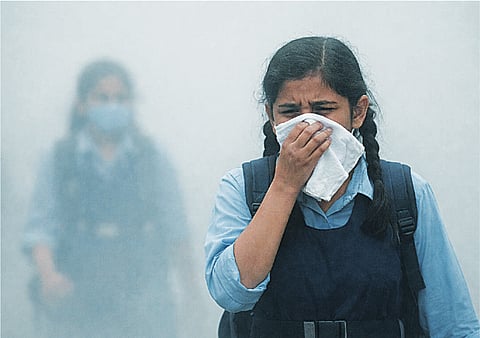


Six-year-old Dipanshu is the only child of his parents. His mother, Dulari Gupta, works as a domestic worker, and his father Sarvesh Gupta, is a security guard in Vasant Vihar, a posh locality in South Delhi. With great effort, Dipanshu’s parents got him enrolled in a prestigious public school in Vasant Vihar, under the Economically Weaker Section (EWS) category. But, the child is no longer going to school and is on a long sick leave.
Reason: high air pollution.
“Every winter my child suffers due to poor air quality in Delhi. But this winter has been particularly bad,” Dulari Gupta told On Air. “Because of high air pollution, Dipanshu kept falling ill every second week. Bad throat, headaches, itchy eyes, wheezing, and chest pain — it was unbearable. He missed so much of school,” she narrated.
“As if this was not enough, he also developed jaundice and became very weak. We had no choice but to take a long sick leave from his school and send him to his grandparents in our village in Mathura [Uttar Pradesh]. At least the air there would be less poisonous than in Delhi,” said the hapless mother, who misses her only child, but is torn between her job in Delhi to feed the family and her maternal instincts.
Dipanshu misses his parents too, but finds the national capital claustrophobic. “In Delhi, I had to wear a face mask all the time. I could not play outside. I felt sick all the time,” the six-year-old told On Air over the phone.
The story of Dipanshu and his parents repeats in almost every other household in Delhi as citizens are breathing a cocktail of pollutants, which is affecting almost all the organs in their bodies, including the brain. The biggest victims of air pollution are young children.
New Delhi-based Chintan Environmental Research and Action Group has conducted a one-of-its-kind survey of 1,257 children in Delhi-NCR (national capital region), aged between six and 15 years, in December 2025 and January 2026. The findings of the survey is compiled as a report—A Generation Under Siege—which exposes how air pollution is no longer just an environmental problem; it is a childhood crisis.
“In our survey, nearly 70 per cent of respondent children reported feeling distress, fear, or worry due to poor air quality. It is affecting both their physical and mental health. Girls report this psychological strain more often than boys,” said Ayush Garg, Manager with Chintan Environmental Research and Action Group, who led the survey team.“Over 70 per cent said that masks and air purifiers do not fully protect them. Alarmingly, nearly half of the children [46.6 per cent] said that they would leave Delhi-NCR, if they had a choice."
Garg said that air quality is often discussed through numbers, policies, and pollution sources, but very little attention is paid on how polluted air is actually experienced and perceived by children in their everyday lives. “A Generation Under Siege was undertaken by Chintan to change that. Instead of treating pollution as an abstract issue, it seeks to understand how children perceive air pollution to be affecting their bodies, minds, schooling, and sense of safety,” he said.
Ravindra Khaiwal, a public health expert on air pollution, acknowledged the grave impacts air pollution has on growing children: “Children are more susceptible as the blood-brain barriers are still developing in them. A process of myelination—the development of a protective coating around nerve fibers in the brain—is still under process, which continues to develop through to their adolescence.”
“When pollution interferes with the process of myelination, messages in the brain don’t travel properly, affecting learning and thinking abilities,” said Khaiwal, a professor of environment health at Department of Community Medicine & School of Public Health, Postgraduate Institute of Medical Education and Research (PGIMER), Chandigarh.
Key Findings of Chintan’s Survey
A Generation Under Siege is based on responses from 1,257 children, aged 6–15 years across Delhi-NCR, collected during the peak pollution months of December 2025 and January 2026. About 23 per cent of respondents were from low-income households and were physically surveyed, while online surveys were used for 77 per cent of the children.
Almost 86 per cent of respondent children believed that polluted air harms their health. Nearly 44 per cent have visited a doctor since October 2025, and many of them had to go more than once for breathing trouble, cough, headaches, and fatigue.
Children and their families try to protect themselves from air pollution. Almost 85 per cent of respondent children said they use some form of protection—face masks (N-95) or air purifier—but still suffer from eye irritation, cough, headaches, and tiredness. Around 55 per cent of the children have missed school because of pollution-related health problems. Clearly, air pollution is not only a public health crisis but is also disrupting education.
The survey found that children in Delhi-NCR are partly aware of air pollution. Almost 65 per cent of children check the Air Quality Index (AQI) every day, mostly through mobile apps and websites. Around 46 per cent of respondents are aware of PM2.5 and PM10, the microscopic, inhalable articulate matter (air pollutants) defined by their diameter—2.5 microns or less (fine), and 10 microns or less (coarse), respectively. Children know that air pollution is a serious problem but this awareness is uneven.
Chintan’s survey also revealed that children do not have much faith in pollution control efforts of the government. Nearly half of the young respondents (46.6 per cent) said that they would leave Delhi-NCR, if given a choice.
Air pollution is snatching away childhood joys and making children lonesome. Chintan's new report is a clear warning. Aadhira Malhotra, an 11-year-old student of a private school in Gurugram (Haryana), told On Air how in the winter season her school often switches to online mode during the poor AQI days.
“It feels very isolating. We feel cooped up at home. We have to always wear a face mask but still get sick because of a cough, congestion and wheezing,” said the young girl, who is also an athlete and a budding singer.
“Poor air quality affects my practice as stadiums are shut down and I have to practice indoors. Often, I get a sore throat because of high pollution levels, which affects my signing practice,” she complained. “Sometimes we just go out for a drive with the car air purifier switched on, as it feels claustrophobic at home,” she added.
Poor Air Quality in Rural India
Six-year-old Dipanshu has already left Delhi and now lives with his grandparents in their village in Uttar Pradesh. But, the air of rural India is also turning toxic.
A recent report, Beyond Cities by the Centre for Research on Energy and Clean Air (CREA), has found 60% of India’s 749 districts breaching the annual National Ambient Air Quality Standard (NAAQS) of 40 micro gram per cubic metre (µg/m³), with no district meeting World Health Organization (WHO) PM2.5 guideline of 5 µg/m³. PM2.5 are fine inhalable particles that are more likely to travel into and deposit on the surface of the deeper parts of the lung.
The reason we know so little about air pollution in small towns and rural hinterlands is the lack of air monitoring stations, which are concentrated in Delhi-NCR and other big cities. This has been demonstrated in a study released by the Centre for Science and Environment in July 2023.
CSE’s Urban Lab found that only 12 per cent of the 4,041 Census cities and towns have air quality monitoring systems and only 200 cities monitor all six key criteria pollutants. This leaves nearly half (47 per cent) of the country’s population outside the maximum radius of air quality monitoring grid (manual and real time combined), and 62 per cent are outside that of real time monitoring network. However, absence of evidence is not evidence of absence!
(With inputs from Abhiveer Gulati.)
(Note: This story was first published in On Air. Read the original story here.)
Have you liked the news article?
Support us now:
https://www.gofundme.com/manage/jammu-kashmirs-sole-independent-voice-under-threat