

As Pakistan and India observe their Independence Days on August 14 and 15, respectively, a little-known story behind those two dates reveals an extraordinary historical irony: in different ways, both nations entered freedom on August 14, 1947.
For Pakistan, August 14 was the day on which the formal transfer-of-power ceremony was held in Karachi. For India, the official date remained August 15, but its leaders deliberately gathered before midnight on August 14 and ushered in independence at midnight. According to accounts of the astrological controversy surrounding the event, this meant that while the Gregorian calendar had changed to August 15, the traditional Hindu/Jyotish reckoning being invoked by astrologers still treated the period before sunrise as belonging to the preceding day.
Thus, for the British clock it was August 15. For the astrological compromise, the day of August 14 had not yet ended.
The more interesting historical puzzle, however, concerns the dates themselves.
Pakistan celebrates August 14, while India celebrates August 15.
The date itself was largely Lord Mountbatten’s choice.
Larry Collins and Dominique Lapierre recount the episode in their celebrated book “Freedom at Midnight”. Mountbatten later explained that August 15 had a powerful personal association for him. It was the second anniversary of Japan’s surrender in 1945, when he was Supreme Allied Commander in Southeast Asia.
“The date I chose came out of the blue,” Mountbatten is quoted as recalling. He eventually settled on August 15 because it marked the anniversary of Japan’s surrender.”
What appeared to Mountbatten an appropriately triumphant date, however, created an unexpected problem for some Indian leaders.
According to the account reproduced in Freedom at Midnight, astrologers across India began examining their charts after Mountbatten announced the date. Friday was regarded by some of them as unsuitable for beginning an enterprise as momentous as an independent state. The book describes astrologers in Benares and elsewhere declaring August 15 highly inauspicious.
One of the most dramatic objections came from Swami Madananand of Calcutta, who examined the planetary configuration and warned Mountbatten against allowing independent India to be born under what he considered hostile stars. Collins and Lapierre recount his dire prediction that an independence granted on that date could bring floods, famine and massacres.
The concern was not confined to obscure astrologers.
Several accounts say leading Congress figures were approached by astrologers seeking a more favourable muhurta, or auspicious moment. Jawaharlal Nehru was publicly associated with scientific temper rather than astrology, but the beliefs of colleagues and the wider political establishment could not simply be dismissed.
Among those worried about the date were people close to Sardar Vallabhbhai Patel and Rajendra Prasad.
Astrologer K.N. Rao, who later discussed the episode in The Nehru Dynasty: Astro-Political Portraits of Nehru, Indira, Sanjay and Rajiv, wrote that astrologers Hardeo Sharma Trivedi and Surya Narain Vyas of Ujjain had warned Rajendra Prasad that August 15 was astrologically unsuitable.
Rao later repeated the account in the Journal of Astrology, writing that the two astrologers told Rajendra Prasad that August 15 “was not an auspicious day.” Since the British decision could not practically be reversed, Rao wrote, midnight was chosen for the ceremony.
This is where the celebrated “Freedom at Midnight” acquired another dimension.
Mountbatten was unwilling to abandon August 15. At the same time, Indian leaders had to contend with the objections being raised over the astrological suitability of the date.
The answer was to exploit a fundamental difference between the Gregorian calendar and traditional Hindu calendrical reckoning.
Under the Gregorian system used by the British administration, a new civil day begins at midnight. In traditional Hindu civil reckoning relevant to the episode, however, the calendrical day was generally treated as running from sunrise to sunrise.
That created a narrow window.
At the stroke of midnight, the British legal calendar would say August 15 had begun. But according to the traditional sunrise-based reckoning invoked by the astrologers, the previous calendrical day had not yet ended.
In that limited traditional sense, India could legally become independent on August 15 while the astrological reckoning still placed the ceremony within the day associated with August 14.
Historical accounts of the midnight ceremony specifically note this distinction, saying that because the Hindu calendrical day began at sunrise, midnight provided a way around the objections to August 15.
It would therefore be more precise to say not that India legally became independent on August 14, but that the midnight ceremony was deliberately situated at a moment that was August 15 under British civil law while, according to the traditional sunrise-to-sunrise reckoning invoked in the compromise, it still belonged to the preceding Hindu calendrical day.
Mountbatten's Dash From Karachi to Delhi
The choreography of the transfer of power fitted neatly into this arrangement.
Mountbatten and his wife arrived in Karachi on August 13. On the morning of August 14, he attended Pakistan’s transfer-of-power ceremony and addressed its Constituent Assembly on behalf of the British Crown. Pakistan’s official parliamentary history records August 14 as the day on which this ceremony took place.
Mountbatten then returned to New Delhi.
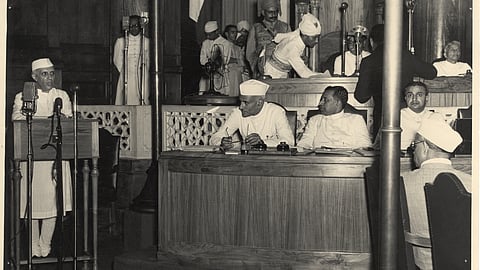
Late on August 14, members of India’s Constituent Assembly gathered in the imposing circular Parliament House. The historic session began before midnight.
There, Nehru delivered the words that would become inseparable from the birth of independent India:
“At the stroke of the midnight hour, when the world sleeps, India will awake to life and freedom.”
The clock provided more than dramatic theatre.
At midnight, the legal requirement was satisfied. August 15 had arrived according to the Gregorian calendar. Yet the timing also accommodated those who were unwilling to inaugurate the new state after sunrise on what they regarded as an astrologically troublesome day.
Accounts of the astrological calculations surrounding independence also refer to concepts such as Abhijit Muhurta and Pushya Nakshatra, although different retellings vary over precisely which calculations determined the final timing.
In Hindu astrology, an Abhijit Muhurta denotes an especially favourable period for undertaking important work, sometimes invoked when another suitable auspicious time is difficult to find.
Pushya, meanwhile, is one of the 27 nakshatras, or lunar constellations, used in Vedic astrology. It has traditionally been considered favourable for significant undertakings, including those connected with authority and governance. In astrological tradition, Pushya is associated with Saturn as its planetary ruler and Brihaspati, or Jupiter, as its presiding deity.
The calculations were therefore an attempt to find the best possible moment within a date that the British had already made politically non-negotiable.
This explains why the midnight hour was more than poetic symbolism. It represented an unusual meeting of British statute, political necessity, calendrical convention and astrological belief.
There is an irony in the way history is now remembered.
Every August, Pakistan's flags go up on the 14th and India's on the 15th, creating the impression that the two countries were born on successive days.
Ceremonially, that distinction is understandable. Pakistan's transfer-of-power ceremony took place on August 14, and that became its national day. India’s defining Constituent Assembly moment came at midnight as August 15 began.
Mountbatten got his August 15, commemorating Japan's surrender. The British Parliament's statute was observed. The astrologers got their pre-sunrise window. Pakistan had already held its transfer ceremony in Karachi. And India's leaders assembled in New Delhi at an hour when two different ways of measuring a day briefly overlapped.
Out of that unlikely convergence came one of the most memorable lines of the 20th century: “At the stroke of the midnight hour...”
The phrase has endured as poetry and political rhetoric.
But behind it lay something much more complicated: an empire leaving, two countries being born, two calendars crossing, and politicians trying to satisfy both the law on earth and, for those who believed in them, the stars above.
Have you liked the news article?
Support us now:
https://www.gofundme.com/manage/jammu-kashmirs-sole-independent-voice-under-threat