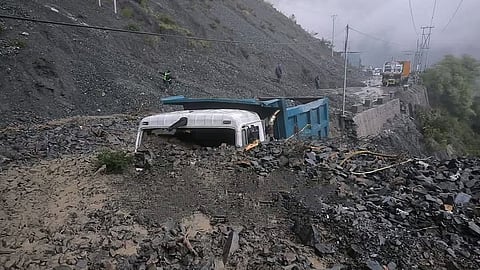


The recent flash floods that swept across parts of Jammu & Kashmir once again exposed the fragility of the Himalayan landscape. Torrential rainfall, cloudbursts and landslides inundated towns, damaged infrastructure, washed away roads and disrupted normal life. As rescue teams worked to restore connectivity, another question resurfaced: Are human interventions making Kashmir's rivers more vulnerable to extreme weather?
Scientists are clear that flash floods are primarily triggered by intense rainfall, cloudbursts and climate change. Yet they also caution that human activities including unregulated riverbed mining, deforestation, encroachment on floodplains and unplanned development can amplify the destructive effects of these natural events by weakening the resilience of river systems.
Among these concerns, riverbed mining has emerged as one of the most contentious environmental issues in Jammu & Kashmir. Rivers naturally carry boulders, gravel and sand that regulate water flow, strengthen riverbanks and recharge groundwater. These materials are crucial elements that give the rivers their stability.
When extracted scientifically and within ecological limits, riverbed material (RBM) supports infrastructure development. However, indiscriminate excavation can fundamentally alter a river's morphology. Removing large boulders increases flow velocity during floods, destabilises banks, deepens channels, exposes bridge foundations and reduces groundwater recharge. In mountainous terrain already vulnerable to cloudbursts, these impacts can increase the severity of flood damage.
Sukhnag Case
No river illustrates this challenge better than the Sukhnag, a trout-bearing stream flowing through Budgam district.
The environmental significance of Sukhnag reached national attention after environmental activist Dr Raja Muzaffar Bhat approached the National Green Tribunal (NGT) through Original Application No. 1211/2024, alleging extensive illegal riverbed mining and ecological destruction. The Tribunal constituted joint committees comprising officials from the Jammu & Kashmir Pollution Control Committee (JKPCC), the Ministry of Environment, Forest and Climate Change, the Central Pollution Control Board and other government departments to investigate the allegations.
The findings were alarming.
Government reports placed before the NGT estimated that between 10.62 lakh and 15.3 lakh metric tonnes of riverbed material including boulders, gravel and sand had been extracted from stretches of the Sukhnag between 2020 and December 2024. This is roughly equivalent to one lakh dumper loads of RBM. Expert inspections also documented excavation reaching up to 5.22 metres below the riverbed in certain locations, far beyond what scientists consider environmentally sustainable.
The expert committees reported that large-scale excavation had disturbed the stream's geomorphological stability, altered natural flow patterns, damaged embankments, affected groundwater recharge and threatened aquatic habitats, including a designated trout stream. The reports recommended ecological restoration, replenishment studies, filling of deep trenches and stricter environmental oversight before mining activities could continue.
Earlier proceedings before the Tribunal also recorded findings that illegal mining had taken place in the Sukhnag, affected water sources and caused losses to downstream trout farms. The NGT further noted that numerous short-term mining permits had been issued while examining whether environmental clearances and statutory safeguards had been complied with.
The Sukhnag case has since become one of the most important environmental litigations in Jammu & Kashmir. It demonstrates how judicial intervention can bring scientific scrutiny to environmental disputes and reinforce the principle that natural resources are held in trust for the public.
Across the Himalayan Region
The lessons extend far beyond a single river.
Across the Himalayan region, climate change is increasing the frequency of extreme rainfall events. Simultaneously, rivers are under pressure from expanding infrastructure, mining, shrinking wetlands and growing settlements. Disaster resilience therefore depends not only on better weather forecasting but also on healthier river ecosystems.
Protecting Kashmir's rivers requires a science-based approach: strict compliance with environmental clearances, periodic replenishment studies, satellite and drone monitoring, transparent disclosure of mining data, independent ecological audits and effective enforcement against illegal extraction. River restoration must become as important as river regulation.
The recent flash floods should serve as a warning, not only about a changing climate but also about the cumulative impact of human actions on fragile mountain ecosystems. Rivers cannot be viewed merely as repositories of construction material. They are living systems that sustain agriculture, fisheries, groundwater, biodiversity and human settlements.
As Kashmir confronts a future of increasing climatic uncertainty, the underlying truth cannot be ignored. Protecting rivers is not simply an environmental obligation, it is a prerequisite for sustainable development and the security of future generations.
Have you liked the news article?
Support us now:
https://www.gofundme.com/manage/jammu-kashmirs-sole-independent-voice-under-threat