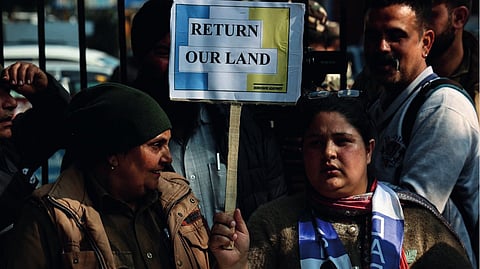


The introduction of a bill in the Jammu & Kashmir Assembly restricting non-locals from leasing government land is being presented as a corrective step. It is also touted as an attempt to restore a measure of protection for the people of the region.
It is not.
At best, this is a limited administrative adjustment. At worst, it is an exercise in narrative management that creates the appearance of protection while leaving the deeper structural transformation of Kashmir entirely untouched.
To understand why, one must look beyond the immediate legislative move and confront a more fundamental reality. The issue in Jammu & Kashmir has never been confined to leasing land alone. It is about who controls land, who shapes demographic outcomes, and who ultimately determines the region’s economic and political trajectory.
From structural safeguards to policy fragments
Before August 2019, constitutional provisions such as Article 35A formed the backbone of land and identity protections in Jammu & Kashmir. These were not symbolic safeguards; they constituted a coherent legal framework that restricted land ownership to permanent residents, prevented external demographic influx, and ensured that economic benefits remained anchored within the local population.
Their removal marked far more than a legal adjustment. It signaled the beginning of a structural reconfiguration of authority over land, resources, and identity.
Seen in this light, the present bill, which narrowly addresses the leasing of government land, appears profoundly inadequate. It neither restores ownership protections nor reintroduces settlement restrictions, and it remains silent on the question of demographic vulnerability. Instead, it functions as a policy fragment within a fundamentally altered constitutional order.
The post-2019 framework: Control without consent
Any legislative measure introduced today operates within the framework that emerged after the revocation of Article 370, and that context is critical to understanding its limitations.
Within this framework, protections can be granted or withdrawn with relative ease, laws remain politically contingent, and institutional safeguards lack permanence. As a result, even measures that appear protective are inherently unstable and subject to reversal.
What is being presented as protection is, in essence, a form of permission that is selective, revocable, and centrally controlled.
Illusion of Safeguards
The present bill risks creating a misleading impression that the erosion of earlier protections is being reversed, when in fact no such restoration is taking place.
Restricting the leasing of government land does little to address the more consequential issues of private land ownership transfers, long-term settlement patterns or structural demographic shifts. More importantly, it leaves untouched the central question of who exercises decision-making authority over land in the region.
This is not a return to earlier safeguards. It is, rather, a recalibration within an already established structure of control.
At the same time, it would be unrealistic to dismiss the renewal of existing leases, particularly in sectors such as hospitality and tourism, where continuity is closely tied to livelihoods. Abrupt disruption of long-standing arrangements could destabilize local economies and create uncertainty for workers and investors alike.
However, it is equally important not to mistake such economic management for structural protection. Extending leases may sustain economic activity, but it does not restore the legal and political framework that once governed land and identity in Jammu & Kashmir.
Between economic continuity and structural control
A clear distinction must therefore be maintained between economic continuity and structural protection.
Renewing or extending existing leases can serve a legitimate economic purpose by ensuring stability and preventing sudden disruptions in key sectors. In that limited sense, policy continuity is not inherently problematic.
The concern arises when such measures are presented as evidence of restored protections. In reality, they operate within a system where the terms of access remain centrally determined, the scope of protection is narrowly defined, and the broader question of ownership and demographic safeguards remains unaddressed.
What emerges is not a genuinely people-centric policy framework, but a model of managed economic participation in which continuity is selectively granted while structural control remains firmly intact.
Real Question: Land or Sovereignty?
The public debate has been framed in deceptively simple terms, focusing on whether non-locals should be allowed to lease land.
Yet this framing obscures a far more important question: who has the authority to determine how land, identity, and resources are governed in Jammu & Kashmir?
Without addressing this, any policy intervention, regardless of how well it is presented, risks remaining superficial.
Land in Kashmir is not merely an economic resource. It is deeply intertwined with identity, demographic balance, and political agency, and control over land ultimately shapes the region.
Why partial measures cannot substitute structural protections
The protections that existed prior to 2019 were not isolated provisions; they formed part of a broader and internally coherent legal architecture.
Their removal cannot be meaningfully compensated through selective restrictions, administrative adjustments, or politically mediated legislation. Such measures are limited in scope, vulnerable to reversal, and lack the permanence required to inspire confidence.
In effect, they create the appearance of corrective action while leaving the underlying structural transformation intact.
What is required is the restoration of comprehensive legal safeguards equivalent in scope to Article 35A, so that land ownership can be regulated, demographic balance safeguarded, and local control over resources meaningfully ensured.
Equally important is the question of durability. Without credible mechanisms of oversight, any restored protections would remain vulnerable to future reversal.
Binding guarantees, ideally with an element of international oversight, would lend continuity and credibility to such safeguards, ensuring that they are not subject to unilateral alteration and that they endure beyond shifting political circumstances.
At the same time, any sustainable framework must recognise the people of Jammu & Kashmir as primary stakeholders in decisions affecting their land and future, rather than as passive recipients of policy.
What is unfolding at present is not merely a debate about land leasing, but an attempt to redefine the terms of control while maintaining an appearance of responsiveness.
By focusing attention on narrow legislative measures, the larger transformation underway risks being obscured. This transformation reflects a shift from protected autonomy to managed integration, from local decision-making to centralised authority, and from structural safeguards to policy-level permissions.
Beyond Symbolism
The bill restricting non-locals from leasing land may generate political debate and provide a measure of administrative clarity, but it does not alter the fundamental reality.
It does not restore rights, reverse structural changes, or secure the long-term future of the region. What it does, instead, is reshape perception within an unchanged framework of control.
Kashmir does not require symbolic safeguards designed to soften criticism. It requires structural protections that are legally robust, politically insulated, and durable enough to withstand shifting political currents.
Extending leases may help stabilise an economy, but it cannot by itself secure a people or their future.
Until those deeper questions are addressed, measures such as this will continue to represent what this bill ultimately is: an illusion of protection within a transformed reality.
Have you liked the news article?
Support us now:
https://www.gofundme.com/manage/jammu-kashmirs-sole-independent-voice-under-threat