

Democracies rarely change course overnight. More often, the shift is gradual, administrative, and difficult to detect until its effects are already embedded. In India today, one such shift appears to be unfolding through the revision of electoral rolls, where the removal of names—presented as a technical exercise—may be reshaping the contours of political participation.
Recent state-wise data compiled by The Telegraph points to the scale of this development.
In Tamil Nadu, over 1.02 crore voters have been removed following revisions. Gujarat has seen deletions of more than 77 lakh names, while Bihar accounts for nearly 68.66 lakh removals. Madhya Pradesh has recorded over 45 lakh deletions, and Rajasthan over 44 lakhs. Even states with smaller populations show notable changes: Kerala has removed around 24.62 lakh voters, and Chhattisgarh over 28 lakhs.
In smaller territories, the percentages are striking.
The Andaman and Nicobar Islands have seen deletions of over 22%, while Puducherry records nearly 12%, and Goa is close to that mark. These figures, drawn from official revision exercises, indicate that the issue is neither isolated nor limited to a particular region.
Authorities describe the process as part of a “Special Intensive Revision” (SIR) aimed at cleaning electoral rolls, removing duplicate, shifted, or deceased voters. Such exercises are not new. Periodic revisions are essential to maintain the credibility of elections. However, the magnitude and pattern of deletions now invite closer scrutiny.
At one level, the concern is procedural. How are these names being removed? What safeguards exist for those who find themselves excluded? And how accessible are the mechanisms for re-enrollment?
At another level, the issue is structural. When large numbers of people—often from economically weaker or socially marginalized backgrounds are required to repeatedly prove their eligibility through documentation, the process risks becoming exclusionary, even if unintentionally.
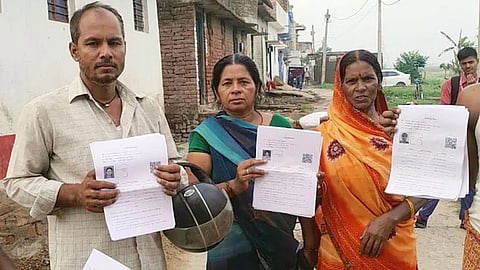
This is where the lived experience becomes critical. As noted earlier, across districts such as Murshidabad and Aligarh, individuals report discovering that their names have disappeared from voter lists due to documentation gaps—minor discrepancies, missing legacy records, or bureaucratic inconsistencies.
For many, especially those with limited access to formal records, these requirements are not merely administrative hurdles. They are barriers that can take years, if not decades, to overcome.
To understand the present moment, it is useful to view it in a broader historical context. The Sachar Committee Report of 2006 highlighted systemic challenges faced by Muslims in accessing education, banking, and official documentation. These disadvantages have persisted, shaping the ability of communities to engage fully with state institutions.
The National Register of Citizens process in Assam further demonstrated how documentation gaps could lead to large-scale exclusions. Nearly two million people were left out of the registry, many of them unable to meet stringent evidentiary requirements. The Citizenship Amendment Act later introduced religion as a criterion in citizenship debates, adding another layer of complexity.
Electoral Participation
Seen together, these developments suggest a pattern where access to documentation increasingly determines access to rights.
Electoral participation is no exception.
Representation data reflects this trend. Muslims constitute over 14% of India’s population but hold less than 5% of seats in the Lok Sabha. In several key states, Muslim representation in Parliament remains minimal or absent. While electoral outcomes depend on multiple factors, the narrowing of voter participation inevitably affects representation.
It is important to note that the issue is not confined to any one community. Migrant workers, rural populations, and economically disadvantaged groups across regions face similar challenges in maintaining documentation continuity.
However, when these vulnerabilities overlap with existing social and political marginalization, their impact becomes more pronounced.
The role of institutions, particularly the Election Commission, is therefore crucial. As the constitutional authority responsible for ensuring free and fair elections, the Commission must balance accuracy with inclusion. A system that prioritizes precision at the cost of participation risks undermining the very legitimacy it seeks to protect.
Supporters of the current revision process argue that accurate electoral rolls are fundamental to democratic integrity. That is undoubtedly true. Duplicate entries, outdated records, and inaccuracies can distort electoral outcomes. Cleaning the rolls is not only necessary but essential.
The question, however, is one of balance.
When deletions run into tens of lakhs, transparency becomes critical. Clear communication, accessible grievance mechanisms, and proactive outreach are necessary to ensure that legitimate voters are not excluded. Without these safeguards, even well-intentioned processes can produce unintended consequences.
There is also a broader democratic principle at stake. Voting is not merely a procedural right. It is the primary means through which citizens participate in governance. Any process that restricts access to this right, even indirectly, must be examined with care.
India has long prided itself on being the world’s largest democracy, a system where diversity is reflected in participation. That strength lies not only in the scale of elections but in their inclusiveness.
Shrinking Electoral Rolls
If electoral rolls begin to shrink significantly, the concern is not just numerical. It is representational.
Who gets counted matters. Who gets to vote matters even more.
The current moment calls for a measured response rather than alarm. It requires acknowledging the importance of accurate voter lists while also recognizing the risks of exclusion. It demands institutional vigilance, public awareness, and a commitment to ensuring that administrative processes do not inadvertently weaken democratic participation.
Ultimately, the health of a democracy is measured not only by how efficiently it conducts elections, but by how inclusively it enables participation. Ensuring that every eligible citizen remains part of the electoral process is not just a technical task. It is a democratic obligation.
As India continues its electoral revisions, the challenge will be to ensure that this obligation is upheld—quietly, carefully, and comprehensively.
Have you liked the news article?
Support us now:
https://www.gofundme.com/manage/jammu-kashmirs-sole-independent-voice-under-threat