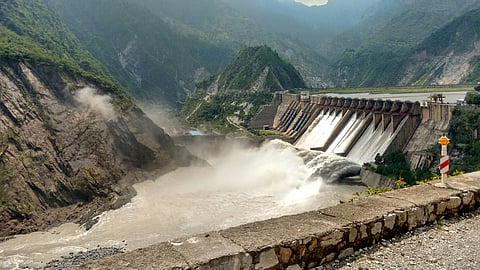


There is a quiet contradiction at the heart of Jammu and Kashmir’s economy, one that becomes most visible every winter when households brace for power cuts and businesses scale down operations.
It is a contradiction rooted not in scarcity, but in abundance. Few regions in South Asia are as richly endowed with hydropower potential as Jammu and Kashmir. Its rivers, fed by Himalayan glaciers, have the capacity to generate thousands of megawatts of electricity. Yet the region remains chronically power deficient.
This is not a story of technical failure or geographic limitation. It is a story of control.
The bulk of hydropower generation in Jammu and Kashmir is managed by NHPC Limited, a central public sector enterprise that operates major projects such as Salal, Uri-I, Dul-Hasti, and Kishanganga. Together, these projects generate more than 2,000 megawatts of electricity, enough to significantly alter the region’s energy landscape. But that transformation has not reached the people who live closest to these rivers.
Instead, Jammu and Kashmir continues to import electricity, often at considerable cost, particularly during peak winter months when demand surges and local generation dips. The irony is stark: a region that produces power at scale is forced to purchase it back to meet its own needs.
Much of the justification for this arrangement rests on the idea of “12% free power,” which Jammu and Kashmir receives as a form of royalty from these projects. On paper, this appears reasonable, even generous. In practice, it is neither.
Twelve percent is not a benefit; it is a limitation. It caps the region’s share of a resource that originates within its own territory. The remaining 88% is commercially traded, often transmitted outside the region and, in some cases, sold back to Jammu and Kashmir at market rates. What emerges is a structurally imbalanced system in which value is extracted from the region while costs are reabsorbed by it.
This is not merely a question of accounting. It reflects a deeper imbalance in economic design.
Hydropower projects are capital-intensive at the outset, but their economics change over time. Globally, such projects typically recover their initial investment within 10 to 15 years. Beyond that point, they enter a phase of relatively low operational costs and high returns. In Jammu and Kashmir, many NHPC-operated projects have long surpassed this threshold. Salal has been operational since 1987, Uri-I since 1997, and Dul-Hasti since 2007.
Over decades, these projects have generated substantial cumulative revenues, conservatively estimated in the range of ₹80,000 to ₹90,000 crore. Yet ownership and control remain unchanged. The logic of Build–Own–Operate–Transfer (BOOT), which was meant to ensure eventual transfer of assets to the region, has effectively stalled. Temporary stewardship has evolved into indefinite control.
Consequences of Arrangement
The consequences of this arrangement extend beyond ownership. Jammu and Kashmir does not determine tariffs for the electricity generated from its own rivers. It does not control distribution networks in a meaningful way. Nor does it retain the bulk of profits derived from its hydropower resources. Instead, it finds itself at the receiving end of the value chain, purchasing electricity to meet domestic demand.
This creates a familiar pattern seen in many resource-rich regions across the world: wealth in natural assets, but poverty in outcomes. It is an economic paradox where extraction outpaces local benefit, and where the geography of production does not align with the geography of gain.
The origins of this framework lie in a particular political context. Agreements governing these projects were negotiated at a time when Jammu and Kashmir’s institutional autonomy and bargaining power were limited. Over time, rather than being recalibrated, these arrangements have solidified. The asymmetry has deepened, not diminished.
The result is a system defined by three characteristics. First, resources are locally sourced. Second, capital and decision-making authority are externally concentrated. Third, benefits are disproportionately distributed away from the region.
In most contexts, such a model would invite serious debate about fairness and sustainability. In Jammu and Kashmir, it has persisted with limited structural reform.
Reimagining this framework requires moving beyond technical fixes and addressing the core political economy of hydropower. The question is not whether the region can generate electricity. It already does. The question is who controls that generation, how its value is distributed, and whether local needs are prioritized.
A more equitable approach would begin by revisiting the share of free power, raising it to at least 25% to 30% in line with evolving norms in other hydropower-producing regions. It would require enforcing time-bound transfer clauses under BOOT agreements, ensuring that projects do not remain under perpetual external control. Joint ownership models, involving both central and regional stakeholders, could provide a transitional pathway that balances national and local interests.
Equally important is the principle of prioritizing local consumption. Electricity generated within Jammu and Kashmir should first meet the region’s own demand before being exported. This is not an argument against integration with the national grid, but a call for a more balanced allocation of resources.
At a deeper level, the debate over hydropower is about agency. It raises fundamental questions about ownership, decision-making and the rights of a region over its natural endowments. Who owns the rivers of Kashmir? Who decides how their energy is used? And who ultimately benefits from that use?
The answers to these questions will shape not just the region’s energy future, but its broader economic trajectory.
For now, the contradiction endures. Rivers flow with immense force through the valleys of Kashmir, generating electricity that lights up distant cities, while many local homes remain in the dark for hours each day. It is a reality that captures the essence of the hydropower paradox: a land that produces power yet remains powerless.
Until the underlying structures of control and distribution are addressed, this paradox will persist. And with it, a growing sense that the region’s most valuable natural asset continues to serve others more than it serves its own people.
Have you liked the news article?
Support us now:
https://www.gofundme.com/manage/jammu-kashmirs-sole-independent-voice-under-threat