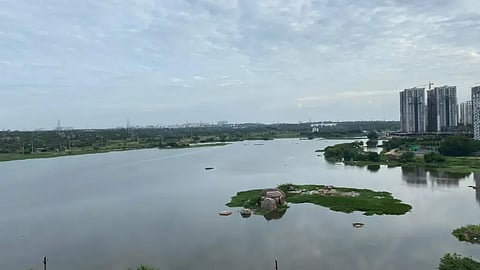


(This note on, ‘misunderstood, misinterpreted and misguided urban lake management and governance in India’ with a case study of Hyderabad is written to bring to the attention of the Urban Local Bodies (ULBs), the Political Establishment, the Judiciary, the Builder/Developer Lobby, and importantly the Hyderabadis. The purpose of the note is to highlight the misunderstanding and the misinterpretation about the urban lakes which misguide the lake management and governance to their systematic misuse, abuse and extinction, often carried out in the guise of urban development.)
I. Foreground
Historically, the land and waterscape of Hyderabad is interwoven between the undulating topography, drainage courses, and waterbodies. However, the modern urban development process entails hillocks mined and flattened, drainage courses and lakes filled and reclaimed. The city located on the Deccan Plateau along the banks of the Musi River still holds the charm of being among the greenest cities in the world which can be attributed to the presence of the lakes.
The city's water bodies shrank by close to 500% between 2000 to 2020 from 12,535 hectares to 2,280 hectares. As of 2025, the Hyderabad Metropolitan Development Authority currently keeps record of 2959 lakes in the Hyderabad metropolitan area and 27 lakes in the city of Hyderabad. According to the Hyderabad Disaster Response and Asset Protection Agency (HYDRAA), with over 61% of Hyderabad's lakes already encroached upon, without immediate action, the remaining 39% could disappear within 15 years. This is simply because, a LAKE LOST IS A LAND GAINED! This is now a well-known fact among everyone involved in lake matters.
The claim of HYDRAA may be right looking at the state of affairs on urban lake governance.
If there has been a systematic deterioration of urban lakes over the past few decades, what ‘actions’ to be done, to be undone and not to be done in the future become crucial to diagnose and discuss before any rushed decisions. The city has to work harder to retain the green and the blue in good shape, in particular, the current rampant demolition and development planned by HYDRAA may further confirm the path to extinction of the urban lakes. Since, rushed decisions including continuing with the current lake development and management approaches may actually result in actions to arrive to what HYDRAA has predicted.
A thorough diagnosis is crucial to question the ongoing urban lake development approach. What is happening between the stakeholders, why is it happening, how is it happening, who is doing it, when is it done, together tell us about the lake governance. What is done to the lake, why is it done, how is it done, who does it, when is it done, together tell us about the lake management. Both are interlinked and important to decode. In other words, it is important to understand the people in the decision-making positions to understand the state of the lakes.
In this foreground, I present some points as why the sorry state of affairs in lake governance towards lake management and what is the solution. The foreground is written with complete cognizance and conviction, on how lake governance influence lake management. Since, the solution is simple. It is derived from 3 decades of research and engagement with several decision makers involved in urban lake management in India with reference here to Hyderabad. For example, I was invited (Oct 24, 2024) to conduct a workshop with the HYDRAA officials where, a detailed description of ‘WHAT NOT TO DO WITH URBAN LAKES’ was presented with highlighting that a ‘a Lake is a Lake’ and must not be misunderstood and misinterpreted as park or garden to misguide its management.
The foreground is laid on a simple hypothesis that, the rising water crisis in the form of flood and drought in a country that is abundant in water resources and wisdom is worth questioning and resolving because, there is more moral crisis than water crisis in managing the lakes and communities in cities.
I.1. Designation and delineation
Designation and delineation of the lakes fundamentally tell us where/how did the lakes disappear. After the implementation of the National Lake Conservation Plan (NLCP) in early 2000 (later amended to the National Plan for Conservation of Aquatic Eco-systems (NPCA), like other cities in India, Hyderabad also under-designated its existing lakes. The lack of integrated data between combined Collectorate, Land Revenue, and Irrigation Department was exploited to de-designate several shallow lakes. De-designation meant a lost lake and a lost lake is a land gained. This was well understood and appropriated by the ULBs with the support of the builder lobby and powerful people. The old revenue records can verify which/how much government offices, builders, industrialists, businesses, politicians benefited from the de-designation of the lakes.
The process of manufacturing new real estate land by manipulating the administrative status of the shallow and smaller lakes to developable land indeed involved illegitimate transactions costs between the beneficiaries, what went unaccounted, yes, corruption. As per the numbers, it may turn out that the ULBs are the biggest land grabbers of the lakes. Privatizing the land of the lakes, also left the ULBs with lesser and larger lakes to manage. In addition, at the time when the ULBs were assigned to maintain and manage the lakes as part of NLCP, they were already discharging wastewater and dumping solid waste into the waterbodies with full authority, earlier out of no option and later as a modus operandi to create land out of the lakes.
With the responsibility of lake conservation and management coming with funds from the central-state government, the idea of lake development for beautification and recreation entered into the imaginations of the ULBs fueled by the politicians. Their imaginations were shaped and materialized by the engineers, planners, and architects who usually perceive cities with cement, brick and steel and without water, people, and crisis. The delineation of the lake was naturalized by them as part of the lake development, a process that takes land out of the lake to make public utilities from park to parking, from treatment plants to tar roads. This legitimized to continue the dumping of solid waste primarily coming from the construction and demolition (C&D), domestic and industries. Further, to hide the garbage which became ideal to create land on the lake edge but tampered the lake area, the lakes were depended in the name of dredging and to maintain the lakes impounding capacity. And then, keeping the lake wet (with water) for year-round was legitimized to defend the wastewater discharge.
Before the NLCP, converting a lake to a developable land was easier due to remote administration and was based on the Full Tank Level (FTL) of the lake. This is when who’s who of the city along with ULBs developed colonies, government offices, courts, hospitals, universities on the land of the lake. This is why when NLCP came the designation of lakes drastically reduced to then present numbers since after designation, they cannot be any more developed into building premises, but then it came with another wrong- lake development.
The designation and delineation also explain why a city faces flood and drought. The common sense and traditional knowledge that, shallow and smaller lakes are actually better water sinks to tackle the floods in the city were completely ignored in greed. Then propagating year-round water in the lake for lake development was never about the lake. That, lakes have inherent characteristic to dry in the summer and rejuvenate with the rains in the monsoon were also completely ignored in need to deal with the unplanned wastewater management. So, when large number of lakes are built over and barricaded besides wastewater already sitting there, leaves no possibility for the rainwater to flow to the lakes and fill them. Then, the streets are bound to flood in the cities.
I.2. Protection and Management
In the present scheme of things, HYDRAA considers its role and responsibility in protecting public assets, such as lakes and parks, from encroachment and managing urban disasters like floods in the Telangana Core Urban Region (TCUR). Keeping asides the administrative mandate which is also questionable, the idea of protection itself is tricky, protect the urban lake for the lake or for the people and within people who, for the rich or for the poor since both doesn’t look as option explored, or protect the image of the lake or the locality. It is often noticed that the lake protection tends to be mostly anthropocentric (for people) but within it, not from an equity point but from an elite point.
When ULBs have the mandate of protection of water bodies and heritage, then it is important to reconsider the lakes as humanly constructed social-technical heritage. It is ironic that the ASI earmarks the buildings but not the lakes as heritage. Several lakes have historic structures in the form of bunds, pavilions, sluice gates. We should have learned from the mistakes of the Hussainsagar Lake development process and not continue doing the same. For example, Rukn-ud-Daula lake or Bum-Rukn-ud-Dowla and Neher-e-Hussain must be considered a rich natural-cultural heritage and put to protection as per the Archaeological Survey of India, ASI, rules and guidelines. Any construction inside and in its premise must be discouraged except the maintenance of the place. The ASI requires institutional framework for designating the lakes as heritage structures. Besides, the organization also requires institutional strengthening otherwise it is inclined to act like the Forest Department which has cleared more forests for development than actually did afforestation since its formation. ASI too is slowly losing its legitimacy under the pressure of urban development where everything is valued as land besides shortage of resources and motivation to preserve. When there is preservation, then protection comes into picture.
And if the land or the lake or both to be protected, they require different approaches. A lake has to be perceived beyond the land to its water, soil, and ecosystem. So, protection has to be about protecting the lake’s health. Protecting a land parcel is indeed crucial first step where designation and delineation are the tools, but is not enough. The land protection transcends to managing the property rights, access rights, appropriation rights, it is about the physical, chemical, technical, social aspects that needs managing to ensure a good health of the lake. Besides, lakes being common pool resources with common property rights regime, it must to be accessible to all at all times with same facilities as that of a healthy lake i.e., of fresh water, native fishes, vegetation, fresh air. That is what a lake management entails. Not what is done today by the ULBs, by claiming authorization to change the characteristics, decide who will use, when it can be used, at what cost one is allowed to use. Then it is no different than privatization. In any case, most of the lakes are severely polluted to the degree of E category as per the Pollution Control Board classification for use. Protecting a lake to further to develop a park (or parking or anything) by reducing the lake area, compromising the lake ecosystem, cannot be considered as protection as it takes the lake to even poor category than E. The Hussainsagar Lake, Durgam Cherruvu, Saroor nagar lake developments are classic examples of the same.
I.3. Encroachment and Demolition
It is important to take a closer look as how the asset protection mandate entitles to enforce building regulations and remove encroachments furthering preventive disaster management over post-disaster response in other words to make Hyderabad more disaster averse or resilient. This needs to be seen in 2 parts- 1. enforce building regulations and remove encroachments, and 2. prevent disaster management. Theoretically, enforcing building regulations and removing encroachments does directly attribute to preventing disaster. We need better understanding of hydrology and sociology as this entire exercise is inclined to the latter because, any development can protect itself from disaster if it is planned to do so.
The class, caste, religion are not confined to individuals, they transcend to access to rights. So, when a lake is occupied by poor vulnerable people (often migrant labors) who cannot afford the expensive housing market, it is considered encroachment. The same lake when occupied by elites through a systematic/administrative land grabbing process facilitated by the ULBs, it is considered development. And then, there is the other option, when the land grabbing happens for all kinds of public infrastructure and utilities, popular being the park, it is considered as lake conservation or restoration. All the three options hamper the lake’s health besides, hampering the rainwater harvesting and thus protecting city from flood mitigation. Developing a park on the lake is no lake protection, period!
If a genuine comparative analysis is carried out, it will be evident that haphazard informal encroachment has lesser negative impact on a lake than the other options such as, planned formal land grabbing and demolition, dumping, and developing. Reason being, room for water to flow in the former and missing room in the latter. In no way that justifies and supports informal encroachment which can be prevented with stricter laws and affordable housing. But ULB has to take responsibility of the formal encroachment of the lake area with same rigor which is a challenge for them.
Since flood is used as a defense mechanism to execute demolition drive, ULBs must be reminded that encroachment by illegal or legal route is wrong, and demolition is equally wrong. Two wrongs don’t make things right.
If protection is by demolition, a common-sense question is, where will the demolition waste go? If the waste is accommodated in-situ then, dumping and developing parks and islands are popular mantras. This means, additional C&D waste to be dumped on the lake edge which will reduce the lake’s water retention capacity. This has been the modus operandi in the last few decades where C&D waste constitutes majority of the land grabbing from the lake edge. Concretizing the edge dumped with waste does not allow amphibian biodiversity to thrive. In addition, the top soil from the lake bed is dredged in the name of deepening to cover the dump waste which is a futile exercise harmful for the lake water, edge, and the ground water. Lawns and exotic plantations are done to beautify which is not really any ecosystem restoration. Much of the plantations in these hollow gardens have annual mortality of over 70% which becomes then an annual planting business. It is to be reminded that the lake edge is the richest ecosystem part of the lake. Concretizing or gardening on those dumped spaces is wrong.
If the waste is removed from the site, then it will be dumped in some other lake in the outskirts of the city outside the limelight where there is neglect and the same saga will be implemented there after some time.
What is important to note is the systematic deterioration and extinction of the urban lakes to create land gets further institutionalized (systematically cemented) with the kind of agenda and approach an enforcing agency, like HYDRAA, is entitled to execute.
I.4. Data and Information Flow
Flow of information from the ULBS must transcend the firewall and bring transparency in the governance. Lake crisis is data crisis. Data in the public domain is possible, if ULBs implement the Integrated Lake Basin Management (ILBM) Framework in true spirit, a foundational pillar of implementing NLCP. Every planning, design, and construction on the public land must be brought to the scrutiny of the public. Who is consulted, how are the agencies selected, budgeting, monitoring and evaluation data must be out in the public domain. The weak Lake Management Cell, a State Level Body completely out of the picture, needs strengthening with lake data management, monitoring, and evaluation as core activities.
The Right to Information, RTI, must be fully operationalized and the ULBs must be reminded to provide every information to the affected citizens including those who are challenging the government’s (wrong)doings. It is the role of the judiciary to ensure that the ULBs take the responsibility to provide information to the people. For example, HYDRAA claims to focus, rightfully so, on conserving and restoring urban lakes, ensuring to make the lakes as sources of clean water while enhancing surrounding environment with plantation drives to create conducive habitats for biodiversity. To attain this goal, it is unclear as what approach will be taken, who will be assigned, by when it will be achieved, what will be the cost, who will benefit, etc. Since, importantly the organization does not have a mandate to do so and it is also not equipped to do so. Obviously, it will work with other organizations which is perfect as long as the governance terms and conditions are transparent and the documents are in public domain which is presently missing. Besides, in a functioning democracy, lake governance must/should be approached through public engagement and not by police enforcement.
II.4. Lake Development versus Conservation
As the country rides high on the lake development model, the lake conservation is confined to mere texts in the policy and project documents (ex. Detailed Project Report, DPR) and far from reality. Conservation by lake development is never a solution. In fact, development is an exercise of capital investment with not much capital-social gain. The truth is, lake development with boundary walls, dumping mounds with lawns, planting exotic species, discharging the wastewater (with flimsy treatment), and further extracting ground water to fill the lake and to dilute the pollution, are actually adding to the water crisis of flood, drought and asymmetric access to facilities.
The Full Tank Level (FTL) is the game changer in the politics of lake development by water grabbing. The lack of water data comes handy with the ULBs to manipulate the designation and delineation to manufacture land alias real estate. The water grabbing is happening through land grabbing. The Hussainsagar Lake, Durgam Cherruvu, Gurram Cherruvu, Saroor nagar lake developments are classic examples of how the FTL was played with to acquire land from the lake. And now with new asset protection and management regime, this process is being expedited in other words, final nail in the coffin.
Every lake development has resulted in reduction of the lake size by 20-25% reducing the lake’s impounding capacity. The argument to compensate the lake capacity by deepening is wrong. Changing the depth of the lake as a compensation to maintain the same water quantity is lesser useful for storing rainwater especially heavy rains because, the area for rainwater holding and percolation is reduced. Thus, the increase in floods can be witnessed in areas where lake developments are undertaken. Besides, a deeper lake faces changes in the ecosystem characteristics including increased invasive species of flora and fauna. Shallow lakes are richer ecosystem than deeper but shallow lakes are already consumed in urban development.
We need to also reminded that lakes are carbon sequestration grounds and provide more oxygen than the trees when compared with the same area of land. Yet the ignorance pushes us to reclaim the lake area, fill with garbage, do plantation of alien species, and later water them drawing ground water. Many a times, even lakes are filled with groundwater. Misuse of groundwater to fill up the lakes or dilute the water pollution besides watering the gardens must be urgently stopped.
In most Lake Development documents (DPRs), the lake sustainability is misrepresented as a mere a concept pulled out of the Sustainable Development Goals (SDGs) than the concept’s ecological rootedness. In the designation and delineation, protection and management of lake, encroachment and demolition processes, both SDG 14 (Life below Water) and SDG 15 (Life on Land) both are tampered which then make the efforts of SDG 13 (Climate Action) a futile exercise. No climate action will work, unless right designation and delineation, protection and management of lake, encroachment and demolition processes in and around the lakes are rethought. We need to be reminded that sustainability in such situation becomes a mere concept if the actual lake sustainability rooted in ecological sustainability is not brought to the fore.
When Environmental Impact Assessment (EIA) is made redundant in the country, the ULBs must advance to carrying out Strategic Environment Assessment (SEA) for every lake project before the panacea lake development model is multiplied to more lakes.
Exclusive is Excluding
The discriminative nature of the society is so deep that flood is considered a disaster whereas, drought is a water crisis. While is poor is affected by both flood and drought, rich are only affected by flood. Thus, so much of attention to flood just like the COVID times. If drought was a serious concern of the rich, most lakes would have still lived.
Like the discrimination in protection and demolition, the discrimination in the use of a developed lake is an open secret. Every lake development project becomes exclusive to such an extent that it is excluding many for which the lake is a lifeline. Importantly, the exclusion transcends the human beings to other beings that define the health of the lake. The exclusivity of the lake development with its gated premise often excludes the poor people from the rights and benefits of the lakes. In that complex exclusivity, the soil as the most important part of lake is out of discussion and documents as it is perceived as land which has only economic value for those who can afford to own it or lease it. That soil with water grows life is totally ignored.
The first right to the lake is of the local flora and fauna. Mention of fishes, birds, insects, animals, are completely out of the DPR document. Having certain quality of fishes, aquatic flora and fauna which are actual indicators of lake health and which also impact the surrounding local land-based flora and fauna. The exclusivity of the lake development is focused around having water of certain quantity and quality which are already challenged due to reduced area and wastewater discharge. In addition, the deeper lakes are not letting indigenous fishes survive and the invasive fishes are growing in leaps and bounds. The indigenous vegetation of wilderness in and around lake is replaced with manicured gardens full of expensive exotic species which are negatively affecting the local flora and fauna especially noticeable in the changing avifauna and insecta.
With boundary walls, gates, security, steep edges to the water, the domestic animals like cattle, goats which were integral part of village ponds are completely out of the city. Everyone wants to drink milk, but no one like them in the city. Then, it is no surprise that today milk contamination in India is a severe crisis. The fact that lakes are barricaded with walls and dumped with wastewater and garbage; the water is stagnant in the absence of connected natural drains; they have become cesspools breeding mosquitoes resulting in the rise of malaria, dengue, and many water epidemics which again affect the poor vulnerable people. We need to understand that social life in a city is interlinked to ecological life. This is why inclusivity and integration are key to lake management.
I.4. Democratization of the Lake Governance
Lake management is people management, and that people include the people in decision making and powerful rich people who manipulate and manufacture water crisis through all the above points discussed. Therefore, it is important to relook at the homogenization of lake development model. Every lake is unique with its geographical-historical-physical characteristics. They should be and can be dealt individually if the decision makers believe in democracy and justice.
Urban lakes spread across the city represent democratization of water resources for sustainable future through ecology and equity. Several examples exist across the country to learn that water governance is possible with the several smaller lakes by empowering the local community with the custodianship and distributed financial supports instead of government taking the solo ownership and claiming to be the service provider. The Jal Swaraj concept is very much possible and in existence.
The big water infrastructures like the Musi Riverfront are a manifestation of water autocracy leading to governmentalization loaded with centralized investments which has a tendency to pave way to privatization with more room for corruption. For example, the Musi Riverfront project details stand completely opaque and must be brought to public scrutiny. Since, much of the Hyderabad floods can be attributed to disconnect of the lakes with the river, it is important to know whether the riverfront projects take that into account or not. Besides, the amount of funds (loan amount from international bank) to be poured in Musi for its development (read destruction) must be save to take up conservation initiatives of the several lakes in the region. The state of society is similar to the state of the lakes. Few rich holds majority of the wealth and the poor get poorer. Irony is that the educated elite middle class facilitates this process of economy and ecology. This is a kind of colonization by the rich and educated.
Then, protecting a lake for the lake first (lake conservation) or for the people first will have a different approach (lake development) towards lake. We have taken the latter approach with no work on the people, and all work on the lake. For ex, of the total lake development budget, barely 1-2% is spend on public awareness and engagement and that too in tokenism manner to tick mark. Unlike the past, community engagement is completely rooted out in the contestation of funds used by the ULBs. The funds, roles and responsibilities require a fresh look of delegating local community and local experts. Hiring distant experts to implement the lake development panacea is a trap and source of corruption.
Gender and Generational Gap
Finally, and fundamentally, what comes out of the overall planning, development, and political processes in the urban lake governance and management is an explicit pattern of elitism of the manels. Gender and generation inclusiveness in decisions and actions are completely missing. The complex nexus of capitalistic masculine approach, a known dark secret of patriarchy, treats the issues of the gender, generation, and natural (water) resources, as objects of appropriation making lake governance too as, of the manels, by the manels, for the manels. Where are the women in the decision making of urban lakes? I know from the early 2000 struggles led by Jasveen Jairath (founder, Save Our Urban Lakes, SOUL) to the latest struggles led by Dr Lubna Sarwath (an activist and Indian National Congress politician). Their stand on lake conservation speak volumes how women have been systematically kept outside of the decision making of water and lake governance while they continue to present an eco-feministic wholistic perspectives to stop the degradation and extinction of the urban lakes of Hyderabad. Inclusivity of gender and generation is the only way towards sustainable water and lake governance.
Misguiding in the guise of misunderstanding and misinterpretation
The misguided lake development in the guise of misunderstanding and misinterpretation must stop now. Atleast a simple math should be understood by everyone especially the ULBs, the Political Establishment, the Judiciary, and the Builder/Developer Lobby.
Lakes occupy less than 1% of city’s land area and they are crucial to mitigate flood and drought. A serious plan and rush to extinguish the lakes is unfolding with the ongoing demolition and development drives. Grabbing land from the lake for parks and gardens by ULBs with getting developers and corporates onboard is a plain exercise to increase the valuation of the surrounding real estate owned by the powerful-rich people. Since, a lake with park and garden fetches over 10-20 times the real estate price than a natural wildered water body.
If there is a genuine attempt to protect the urban lakes, it calls for stopping the pretention of misunderstanding and misinterpretation. Let the required designated green-open spaces of the city be carved out of the 90% land area and not from the 1% lake area which anyway is insufficient to suffice the need as per the Urban and Regional Development Plans Formulation & Implementation (URDPFI) Guidelines, 2014.
Let the idea of beauty of a lake is decolonized from lake development. Decolonizing the idea of manicured nature is urgent. It is urgent to bring the idea of wilderness into the nature. Let it sink in that, ‘a Lake is a Lake not a Park or a Garden’. It is ok if there is wilderness. It is ok, if people don’t like the wilderness and it is ok, if they cannot go to the wildered lake. As long as lake is regenerating its ecology, as a city, we must let a less than 1% land of the lake live its life to help us live. In fact, what is needed is reclaiming the drains back to rainwater channels to rejuvenate the lakes.
II. Discussion and preliminary path to solution
Acknowledging and accepting a lake in its lake form requires mapping at the least, the lake’s origin, delineation, the capacity, the physio-chemical properties, and the lake biodiversity.
Lake as a complex social-ecological system, requiring the simple nested solutions. We need more investments on people than on the lake. Besides lake education and awakening (not awareness) among the ULBs, Political Establishment, the Judiciary, and the Builder/Developer Lobby, we need to protect the lakes from behavioral aspects of encroaching lakes in different ways like, garbage dumping, wastewater discharge, land encroachment, reclaiming for park and gardens. As they all do equal harm to the lake to the extent of losing the lake.
A curiosity and a concern I continue to live with in my 3 decades of engagement with lakes is, why well-educated beings are arrogantly and well-intended beings are ignorantly destroying the urban lakes alongside damaging the social fabric of the city/country? With nearly 70% lakes lost, it is also a stark reminder that we have not constructed new lakes (dams are not lakes even if they are names lakes) in the last century post urbanization. It is also a reminder that sustainability calls for leaving the lakes for the future generation in the way I experienced them in the past. The systematic grabbing of lakes in the present approach of lake management and governance totally blinded to lake development may actually not leave much lakes after the 25 years as we have lost 25% lakes in the last 25 years in the lake development. It is time to rethink, rewire, rewrite, the lake development projects into lake conservation process by public conversation and consultation.
There are still enough number of lakes in Hyderabad that needs integrated and interactive lake conservation and management. Keeping the foreground in mind, it is just a hope that the Local Government Authorities, the Political Establishment, the Judiciary, and the Hyderabadis will realize that the narrative and policy documents have to change to lake conservation and a new set of experts are to be involved into the process.
That climate crisis is water crisis and Hyderabad flood and drought proves it thoroughly. Cities are flooding because the planning and construction of buildings and infrastructure where land-based and still continue to ignore water or deal with water separately. Cities are drying because the development and maintenance of buildings and infrastructure is extracting groundwater way too much with having lesser and smaller lakes to hold rainwater. Though much of the lake issues in the current debate is to protect Hyderabad from flooding, the smart city’s drought dependency to the newly planned distant water resources and heavy infrastructure is worth questioning from feasibility and sustainability perspectives.
To tackle the flood as well as drought, time has arrived to reclaim the lakes back from their land unlike the current agenda. It is not difficult if judiciary is directing rightly towards the real protection and management of lakes. We need more lakes and thus reclaiming the old lakes is worth an idea exploring and exploiting should we really wish to address the flood and drought. Or, make bigger parks and garden with new lakes from the land. Doing lake development and making more concrete drains can only provide bags of ‘paisa’ (money) to few contractors, government officers, politicians, and developers, it can never solve the problem of ‘pani’ (water). Rise Hyderabadi Rise!
The interesting and ironic part is that we have the all the science and technology to solve the problems of flood and drought using these lakes. What is really needed is some conscience to protect them as vital source of water for all beings and some common sense of the politics and people to manage them beyond land. Bottom line remains, consider a lake as a lake, a living being just like you and who should have a right to its own identity!
III. Background
The rising water crises in the form of flood and drought in a country that is abundant in water resources and wisdom is worth questioning and resolving. Hyderabad’s land-waterscape in the traditional past were interwoven between the topography, drainage courses, and waterbodies.
Keeping the inquiry rooted, the foreground is written a background pertaining to my association with the lakes of Hyderabad.
Firstly, 3 decades of research on urban lakes including my PhD (see reference) in Public Administration on, ‘Social-ecological System Framework: Understanding urban lake governance and sustainability in India’, from Erasmus University Rotterdam, The Netherlands, included investigating Hyderabad lakes from time to time.
Later in different capacity, I have walked and talked several urban lakes in the country including that of Hyderabad (see references). The foremost learning summed up in a proposal is that, ‘a Lake is a Lake’, and should not be misinterpreted and mistreated as a land for encroachment both, formally and informally, importantly for development of a garden/park or a forest in the guise of conservation. Besides, the modus operandi of development process in the past when lakes were treated as, dumping grounds for solid waste and wastewater; low-lying neglected lands for encroaching by the formal and informal sector; and reclaiming it fully for the development of land for colonies, government office premises, playgrounds, roads and other urban utility infrastructures.
Secondly, in its early stage of formation of HYDRAA, I was invited (Oct 24, 2024) to conduct a workshop with the officials where, a detailed description of ‘WHAT NOT TO DO WITH URBAN LAKES’ was presented reiterating that ‘a Lake is a Lake’, period! It should not be used as anything else as listed above. Importantly, the key to the existence and ecosystem of a lake lies in its natural storm water drainage systems that connects different lakes with each other in a cascading way. Thus, the inlet and outlet channels of the lakes and what/how much it carries through it to the lake and throws out decides the health of any lake. The workshop also highlighted the role of drains to catch the rains for restoring the lakes. The Hyderabad Disaster Response and Asset Protection Agency (HYDRAA), a statutory body of the Government of Telangana established in July 2024, has a role and responsibility of protecting public assets, such as lakes and parks, from encroachment and managing urban disasters like floods in the Telangana Core Urban Region (TCUR).
Thirdly, in the international workshop (Nov–Dec 2024) on, ‘Water and Metropolitanisation- A bioclimatic city of lakes’ on Hyderabad, coorganized by Les Ateliers de Cergy-Pontoise, Government of Telangana and the Musi Riverfront Development Corporation and with the support from the French Agency for Development, the final proposals reiterated the crucial role of urban lakes and natural drainage course in the city’s resilience and presented ways to rejuvenate the lakes from ecosystem and wellbeing approach for the health of the water systems the people. In the CSIR-NEERI Hyderabad Zonal Centre conference (Nov 26, 2024) on, ‘Brainstorming on Urban Lake Management,’ themed, "Lifeline for Future Generations,’ my talk was focussed on considering urban lakes as social-ecological systems thus calling for an integrative, interactive, and regenerative approach instead of a land-based development approach with techno heavy for beautification for the elites. The exercise to climate resilience has to be through social-environmental justice that safeguards ecological integrity while ensuring equitable access and community stewardship.
Fourthly, a white paper published (Oct 2020) on, ‘Reclaim the Drains in the Cities for relishing the rains and replenishing the rivers & lakes,’ highlights the reasons for the flooding in the cities with example of Hyderabad. If there is ONE thing as the root problem as well as the solution of the flood (and even drought and loss of biodiversity) in the cities/towns of India, it will be: addressing the systematic loss of the drains which were the natural drainage courses connecting the lakes. The paper provides a detail investigation and inquiry into the social, cultural, political, and technical aspects of why/how drains were sacrificed in the land-based urban development process that ignored the city’s rich water system. It is crucial to reclaim the drains for relishing the rains and replenishing the lakes and rivers. Instead, the local authorities seem to be busy in concretizing and covering the drains and beautifying the lakes and rivers.
Finally, I have been following the efforts made by the awakened Hyderabadis, environmental activists, resident welfare associations, and civil society organizations to question and curb the systematic misuse and abuse often carried out in the guise of the urban development by the ULBs. Their efforts highlight the crucial role of judiciary in ensuring a fair social-environmental justice process.
Have you liked the news article?
Support us now:
https://www.gofundme.com/manage/jammu-kashmirs-sole-independent-voice-under-threat