

Woh insaanon ke bheed thee sahib
Iss liye Gopal, Kapil aur Gunja bach gaye
Hum ne jaanwaron kee bheed mein
Akhlaq, Pehlu, Tabrez ko marte dekha hai
(That was a mob of humans, sahib
Therefore Gopal, Kapil and Gunja were saved
We have seen Akhlaq, Pehlu, Tabrez dying
In an animals’ mob
- Shilpa Rajput Bharti@ shilpa_bhartiy
Towards Lynchistan?
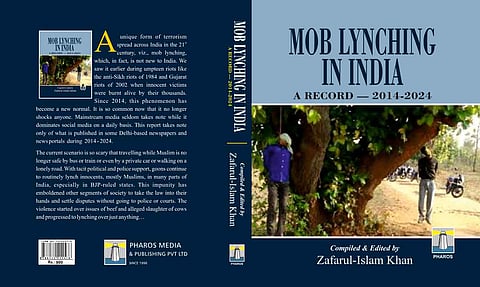
The focus of the last chapter of Zafar-ul-Islam’s ‘Mob Lynching in India: A Record - 2014-24’ - ‘Indian Civil Society, States and Union Laws on Mob Lynching’ is the ‘sharp and steady rise in mob lynching cases since May 2014 elections which brought BJP to power with a clear majority for the first time’ and Hindutva Supremacist forces getting emboldened to ‘implement their long term agenda’. (p. 75)
It does not need repeating how the second Supremo of RSS Golwalkar had clearly given an outline of this agenda way back in 60s, only when RSS was trying to draw attention of Indian masses towards its vision of Hindu Rashtra. It was a period when it was still trying to make a clean break from its past of non-participation or even opposition to the anti-colonial struggle and the assassination of Mahatma Gandhi, as made absolutely clear by then Home Minister of India Sardar Vallabhbhai Patel. Golwalkar, in his ‘Bunch of Thoughts’, had (in)famously talked about ‘Internal Enemies’ and focused his attention on Muslims, Christians and Communists.
As is obvious from these ramblings, one main point of this agenda was to ‘demoralise Muslims’ and force them to accept Hindu superiority in every walk of life and live like second-class citizens. Lynching of hapless Muslims found on roads, parks, etc., was one of the main ways to force Muslims to accept an inferior status. As explained earlier, the Central and State governments, judiciary, media as well as civil society largely ignored this menace, which had no compunction in using unsubstantiated claims that Muslims consumed beef or failed to chant ‘Jai Shri Ram’. Neither the government nor the judiciary felt it important to take urgent steps - right from issuing a clear-cut order to the law-and-order machinery to make new laws to prevent this menace.
What was further disturbing to note was that the ruling dispensation 'did not keep any database which would help analyse the phenomenon, study it and appreciate its seriousness' ..' to hide lynching and violent hate crimes'. (p. 76) It was its sheer failure to do so which contravened its constitutional responsibilities and can easily be construed as its complicity in these targeted attacks.
The National Human Rights Commission, which was constituted to ensure justice delivery and also document miscarriage of justice did not prove better. It omitted sub-heads of mob lynching, murders ordered by the Khap Panchayats and murders committed for religious reasons from its annual reports. The Indian government supposedly had no qualms that it had failed to comply with its international human rights obligations to ‘protect victims under Article 27 of the International Convenant on Civil and Political Rights to which India is a signatory.’ (p. 76)
The failure of the government was clearly visible but instead of making a course correction it even ‘stalled civil society’ private members and state initiatives to enact laws against lynching, emphasising that ‘lynching is not mentioned in the Indian Penal Code (IPC). Secondly, since law and order are state subjects, no central law can be enacted’. It was a way to avoid enacting a specific law to combat mob lynching as these criminal assaults and targeted killings were carried out by people close to the saffron brigade at the centre as well as various states.
Judicial Delays
As far as the highest courts are concerned, it took more than four years for the Supreme Court to condemn lynching when it characterised lynching as “horrendous act of mobocracy” (17th July 2018) and it also issued directives on the preventive, remedial and punitive measures to control the menace. It is a different matter that the Central government did not try to take up any significant measures to rein in these acts of mobocracy and kept dilly-dallying around the issue. To pressurise the government and fill the legal void, civil society came forward to unveil a draft law to address the menace of lynching. (p. 79)
What was also noticeable was that the Supreme Court’s clear directions prompted some states to promulgate anti-lynching laws, but these could never become active laws as state governor - all appointees of the Central government - refused to sign them into law on one pretext or the other. (p. 80)
Finally, the union government did enact a new criminal law - Bharatiya Nyay Sanhita (BNS) - passed by Parliament in December 2023, which came into effect in mid-2024 and replaced the Indian Penal Code of 1860. BNS did include lynching but did not name it. It was passed despite the previous BJP government’s claim that ‘law and order are a state subject’.
The ruling dispensation's apathetic attitude towards mob lynching menace which had emerged since its ascent to power at the centre (2014) was evident because it took five years for it to frame a law after Supreme Court’s prodding.
The clauses of BNS which deal with mob lynching left much to be desired.
One, it seems to dilute the menace by ‘stipulating that the section will apply when such a crime is committed by at least five persons’ (p. 81) - as it excludes solitary hate crimes. The brutal killing of Mohammad Afrazul in Rajasthan by Shambhu Raigar was a clear example of such gory crime.
Perhaps the lawmakers conveniently glossed over the fact that ‘essence of what distinguishes these crimes is not the numbers of attackers but the motivation of hate behind the crimes’.
Two. It is also silent about quantum of fine and the compensation which should be paid to the victim or his/her descendants.
The report further compares the draft laws by civil society, states and the BNS and ends with recommendations directed towards victims and their relatives, state administration, civil society, Government of India and the international community.
It asks the victims and their relatives to bring the crime to the attention of the police, media and civil society groups and withstand all pressure and inducements by the police, criminals etc to withdraw the case as it will encourage criminals to continue their crimes.
For the State administration it appeals to ensure speedy investigation and prosecution of the perpetrators and instigators of lynching, investigate hate speech and hate crimes. Its recommendation to the government of India is to enact a more stringent law for lynching, as the present BNS is too weak to fight the menace and also make bail most difficult for persons indicted in lynching, mob violence and hate crimes.
It also asks the government to enact a strict law against hate crimes, including propagation of hate and Islamophobia through social media which, in most cases, leads to lynching and mob violence.
As far as the international community is concerned, it asks the human rights organisations to diligently monitor hate crimes in India, encourage India to investigate and prosecute perpetrators and instigators of hate crime, and encourage India to abide by its commitment to relevant international instruments.
As already mentioned, after these introductory chapters to the phenomenon of lynching, which have seen a spurt in the last more than one decade, the massive 750-page report includes details of 1748 cases spread across 630 pages.
Appendix of the book takes up ‘Fact finding report on Dadri (Akhlaq) Beef Rumour Lynching’ and also presents extracts of editorials in some newspapers on lynching.
Organized Psychopaths
Fergal Kane, a BBC journalist, wrote these lines in his book Season of Blood: A Rwandan Journey:
A few gave the appearance of being truly psychopathic individuals. The mass of others were ragged and illiterate peasants easily roused to hatred of the Tutsis. Perhaps the most sinister people I met were the educated political elite, men and women of charm and sophistication who spoke flawless French and who could engage in long philosophical debates about the nature of war and democracy. But they shared one thing in common with the soldiers and the peasants: They were drowning in the blood of their fellow countrymen.
It sends a chill down one’s spine. The organised and planned killing in Rwanda resulted in the death of 8 lakh Tutsis in 1994. It was one of the darkest episodes of the last decade of the 20th century.
The echoes from Rwanda to India are loud.
Violence is a fact of life in India. Surely this violence must be blamed both on the actors of violence, the fanatics on the streets, and on the deep social roots that generate this violence.
This massive report that documents mob lynching during the decade 2014-2024 is a testimony to this violence against the socially and religiously marginalised sections and women of our society. The data presented is evident that in this ambiance of hate nobody is safe if there is no radical rupture to whatever is happening around us under the name of politics. The case studies presented have a significant number of non-Muslims, Dalits, Hindus, Christians etc and it should become a wake-up call for all of us.
Learned and concerned citizens from different parts of the country should try to propagate the findings widely; maybe efforts can be made to summarise the main observations and findings.
It is really very important that this report is widely read and discussed among thinking people of this part of South Asia who still yearn to reinvigorate the Republic of Hope, which we entered more than 75 years ago, and not let it turn into Republic of Hate which the supremacist forces have envisaged for us.
Have you liked the news article?
Support us now:
https://www.gofundme.com/manage/jammu-kashmirs-sole-independent-voice-under-threat