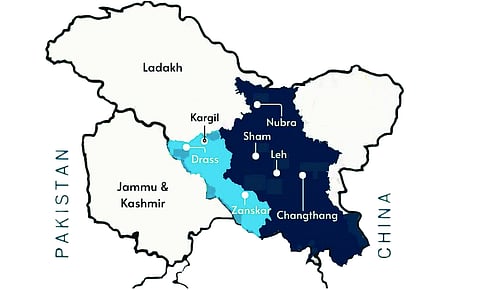

The creation of five new administrative districts carved out of Ladakh's existing two - Leh and Kargil - has once again made this high-altitude Indus Valley desert a subject of intense political scrutiny.
The reorganisation, coming in the wake of Ladakh's conversion into a Union Territory on August 5, 2019, was presented as an administrative rationalization. But in a region where every boundary drawn has historically carried the weight of identity, demography and grievance, the new map has reopened questions that were never settled.
A Region Always Contested
Ladakh's troubles with governance long predate the current moment. The region lost its centuries-old sovereignty when the Dogra Army occupied it between 1834 and 1842, inaugurating what many Ladakhi, particularly its Buddhist population, experienced as an unbroken era of insecurity, identity anxiety and demographic fear.
During the freedom movement against the Dogra Maharaja's rule, Buddhist elites and religious institutions had largely aligned themselves with the Maharaja, wary of the predominantly Muslim character of the independence movement sweeping the state. The partition of the subcontinent in 1947 reshuffled these allegiances in unexpected ways.
Among the most vivid figures to emerge from this period was Kushak Bakula Rinpoche, a monk-politician of rare charisma who was elected to the Constituent Assembly as a National Conference candidate. In those early legislative sessions, he would speak with extraordinary boldness: at the mere mention of Sheikh Mohammed Abdullah's name, Bakula would launch into scathing criticism, met with the enthusiastic desk-thumping of fellow legislators, until a member from Kargil alerted them to what exactly was being said.
Bakula had been delivering his speeches in Ladakhi, a language his audience did not understand. It was a moment that captured something essential about Ladakh's place in the new state: present at the table, but not quite heard.
Decades of Neglect
Successive governments paid no credible attention to the integration of Ladakh's communities into the mainstream. The financial allocations directed toward the region remained inadequate relative to its genuine needs, and no serious effort was made to build a decentralized, empowered administrative framework that might have given Ladakhis meaningful agency over their own affairs.
Sheikh Mohammed Abdullah, in 1980, indicated to his Cabinet a plan for upgrading Ladakh into a division, but spontaneous protests in Kargil thwarted its implementation. Kargilites demanded headquarters for the division at Kargil on the logic of it being equidistant between Srinagar and Leh.
Earlier during 1972-74, Syed Mir Qasim deputed Ali Mohammed Naik, an independent MLA with a Plebiscite Front background, to Kargil for deliberations with local religious leadership for persuading them about societal transformation through literacy, particularly in women. A decisive push remained elusive in the half-hearted endeavours.
A significant opportunity was missed in 1978, when Ladakh could have been elevated to the status of a full Division, with Kargil simultaneously carved out as a proper district from its parent district of Leh. Instead, the creation of Kargil as a separate district was not received graciously by the Buddhist community, who read it as a communal partition of Ladakh designed to dilute Buddhist demographic identity. The bitterness lingered.
What eventually created some functional continuity was a four-pronged arrangement: the establishment of two Hill Development Councils with Plan Outlays, budgetary allocations, on clearly defined criteria, and a convention of including two ministers from Ladakh in the Council of Ministers. This framework, even though imperfect, had moderated the urgency of the Union Territory demand, until the BJP chose to revive and amplify it for its own political purposes.
It is important to point out that no responsive state can afford the discontentment of any society, especially in the border areas, which can be more vulnerable to outside exploitation.

Why the New Districts Are Contested
This is the context in which the creation of five new districts must be understood, and why it has generated suspicion.
Ladakh's Muslim community, which constitutes a slender majority of the region's population, finds itself feeling newly marginalized in the current phase of administrative reorganisation. A demographic dissection of the region will shed some light on this.
According to the 2011 Census, Leh and Kargil had populations of 133,487 and 140,802 respectively - a combined 274,289. But this figure includes 35,486 Hindus and Sikhs who, by their own mother-tongue declarations, are not native Ladakhis; most are central government employees, seasonal workers on temporary tenures, who were simply present during enumeration.
In the Electoral rolls of Ladakh, few families from rest of J&K are recorded as electors. These can be counted on fingers, and they are Permanent Residents of the erstwhile state. On the contrary the non-native segment of people comprises Central government employees and other categories of workforce who had been living in the two Districts (now seven) for periods exceeding six months during the census enumeration 2011. By now, most of them may have returned to their native places and have been replaced by new arrivals. Postings are tenure based temporarily for non-natives and unskilled labourers are seasonal only.
Crucially, Ladakh's Domicile Rules are prospective rather than retrospective, meaning non-Ladakhi residents will not become eligible for domicile certificates until 2035-40. Strip out the 35,486 non-natives and the actual settled population falls to 238,803 from 274,289, with Leh at 109,434 and Kargil at 129,369.
These numbers matter. If population and permanently inhabited villages are to be the twin criteria for creating new districts as administrative logic demands, and as the example of Delhi's eleven districts across a mere 1,483 square kilometers suggests, then Kargil's larger native population and Leh's vastly greater area should have produced rough parity in how additional districts were distributed between them. They did not.
Five of the seven new districts have ended up with Buddhist majorities, and that asymmetry has not gone unnoticed.
The Zanskar Aberration
Nowhere is the suspicion more pointed than in the case of Zanskar.
The population of Buddhists in Kargil is 20,126, mostly residing in Zanskar which is connected with Kargil and Leh, involving a surface distance of 240 kilometers and 275 kilometers respectively. In Leh, the Muslim population is 19,057 but is spread across Leh (3/4th) and Nubra (1/4th) with a few households in Sham, though none in Changthang. Since the Ministry of Home Affairs had already sanctioned five districts without any public feedback, including none from Hill Development Councils, the Committee on fixation of boundaries amongst the districts had a limited mandate. The Committee evidently has adopted territorial jurisdiction positions of sub-divisions of Nubra, Zanskar and Drass for the districts, but reminiscent of partition woes in case of Zanskar.
The village of Rangdum, administratively part of Tehsil Sankoo in Kargil district, has been detached from its natural jurisdiction and folded into the new Zanskar district, the stated rationale being the presence of a monastery in Zanskar and Buddhist settlements in the village. It is precisely this kind of boundary adjustment, whatever its administrative justification, that feeds the fear that the reorganisation is being shaped by communal geography rather than administrative need. The sooner it is corrected, the less damage it will do.
Civilizational Bonds and Political Suspicion
There is a broader anxiety at play here. Given Ladakh's deep spiritual, cultural and geographic ties with Jammu & Kashmir - from the Fourth Buddhist Council held at Harwan in Srinagar under Kushan King Kanishka in 72 AD, to the Buddhist sites at Zanipur, Ushkur and Parihaspur in Baramulla —-the majority of Ladakh's population will inevitably remain bound to J&K in some form. For Muslims, Kashmir carries a weight that transcends administration. These affinities are not a loyalty problem; treating them as one would be the real error.
The people of Kargil fiercely opposed separation from the erstwhile state, and have since reconciled conditionally, pending fulfilment of demands jointly presented to the Ministry of Home Affairs by Leh and Kargil's leaderships. That reconciliation is fragile. The Buddhist Students Association's threat, issued from Jammu amid the post-2019 celebrations, to push for a "Greater Ladakh" absorbing Zanskar, contiguous Kargil villages, Padder from Kishtwar and areas from Himachal Pradesh was noted and not forgotten. The creation of a separate Zanskar district, and particularly the Rangdum boundary decision, has only sharpened that memory.
The apprehensions in the minds of people are logical outcome of the 2019 actions and have further intensified with the five districts ending up as Buddhist majority ones.
As an aside, Gilgit-Baltistan covers an area of 72,496 sq kms and is administered through three Divisions and 14 Districts. Cartographically, the region is considered part of Ladakh. However, this designation applies only partially. Of its three Divisions, only Baltistan has a historical connection to Ladakh, having once served as Ladakh's winter capital. The Gilgit and Diamer Divisions, by contrast, were never part of Ladakh in any administrative or historical sense.
The Way Forward
In order to strengthen administrative equity and self-governance in Ladakh, the following measures are recommended:
· The Ministry of Home Affairs may consider creating an eighth district by designating Sankoo as a new district. This would rebalance, to a great extent, the current skewed ratio of 4:3 between the two sub-regions and 5:2 between the two religious communities, by bringing it to a more equitable 4:4 and 5:3 matrics respectively.
· To preserve and give lasting recognition to the distinct identities of Leh and Kargil, Ladakh's current single Division should be reorganised into two Divisions. The proposed Leh Division would comprise the districts of Changthang, Leh, Nubra, and Sham, while the proposed Kargil Division would encompass Drass, Kargil, Sankoo (as proposed above), and Zanskar.
· A four-tier self-governance model should be introduced to decentralize administration and empower local bodies at every level. The four tiers would consist of the Panchayat, the Block Development Board, the District Development Board, substituting Hill Development Councils, and a newly established Ladakh Divisional Development Board at the apex. The Ladakh Panchayat Raj Act and the Ladakh Hill Development Councils Act need to be amended to comply with the roadmap suggested, apart from vesting the powers in the apex bodies of Leh and Kargil - similar to how these powers are exercised by the ministers in Union Territories of J&K, Delhi & Puducherry.
(This news article has been updated with corrections and additions in some paragraphs)
Have you liked the news article?
Support us now:
https://www.gofundme.com/manage/jammu-kashmirs-sole-independent-voice-under-threat