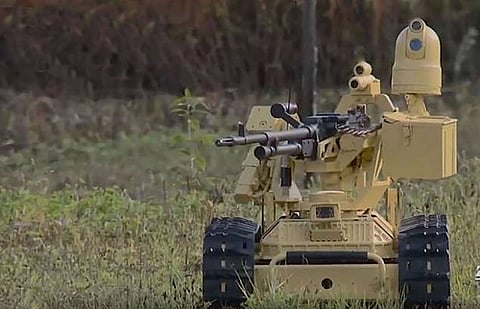


The new Mandarins of war are being stress-tested in the Tibetan plateau, where the oxygen level depletes and the mercury plummets, as squads of unmanned ground vehicles advance across permafrost. Overhead, a swarm of autonomous drones map the terrain, invisible and inaudible to the adversary.
These are the new ‘soldiers’, part of Beijing’s accelerating drive to dominate the battlespace through artificial intelligence and robotics, which is an ambitious programme.
This technological surge is not occurring in a vacuum. It coincides with China’s assertive geopolitical posture, particularly across South Asia, where geographical contiguity with most SAARC nations offers a natural sphere of influence.
A pressing question for the troubled regions of South Asia and the Middle East arises as Beijing exercises this new form of power. Does this automated ascendancy provide a novel, objective means of mediating and resolving disputes, or does it simply add a more volatile and unpredictable element to the already complicated disputes? Essentially along the McMahon Line (LAC), it poses a new challenge to India.
A Warfare Powered by AI
The images from Chinese military exercises are deliberately circulated through their state media and defense journals. These include rugged, dog-like robots trotting alongside infantry across glaciers, unmanned tanks conducting coordinated manoeuvres, AI-enabled command systems parsing vast data streams to make targeting decisions in microseconds.
The current trials are China’s ultimate testing ground. If these systems can operate in some of the planet’s most hostile environments, they can operate anywhere.
This represents a doctrinal leap, not just an incremental upgrade. In this ‘intelligentised warfare’, superior decision-making power, made possible by AI and autonomous systems, is what matters most. Human soldiers are elevated from riflemen to supervisors, with machines forming the tip of the spear.
The investment is colossal. While exact figures are opaque, the Pentagon’s latest report on Chinese military power notes that Beijing is likely spending billions annually on AI-related research, with a significant portion dedicated to unmanned and robotic systems. A desire to secure what planners refer to as full-spectrum dominance in any potential conflict, particularly over Taiwan or in the South China Sea, is the driving force.
Both goals are aimed at countering traditional US strengths in manned platforms. However, the goal goes beyond immediate theatre. Technology itself is a commodity of influence. For nations lacking the capacity to develop their own advanced arsenals, China’s export-ready robotic and electronic warfare systems present a compelling, and often more politically palatable, alternative to Western suppliers.
The SAARC Chessboard
This is where geography and strategy fuse. China has land borders with Pakistan, India, Nepal, and Bhutan, all members of the SAARC, and it also has close maritime ties with Sri Lanka, Bangladesh, and the Maldives.
This proximity is more than just topological. It is actively wired with digital and physical infrastructure, including the digital corridor of the Belt and Road Initiative (BRI), fiber-optic networks, and ports with the potential for dual use.
According to regional strategic experts on South Asian security, China's geographical contiguity is being leveraged into technological and strategic contiguity. The offering is a package of infrastructure loans, surveillance technology for internal security, and now, potentially, advanced unmanned systems for border patrol and conflict.
It is an integrated solution to both development and security concerns for capitals from Islamabad to Dhaka. Pakistan, China’s ‘all-weather friend’, is the primary beneficiary and testing laboratory. It already has unmanned aerial vehicles (UAVs) made in China patrolling its borders. The next step could involve ground-based robotic sentries along contested zones.
The allure of cutting-edge, AI-driven border security systems is significant for Nepal and Bangladesh, which face their own internal and external pressures, bringing them further into Beijing's technological orbit. The great exception, and the ultimate target of much of this posture, is India. The long, disputed Himalayan border has seen deadly clashes in recent years.
China's introduction of robotic forward observers and autonomous surveillance systems carries the potential to fundamentally alter the tactical domination. It could result in a front line that is permanently manned and emotionless, thereby reducing China's risk of immediate human casualties and putting more pressure on Indian forces.
Does this create constant, frictionless coercion? The dispute is not resolved. Instead, it is automated, which in some ways makes it more difficult to resolve. The point of contact no longer contains the human element necessary for de-escalation.
The Electronic Umbrella
Domination by electronic warfare (EW) is fundamental to this robotic push. The concept is to create an ‘electronic umbrella’ over a region, jamming communications, spoofing GPS signals, and hacking into enemy networks. Combined with robotic forces, it forms a nightmarish scenario for an adversary; a blinded military facing intelligent machines that communicate on a secured, unhackable network.
In South Asia, this capability could be deployed to shield allies or pressure neutrals. According to some reports, Chinese EW assets based on Pakistani soil or flying from the Tibetan plateau were made fully operational during the May 2025 India and Pakistan confrontation.
Additionally, the integration of Kaan HALE, a sophisticated hybrid manned-unmanned combat aircraft into the Turkey-Pakistan axis deepens this qualitative shift. Islamabad has also established Rocket Force. This represents a leap beyond the purely unmanned systems, merging AI-enabled autonomy with human cognitive oversight for complex, deep-strike missions. The capability significantly extends Rawalpindi’s operational reach and penetration against integrated air defenses, forcing adversaries to contend with a more resilient layer of warfare.
However, the Chinese new paradigm would be a game-changing intervention and is a power projection without a visible footprint, deploying a signal rather than aircraft carriers. Importantly, the susceptibility to such dominance is exponentially higher for nations whose digital infrastructure and 5G networks are constructed in China.
The Middle East Calculus
The Middle East presents a different, yet equally critical, theatre. China has maintained a cautiously pragmatic stance, avoided direct military entanglements, and cultivated economic ties with all sides, from Iran to Saudi Arabia. A new option exists in its growing military-tech prowess. Beijing's role in facilitating the Iran-Saudi détente shows that it has positioned itself as a potential neutral broker.
Could its advanced surveillance and monitoring technology provide the backbone for new, more reliable ceasefire verification mechanisms in Syria or Yemen? China could theoretically supply and maintain autonomous drones that would operate under a UN or multilateral mandate and monitor borders and troop movements with impartial precision, providing a tool for building trust.
There is a theoretical appeal. A regime in Riyadh or Abu Dhabi might see Chinese AI-powered border security as a more reliable, long-term partner than a politically fickle Washington. It promises stability through technology.
However, the negative potential is significant. The same robotic and EW systems are ripe for export to the region’s volatile states.
Imagine autonomous armed drones, less constrained, however flawed, by the protocols of human operators, in the hands of multiple adversarial states. Imagine electronic warfare systems that could, with the flick of a switch, disable the oil infrastructure or financial networks of a neighbour.
The Middle East’s conflicts are already proxy wars. Introducing advanced, opaque AI systems could create a new breed of proxy, one that acts with unpredictable autonomy.
In addition, China's ‘leadership role’ is primarily economic and strategic, not ideological. It would use its technology to safeguard its investments and allies, not necessarily maintaining a rules-based order.
A powerful new technological tool used by a party with its own specific interests is just as likely to distort and make things harder to work out than it is to solve the tangled conflicts in the Middle East.
The Human Cost of the Automated Peace
Beneath the geopolitical calculus lies an ethical abyss. The hostile environments test hardware and software, but they do not test the moral framework for automated conflict. There are no universally accepted guidelines for autonomous weapon systems. Along with the United States and Russia, China has opposed binding international treaties that would regulate them.
As a result, this leadership in robotic warfare is leading to a terrifying ambiguity. A border incident triggered by an autonomous sensor, escalated by an AI’s rapid decision-loop, could spark a major conflict before human diplomats have even been alerted.
With a perilous illusion, the dehumanization of the battlefield may lower the threshold for violence, making conflict appear more manageable and politically cost-effective. What we are witnessing is the militarisation of AI at a pace that far outstrips our ethical and legal development, warn AI experts.
China is writing the playbook for this new era of conflict through practice and it may demonstrate the system’s endurance, but this does not reveal anything about our endurance in relation to the world they are creating.
The Mandate of the Machines
The message is clear as Beijing's robot armies finish their winter trials, the competition between great powers will be automated in the future. This technology enhances China's natural geographical advantages in South Asia, enabling it to exert persistent pressure without mobilising a million soldiers. It is a strategy of managed friction. In the Middle East, it offers a dual-edged sword, as a tool for potentially stabilising monitoring, or as the most dangerous export to a region drowning in weapons.
In the end, intent determines whether this power resolves disputes or exacerbates them. And China’s intent, as ever, is opaque. Its technological leadership is not coupled with a vision for global security governance that the West would recognise. It offers efficiency, not ethics. It offers control, not conflict resolution.
As a nation bent on making its own rules, wields the sharpest end of power made of steel, silicon, and algorithms, is the international community ready to deal with its unimaginable consequences?
Have you liked the news article?
Support us now:
https://www.gofundme.com/manage/jammu-kashmirs-sole-independent-voice-under-threat