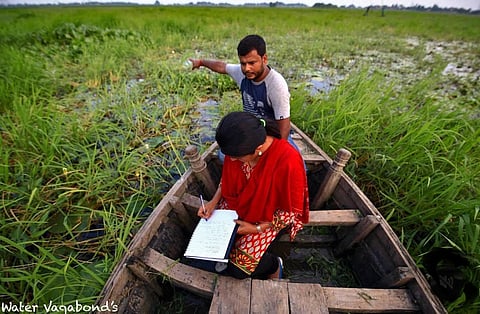


While the world obsesses over machine learning and artificial intelligence’s (AI) predictive data points, I spent a significant part of 2025 in rural India documenting grassroots stories, the kind that AI algorithms systematically ignore.
Three Ts governed my journey—Travel, Tribal, and Training. As an environmental journalist, I felt the urgency to report on the lived realities of the people and the planet instead of relying on information coming out of ‘content creation’.
From the coalfields of Jharia in Jharkhand and the sacred hills of tribal communities in Odisha, to the villages of Tripura, the reporting assignments I went on were a masterclass in grassroots agency, which no journalism school can teach. I met the real faces of climate resilience, who were so much more than just data points. The message I brought back with me was clear — the community is the first line of defense in the war with climate change.
My travels to villages in Marathwada (Maharashtra) and Odisha uncovered a quiet but growing revolution of self-dependence and collective action. In the tribal areas in Mayurbhanj, Kalahandi, and Bargarh districts of Odisha, I witnessed how gram sabhas (village institutions) are coming together to form larger rural collectives that not only practise decentralised planning but also implement progressive farming techniques and forest governance.
In the Kankadahad block of Dhenkanal district in Odisha, emerging from the shadow of violent conflict of Naxals, a federation of 130 gram sabhas is scripting rules of forest protection and trade in forest produce for improved livelihoods.
Similarly, 43 tribal villages inside Similipal Tiger Reserve in Odisha have got together to stand up against eviction and relocation from the tiger reserve, which is their ancestral home.
This year also taught me that while government dashboards may boast of progress, the ground reality often tells a “cruel truth.” In Tripura, where official data shows over 86 per cent functional tap water coverage, I found tribal women still trekking through steep terrain to fetch water from mountain springs because the taps back home were never connected to a pipeline, or discharge contaminated water.
My experiences only reinforced what I always believed. Environmental journalism cannot be outsourced to algorithms or government press releases. Content creation cannot replace ground-up reporting. As journalists, we must travel to these far-flung edges not just to verify facts, but to ensure that the most vulnerable aren't erased by a digital percentage point.
In an age of quick dissemination of misinformation and disinformation through social media and WhatsApp channels, media platforms need to invest in and scale up grassroots reporting because large chunks of facts never get recorded and reported.
AI models keep echoing and regurgitating information based on limited data points on which they are trained. Newsrooms today heavily depend on AI to curate content and dish out stories at breakneck speed that do not require any human intervention.
I am no Luddite, nor am I "anti-AI." In fact, I am currently immersed in a 10-week programme by Google News Initiative AI Skills Academy to better understand how these tools can strengthen journalism, not substitute it. I now see the immense potential for AI to act as a force multiplier in the newsroom—helping us parse massive datasets on electoral results, air quality, deforestation patterns via satellite imagery, or automate the mundane tasks that eat away at a reporter's time.
When used ethically, AI can help us see the big picture of the climate crisis more clearly than ever before. However, a lens is not the eye, and a data point is not the truth. And, AI must never—and can never—replace ground reporting.
If we allow algorithms to become our primary narrators, we run the risk of erasing the lives of millions. An AI model trained on mainstream datasets will never see the Adivasi woman in a remote forest of Kalahandi, or the jhum farmer practising shifting cultivation in Tripura, just because their lived experiences aren't digitised.
Watching Humans in the Loop last night reminded me about why as an environmental journalist I chose the road over the dashboard. The film’s protagonist, Nehma, an Adivasi woman from Jharkhand, captures the fundamental crisis of our digital age: the erasure of indigenous wisdom by the binary logic of algorithms.
When Nehma refuses to label a caterpillar as a "pest," she isn't just being difficult; she is asserting a generational worldview where nature is a symbiotic partner, not a resource to be sanitised. To the AI, the caterpillar is a target for a pesticide drone; to Nehma, it is a creature that eats only the rotten bits of leaves so the rest of the plant can survive.
Bottom-up reporting is the only antidote to this “algorithmic colonialism”. If we rely on government dashboards and tech-driven climate solutions that often ignore traditional knowledge of indigenous people, we risk scaling up these very biases. Our job, thus, is to keep these “humans in the loop”, documenting the nuances that machines are incapable of discerning or just designed to ignore.
Training is the final, and perhaps most vital “T” of my 2025. While ground reporting is the heartbeat of our craft, it is often a lonely and uphill battle for those writing from the most remote corners of India.
Grassroots journalists are our first responders to climate change, yet they frequently lack the formal support, scientific vocabulary, and digital tools to translate local struggles into stories with global resonance.
Training isn't just about polishing prose; it is about empowering rural reporters to bridge the gap between traditional knowledge, people’s lived experiences, and climate science.
So, my role as a co-mentor for the VOICE Fellowship (Voices of Impacted Communities and Environments), under the CARE Project (Communicating Action and Resilience for Environmental Health in India) at IISER Pune, is one I took very seriously.
From December 16-20, the VOICE Fellowship brought together a diverse cohort of 40 grassroots journalists and communicators from across India for an intensive residential programme. It was an initiative led by Shalini Sharma, a social scientist and associate professor at IISER Pune, to help regional communicators report on the complex intersections of climate change and public health—from respiratory disorders due to air pollution to its invisible toll on mental health.
Watching these grassroots journalists, many of whom work in regional languages and in underserved districts, engage with scientists and public health researchers was a powerful reminder of what is possible when we invest in strengthening the local voices.
Vital climate stories aren't found in cold statistics slapped onto glossy pitch decks. They are found in the voices of people who live closest to the land, and community reporters who have their ear to the ground.
We need to continue listening, and training the next generation of sentinels. In the end, the survival of our planet hinges not on the efficiency of our algorithms, but on our ability to hear the grassroots stories the machines ignored. These stories of climate resilience exist beyond the world of large language models (LLMs).
Have you liked the news article?
Support us now:
https://www.gofundme.com/manage/jammu-kashmirs-sole-independent-voice-under-threat