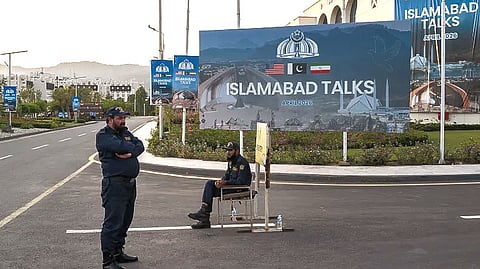


The talks were never supposed to happen in Islamabad. Geneva was the preferred venue. Muscat was the fallback. But by the first week of April 2026, with oil at $144 a barrel for Brent crude and global supply chains in diplomatic haemorrhage, neither option was viable. Europe was paralysed and China hesitant. And so, the United States and Iran found themselves in the Margalla Hills, the talks hosted by a country most had written off.
The three days of talks that followed, from 10 to 12 April 2026, did not produce a treaty. American Vice President JD Vance and Iranian Foreign Minister Abbas Araghchi did not embrace. They shook hands for 47 seconds across a table, with Pakistan's Prime Minister Shehbaz Sharif and Field Marshal Asim Muneer standing as guarantors.
The one-page joint statement, reiterating that dialogue is necessary, made no concrete commitments. It emerged as a tactical pause to manage tensions rather than resolve core disagreements, keeping channels open for future engagements and indirect ones. The inconclusive dialogue left open a wide window of opportunity. The light that shines over Margalla Hills carries a different weight.
The Making of an Intermediary
The war had begun on 28 February with a decapitation strike on Iranian Supreme leader Ayatollah Ali Khamenei. What followed was 39 days of conflict that exposed the brittleness of every existing security arrangement.
April 10 marked the reluctant beginning of a shift towards easing tensions. The Americans demanded immediate cessation of all Iranian proxy activity and full IAEA access. Tehran countered with the unfreezing of $60 billion in assets and a permanent end to sanctions. For twelve hours, the two sides refused to share a room.
Pakistani facilitators carried handwritten notes between suites. Chinese and Russian observers sat in adjoining rooms but not at the table. Saudi Arabia and the UAE, whose $15 billion reconstruction pledge had helped make the talks possible, sent quiet emissaries. By evening, a formula had emerged: indirect proximity talks, with Islamabad holding the thread.
The second day nearly collapsed the process entirely. Israeli jets struck a depot near Beirut, killing more than a dozen people. Tehran walked out. Washington threatened to expand its target list. It was Field Marshal Muneer's call to Riyadh, and Riyadh's call to Tel Aviv, that bought three more hours. Pakistan offered a military guarantee. PAF squadrons already forward-deployed in Saudi Arabia would enforce a no-fly buffer if Iran widened the war, while Islamabad quietly assured Tehran that its nuclear sites remained off-limits.
Putin urged strategic patience. Xi reaffirmed logistical support for any deal. By midnight, four pillars had been agreed: an immediate ceasefire in Lebanon, a six-month freeze on US force redeployments in the Gulf, a 15-vessel daily limit through Hormuz with transit fees funding reconstruction, and phased release of frozen assets.
Behind all of this was a mechanism that will be studied by crisis diplomats for years - the Islamabad Air Corridor. In less than 72 hours, Pakistan's Civil Aviation Authority established a demilitarised aerial highway from the Iranian border at Taftan to the Chinese border at Khunjerab and down to the Arabian Sea.
US C-17s and Iranian Mahan Air jets, theoretically hostile belligerents, flew within thirty nautical miles of each other, separated only by altitude and the quiet professionalism of Pakistani air traffic controllers. Over 96 hours, 47 diplomatic flights passed through.
The Americans trusted that Pakistan would not sell their flight plans to the Chinese. The Iranians trusted that Pakistan would not tip off the Pentagon. That double-sided trust, vanishingly rare in international relations, made everything else possible.
The Age of Asian Agency
The ceasefire is two weeks old, and nobody pretends it will hold forever. Iran's Revolutionary Guards retain their arsenal. Proxies in Yemen and Iraq have partially pulled back. Washington has quietly moved two carrier groups deeper into the Indian Ocean, signalling deterrence without escalation. Israel, sensing Gulf abandonment, is accelerating normalisation with select countries. The war's long tail will stretch into 2027 and beyond.
The questions are: Will oil settle at $90–110, permanently above pre-war levels? Can global supply chains route around the Strait of Hormuz, hastening the shift toward friend-shoring? Will climate negotiations carry new urgency, now that the Gulf crisis has made it clear that energy interdependence and climate interdependence are the same thing? Nuclear proliferation fears will deepen, as demonstrated by Saudi Arabia already floating "peaceful" enrichment rights.
But the war's most consequential legacy is geopolitical. Unipolarity as opposed to America's capacity to unilaterally dictate outcomes. Multilateralism, long dismissed as naive, proves to be the only exit ramp. At the same time, Asia’s significance has emerged.
Asia did not start this fire. But Asia tried to put it out. China applied quiet pressure on both sides. Pakistan extended a diplomatic umbrella over Riyadh, leveraging its unique relationships with both Washington and Tehran, its geography, and the weight of CPEC. India's conspicuous absence spoke loudest of all, signalling that reflexive alignment with the US-Israel axis and the unilateral suspension of the Indus Waters Treaty had cost New Delhi its credibility as an independent actor.
Historians may mark 2026 not as the year Asia triumphed, but as the year it was tested. None of the major Asian powers - Beijing, Delhi, Islamabad - overtook Washington. What shifted was gravity. The continent's internal contradictions began searching for solutions the West could not offer. China won without firing a shot. Pakistan, long marginalised, found unexpected leverage. India, despite 8.2% GDP growth, suffered a diplomatic freefall of its own making.
This is not an Asian century of dominance, but a test of whether multilateralism, the art of managing difference without domination, can replace the exhausted logic of hegemony. It cannot be met while the subcontinent's two largest nations weaponise water and seal their borders. Those rivalries, indulgent in any era, are ones the planet can no longer afford.
Global Impact
The pause in the US-Israel-Iran war finds a resonance across the globe.
In Europe, the €4-a-litre petrol queues and factory shutdowns that had accompanied the war gave way to cautious relief and a difficult reckoning about the cost of strategic autonomy without Asian partnerships. Brussels and Berlin found themselves praising Pakistani statesmanship not out of sentiment but out of need.
In Africa, from the Sahel to the Horn, nations that had watched the Gulf fire with dread now saw that multilateral crisis management could work, and that peripheral voices need not remain peripheral.
In South America, the war's ripple effects had disrupted soya, beef, and copper exports from Brazil to Buenos Aires. BRICS members like Brazil watched with interest as Pakistan demonstrated the value of a peace broker that could speak to both Washington and Tehran simultaneously.
Even Antarctica felt the heat indirectly. Research station resupply delays served as a reminder that global crises respect no geography. The Antarctic Treaty System, already strained by climate pressures, now faces the added weight of resource competition from an Asia in flux.
For North America, the Vance-Araghchi handshake was something of a quiet admission — that the United States cannot police the world alone, that multilateralism is not weakness but realism, and that global outcomes are increasingly shaped by Asian powers beyond China.
The current US-Iran-Israel conflicts highlight how beyond-visual-range (BVR) missiles, AI, and drone warfare have redefined battlefields. Autonomy, stand-off strikes, and real-time intelligence now dominate. Another example is the India-Pakistan confrontation in May 2025, which lasted 88 hours. A common lesson for the world from the ongoing conflict is this: there is no future without peace and diplomacy.
As Kashmiri wisdom reminds us: akh gaye kath, baikh gaye lath. One word saves a hundred blows. True resolution grows from dialogue, not dominance.
What This Means for Asia
The Islamabad moment cannot be fully understood without its Asian context — and that context is the source of both its significance and its fragility.
Pakistan's role in brokering the talks was built on a unique combination of geography, nuclear deterrence, and relationships that span Washington and Tehran, Riyadh and Beijing. It leveraged the China-Pakistan Economic Corridor, its position as a country that could speak to the East and the West without losing credibility. For a country still in economic intensive care, with domestic politics simmering and its diplomatic capital newly and unexpectedly earned, this is a fragile dawn.
New Delhi's reflexive alignment with the US-Israel axis, compounded by its unilateral abeyance of the Indus Waters Treaty, left it on the margins of an event that took place in its own neighbourhood. An 8.2 percent GDP growth rate means little when the architecture of regional diplomacy is being rebuilt without a presence at the table. South Block silence must now give way to pragmatic reengagement, a series of constructive and composite dialogues aimed at resolving the core disputes, including water and closed borders, that have for too long been treated as immovable facts rather than political choices.
Historically, the subcontinent's two models - India's hedging and Pakistan's survivalism - have both been incomplete. Nehru's non-alignment gave way to strategic ambiguity; Zia's frontline-state opportunism gave way to CPEC dependency. Neither produced lasting stability. What the Islamabad talks suggest, tentatively, is that a third path is available: one in which South Asian nation-states become anchors of a broader Asian multilateralism that includes ASEAN, the Gulf, and Central Asia.
Joint water management from the Himalayas to the Sundarbans, a regional energy grid connecting the Indus to the Mekong, intelligence cooperation against shared threats are the logical extensions of what just happened in the Margalla Hills. SAARC’s corpse can now be exhumed.
The peace remains fragile, and Islamabad Accord may not hold, but the deeper question is whether the moment it created of a non-Western country bringing to the table the world's most dangerous adversaries can be built upon before it dissolves. The age of Asia is not about replacing one hegemon with another. It is about demonstrating that the only viable grammar for the 21st century is unity across faiths, borders, and continents.
Have you liked the news article?
Support us now:
https://www.gofundme.com/manage/jammu-kashmirs-sole-independent-voice-under-threat