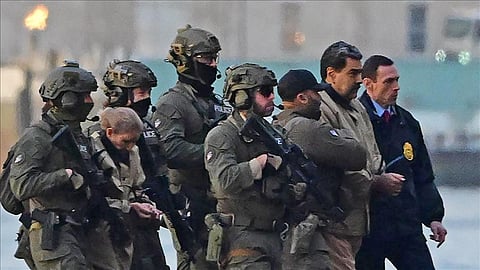


The predawn raid on the Miraflores Palace in Caracas signals not just the bending but also the shattering of post-Cold War rules. The operation by United States forces to apprehend Venezuelan President Nicolás Maduro and his wife represents a seismic escalation in unilateral interventionism. Codenamed “Operation Sovereign Justice,” the mission has sparked a global crisis far exceeding its immediate objective beyond Venezuela's troubled borders.
It strikes at the core of international law, sending shockwaves that threaten to ignite every simmering conflict worldwide. The shadow of a third World War, once unthinkable, now casts a palpable and grim shadow. It hangs like a warning as the world's fault lines are blazing, from the South China Sea to the Eastern Mediterranean, from the Himalayas to the Korean DMZ.
Washington’s framing of the action as ‘protection of democracy’, ‘curbing of a narco-state’, or ‘securing global energy supplies’ rings hollow. This is raw realpolitik; the muscular reassertion of the Monroe Doctrine for the 21st century, and a blatant bid to control the world’s largest oil reserves amidst a volatile energy market.
Global unease over the action is spreading. Protests have flared from Kolkata to Latin America. Moscow and Beijing responded with cold fury. For the Kremlin, this validates their narrative of an unrestrained West that respects no sovereignty but its own. For Beijing, it threatens the Taiwan principle and shatters the non-interference doctrine. The age of norms has ended. The age of naked aggression begins.
Ukraine and the Asian Powder Keg
Russian forces are massing along the front with Ukraine. Western intelligence warns of impending brutality. Moscow sees the Venezuela action as proof of Western hypocrisy—a green light. "Why is Caracas different from Donbas?" ask analysts. "America wrote the playbook, others are learning the script." International constraints are dissolving. It is now feared that Russia may launch a brutal escalation aimed at total subjugation, with tactical nuclear threats resurfacing to break NATO's will.
In Asia, the strategic calculus has shifted. If the US can topple Caracas, what stops them from securing Taipei? Pre-emption becomes seductive. Taiwan's seizure moves from "if" to "when." Satellite imagery has shown a noticeable increase in activity at People’s Liberation Army (PLA) bases facing the Taiwan Strait, and Chinese diplomatic language has shifted from warnings to explicit threats regarding “the full costs of interference”. The South and East China Seas would become instant theatres of potential superpower collision, with Japan, South Korea, Australia, and the Philippines inexorably drawn in.
In another critical Asian flashpoint, the Korean Peninsula, the raid on Caracas validates a decades-old conviction that only an undeniable, deliverable nuclear arsenal guarantees regime survival. In a fiery statement, state media declared the operation “proof that American imperialists respect only the language of absolute force.” Reports suggest that preparations for a seventh nuclear test, potentially involving a tactical warhead, are now complete.
For South Korea and Japan, this creates an impossible dilemma. Their security is irrevocably tied to the USA’s extended deterrence, yet that same ally has just demonstrated a capacity for reckless unilateralism that could trigger a catastrophic regional war on their doorsteps.
Seoul and Tokyo are engaged in frantic, behind-the-scenes diplomacy, urging Washington for clarity and restraint while simultaneously reviewing their own defence postures, with debates over nuclear sharing or indigenous capabilities.
South Asian Dynamics
South Asia teeters on another hair-trigger. The “88-hour war” in May 2025, following a terror attack in Pahalgam and the unilateral suspension of the Indus Waters Treaty, is a glimpse into a nightmare that has already briefly flickered into reality. With limited but direct strikes across the Line of Control and Radcliffe Line from Punjab to Rann of Kutch and a brief naval skirmish, it suggested a terrifying evolution beyond the conventional war playbook.
New Delhi’s strategic posture is one of siege. India feels encircled by neighbours – Pakistan, Nepal, Bangladesh, Sri Lanka, Myanmar – perceived to be under Beijing’s influence. The Venezuela precedent sanctifies a dangerous idea: that overwhelming conventional force can be used to achieve swift, decapitating objectives.
The Caracas episode has rendered multilateral restraint void. A future crisis could prompt India to launch a "limited war" on Pakistani military targets, betting that nuclear thresholds are higher than assumed. But such action would threaten Chinese strategic interests that neither Beijing nor Islamabad can afford to lose. In Kashmir, small conflicts risk massive escalation. The world's two most populous nations, both nuclear-armed, stand on a precipice.
Though the Venezuela incident and Afghanistan-Pakistan skirmishes are geographically and strategically distinct, and a direct or immediate impact is unlikely, both situations risk drawing key powers (US, China, Russia) into regional disputes. This could create a global atmosphere of heightened confrontation.
The Middle East Maelstrom
The Middle East is now a kaleidoscope of shifting allegiances. The reported UAE attack on Saudi positions in Yemen, followed by Riyadh's consultation with Tehran and retaliatory strike on UAE-backed forces, signals a fundamental realignment. The Gulf Cooperation Council is fracturing in real-time. National interests are trumping old alliances.
Saudi Arabia and Iran, the region's arch-rivals, may find grim, pragmatic common ground in their mutual vulnerability to great powers acting with impunity. Their dialogue, facilitated by Oman and Iraq, is less about friendship than mutual survival—a desperate attempt to create a regional buffer against external shocks.
This realignment throws every other conflict into stark relief. In Israel and Palestine, the Netanyahu government may feel emboldened to pursue long-planned annexation or a large-scale military operation in Gaza and the West Bank, calculating that a distracted and morally compromised Washington will offer unconditional support. For the Palestinians, it is a despairing confirmation of a world order that offers them no justice, potentially triggering a violent, despair-fuelled third intifada.
Libya remains carved up between foreign-backed warlords, its patchwork of Turkish, Russian, Emirati, and Egyptian proxies now operating without even the thin veneer of international oversight. Syria, though quieter, is a tinderbox of Russian, Iranian, Turkish, and residual US influence, a frozen conflict easily thawed by a regional spark, such as a direct confrontation between Israeli airstrikes and Iranian Revolutionary Guard Corps units.
Iraq is a fragile vessel pulled violently between Washington, Tehran, and its own internal factions, with powerful Shia groups now openly calling for the expulsion of all remaining US forces, citing the Venezuela precedent as the ultimate sign of American intent.
Turkey, ever the strategic soloist, watches the US action with deep suspicion. Ankara sees it as the ultimate expression of the unilateralism it has often been accused of. President Erdoğan is likely to accelerate his own operations against Kurdish groups in northern Syria and deepen his strategic outreach to Moscow, further straining NATO’s eastern flank.
Qatar, long adept at navigating rivalries, will fortify its diplomatic and gas-powered defences, but even its agile statecraft may be overwhelmed by the tide of realignment.
Somalia and the Horn of Africa, a longstanding theatre for Gulf rivalry and Wagner Group mercenaries, face the prospect of becoming a primary proxy battleground where the new rules of engagement—no boots on the ground, but remote direction and drone warfare—are tested with devastating consequences.
The targeted removals of Saddam Hussein and Muammar Gaddafi were framed as liberation by the West. However, given the complex tribal and sectarian contexts of the Middle East and Africa, their abrupt downfall dismantled state structures without replacing them with stable order, creating power vacuums, escalating regional conflicts, militia rule, and humanitarian crises. These outcomes serve as a cautionary backdrop for external interventions: forced regime change risks triggering comparable chaos rather than peaceful political transition.
Clearly, this was ignored in Venezuela.
A Planet on Edge
The instability it signals extends far beyond traditional conflict zones. It's a pandemic of dread.
Europe is profoundly torn. Eastern members like the Baltic states and Poland may tacitly applaud US vigour as a counter to Russia, while Western Europe faces existential anxiety. The UN Charter principles central to the EU's post-war identity lie in tatters. France and Germany issued an unprecedented joint statement expressing "profound alarm" and calling for an emergency UN General Assembly session, which is a direct rebuke to their American ally. Simultaneous conflagrations in Ukraine, the Levant, and North Africa could trigger a larger refugee crisis, straining European solidarity to breaking point. The continent is ill-prepared, militarily and psychologically, for the storm its Atlantic ally has helped unleash.
Africa faces renewed chaos. With the West and China distracted by potential direct conflict, secondary powers like Turkey, the UAE, and Russia (via Wagner) may expand influence in resource-rich states, from the Sahel's gold to the DRC's cobalt mines. The continent risks becoming a chessboard for chaotic, multipolar competition, where regimes fall for mineral contracts rather than ideology, destabilising entire regions.
South America is rife with indignation. The attack may unsettle Cuba and Colombia, given their historic ties and proximity. Colombia might bolster border security, viewing the event as a direct regional threat. Cuba, a longtime Venezuelan ally, could perceive it as an escalation against allied states, potentially triggering calls for solidarity or increased defensive postures.
The invasion of Venezuelan sovereignty threatens all, regardless of politics. Brazil, Argentina, Chile, and others are reassessing alliances in emergency UNASUR and CELAC meetings. Leftist movements are galvanized. Even right-wing governments, once quietly aligned with Washington, nervously fear populist backlash. The region could unite in anti-US sentiment or fracture along ideological lines, creating new internal conflicts.
North America itself is cleaved. While neoconservative circles champion "muscular leadership," progressives, libertarians, and traditional realists warn of imperial overreach and terrifying blowback. Protests outside the White House have turned violent. Canada faces an acute crisis.
Australia, reliant on US security via ANZUS but economically tied to China, sees its decades-long assumption of US military predictability voided. South Africa will spearhead diplomatic condemnation at the UN, BRICS, and AU, but its voice—and that of the entire Non-Aligned Movement—may be lost in the roar of escalating militancy.
A Wounded World Order
The kidnapping of a president in Caracas is not an isolated event. It is the catalyst that has exposed the rotten timbers of the global order. The system of international law, painstakingly built after 1945, has been critically wounded.
What replaces it is not a new order, but a dangerous vacuum where might makes right, where pre-emption trumps diplomacy, and where regional conflicts are no longer contained by the fear of great power reproach, but are instead incentivised by their example.
The domino impact globally could be of catastrophic miscalculation. We are not yet in World War III, but we have entered its antechamber. The global reactions could well be the tremors before the quake. The path ahead is shrouded in fog, as what little of the guardrails was left is gone.
There is a need to forge new guardrails from the broken fragments of the old, before the world plunges into the dark. Every nation, from the mightiest to the most vulnerable, must now exercise a level of restraint, diplomatic creativity, and assertive commitment to a reformed multilateralism that has been utterly lacking.
Have you liked the news article?
Support us now:
https://www.gofundme.com/manage/jammu-kashmirs-sole-independent-voice-under-threat