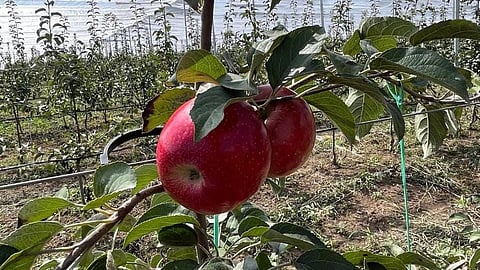


As India and New Zealand inked a free trade agreement recently for granting duty-free or preferential access across a wide range of sectors, it has triggered alarm bells among apple traders in Kashmir.
The anxiety is not limited to one crop or one trade deal. Apple cultivation, along with other horticulture products, has remained the mainstay of Kashmir’s economy and allowed it to breathe through more than three decades of political disturbance, when all other avenues had collapsed.
For tens of thousands of families, apples are not just an export commodity but an economic lifeline. That is why fears of a price crash following increased imports create anxiety. Yet foreign competition alone does not explain why Kashmir apples struggle with price. The deeper issue lies closer to home, in the form of freight and energy costs that should never have been allowed to grow so punitive.
If these two costs were rationalised, Kashmir apples would remain competitive even under partial trade liberalisation. What is presented as a market problem is, in reality, a policy failure.
Freight is the single biggest invisible tax on Kashmir apples. Every box produced in the Valley carries an added burden because growers are forced to depend on a single transport artery. The Jammu–Srinagar National Highway, NH-44, is the only viable route for moving apples to markets. When it closes, as it frequently does due to landslides, weather disruptions, or administrative restrictions, transport costs surge overnight.
Growers pay the price in multiple ways. Delays stretch into days and sometimes weeks. Fruit quality deteriorates. Spoilage rises. Distress sales follow as traders rush to offload stock in mandis before losses deepen. On top of this, freight operators raise rates arbitrarily during peak harvest season, taking advantage of the lack of alternatives.
Imported apples face none of these uncertainties. They move through predictable, often subsidised global logistics chains. Their per-unit freight cost is frequently lower and far more stable than that of apples grown within Kashmir. This is not because they travel shorter distances, but because the system they operate within is efficient and policy-supported.
This disadvantage is not a product of geography alone. After the 2008 economic blockade, the Kashmir Valley repeatedly demanded alternative all-weather routes to reduce its logistical vulnerability. Seventeen years later, those demands remain largely unmet. The result is a structurally inflated freight cost that no individual farmer can control. In effect, freight functions as an economic penalty imposed on production in Kashmir.
Cold Storage and Tariffs
Cold storage and energy costs add another layer of disadvantage. Controlled Atmosphere storage is often promoted as a solution to market volatility, allowing growers to stagger sales and avoid seasonal gluts. In practice, for most apple growers in Kashmir, cold storage is an expensive gamble.
Electricity tariffs are high and unstable. Power supply is unreliable, forcing operators to rely on diesel generators. There is no dedicated agricultural power tariff for storage facilities. These costs are passed on to growers, making storage viable only for top-grade fruit.
Small and medium growers, who form the bulk of the sector, cannot afford to store their produce. They are forced to sell early at lower prices, flooding the market and depressing rates further. Instead of stabilising incomes, storage ends up deepening inequality within the apple economy.
In competing apple-exporting regions, cold storage is treated as strategic agricultural infrastructure. Energy is subsidised. Power supply is stable. Storage is seen as part of food security planning, not merely a commercial service. In Kashmir, growers are expected to compete globally while paying commercial energy rates in a region rich in hydropower.
It is, therefore, misleading to argue that Kashmir apples are uncompetitive. What is uncompetitive is the policy environment surrounding them. When freight costs are inflated due to forced logistical dependence, energy costs make storage punitive, input markets remain poorly regulated, and import duties are lowered without correcting domestic cost structures, the outcome is predetermined.
This is not free-market competition. It is a policy-engineered disadvantage.
The remedies are neither radical nor difficult to identify. Freight rates during peak harvest season can be regulated. Alternate all-weather routes can be developed and operationalised.
Agricultural power tariffs can be introduced for cold storage facilities. Transport and storage can be recognised as food-security infrastructure rather than left entirely to commercial forces.
None of this requires innovation. It requires political intent.
Kashmir apples are losing out not because they lack quality or demand, but because they are made expensive. Freight and energy costs have turned natural advantages into economic liabilities. Until these structural issues are addressed, every cut in import duty will translate into another blow for growers in the Valley.
If these costs are corrected, Kashmir apples can compete fairly and successfully. If not, their decline will continue to be blamed on “market forces,” while the real cause remains firmly rooted in policy.
Have you liked the news article?
Support us now:
https://www.gofundme.com/manage/jammu-kashmirs-sole-independent-voice-under-threat