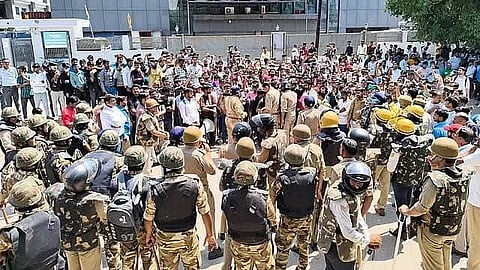


The latest issue (Dated 25 April 2026) of the popular magazine ‘Frontline’ has an incisive article entitled, ‘What Noida’s worker strikes tell us about the Labour Codes’ broken promise’. Written by T K Rajalakshmi, the summary statement says, “The protests by industrial workers across the National Capital Region and adjoining areas and the violence and police repression that followed are telling evidence that despite the hollow promises that accompanied the new Labour Codes, little has changed on the ground”.
The opening paras of the article says it all, “It was waiting to happen. Only the “when” was not clear. The buildings in the industrial areas of the National Capital Region (NCR), with their glitzy interiors, could not camouflage the simmering anger of workers inside any longer. When what started as a small bubble of frustration took on the force of a volcanic eruption, fuelled by the oppressive conditions imposed by hostile employers and abetted by compliant governments, nothing could put a lid on it… Thus, in mid-April, workers poured out of their factories, striking work in the industrial area of the New Okhla Industrial Development Authority (Noida) in Uttar Pradesh, fully conscious of the reprisals and the heavy hand of the state that would come into play as the official reaction to their action. But it was a moment that the workers truly owned, and there was no factory that was unaffected…. There was no coordinated action, no direct union involvement. Yet, it seemed like magic. As per some official reports, workers across 82 factories struck work protesting against the 12-hour, 7-day working week and the harsh and unsafe working conditions within the factories, all for a measly monthly wage of Rs. 11,000 to Rs. 12,000.”
On 21 November 2025, the Government began implementing the four Labour Codes (on Wages, Industrial Relations, Social Security, and Occupational Safety, Health and Working Conditions). Concerned citizens, trade unions and opposition parties label them ‘anti-worker.’ Most regard these codes as favouring the corporate sector. Their ‘anti-worker’ dimensions include ‘the hire and fire policy’; ‘curtailing right to strike’; ‘expansion of Fixed-Term Employment (FTE); ‘diluted safety & welfare’.
The way the NOIDA workers came out in droves to protest their grim reality is a case in point! The Uttar Pradesh government announced a 21% wage hike, but many workers and unions deemed this insufficient. The police have taken legal action against those (apparently several thousands) involved in the violence. On expected lines, the godified media did not highlight the plight and the protest of the NOIDA workers. The situation of the ordinary worker (particularly casual labourers and migrant workers) in India leaves much to be desired: most of them are at the mercy of employers who are exploitative and corrupt. Workers are often denied just wages and have long hours of work. Many do not get appointment letters nor are there the mandatory ‘Service Conditions.’ Trade Unions in India have become almost non-existent. The COVID period revealed the miserable conditions of the working class.
The month of May begins with the ‘International Workers’ Day’. This Day normally focuses on honouring the global workforce, promoting labour rights, and fighting exploitation. The Catholic Church has consistently championed the cause and the rights of workers. On 15 May 1891, Pope Leo XIII gave the world his path-breaking encyclical, ‘Rerum Novarum’ (‘Of New Things’), regarded as the foundational document of modern Catholic Social Teaching. The encyclical addressed the plight of the working class during the Industrial Revolution. It advocates for worker dignity, the right to form unions, and a just wage, while defending private property and rejecting both socialism and unrestrained capitalism.
In his Encyclical ‘Laborem Exercens’ (On human work), Dated 14 September 1981, Pope John Paul writes, “the Church considers it her task always to call attention to the dignity and rights of those who work, to condemn situations in which that dignity and those rights are violated, and to help to guide [social] changes so as to ensure authentic progress by man and society.” Later, on 1 May 1991, he promulgated another Encyclical ‘Centesimus Annus’ (‘The Hundredth Year’) to commemorate the historic anniversary of ‘Rerum Novarum’. It reiterated the fundamental vision, of ‘Rerum Novarum’ and expounded issues of social and economic justice, including a defense of private property rights and the right to form private associations, including labour unions.
In keeping with the significance of the day, the Catholic Church celebrates it as the Feast of St. Joseph the Worker. Pope Pius XII established it in 1955, to honour Joseph as the patron of workers and to celebrate the dignity of human labour.
A year ago, on 8 May, Pope Leo XIV was elected to succeed Pope Francis; he assumed office on 18 May. When asked to explain his choice of name, Pope Leo said, “I chose to take the name Leo XIV. There are different reasons for this, but mainly because Pope Leo XIII in his historic Encyclical ‘Rerum Novarum’ addressed the social question in the context of the first great industrial revolution. In our own day, the Church offers to everyone the treasury of her social teaching in response to another industrial revolution and to developments in the field of artificial intelligence that pose new challenges for the defence of human dignity, justice and labour."
The Catholic Church has been consistent in defending the rights of workers for a more dignified, just and humane life. Cardinal Joseph Cardijn (1882-1967), founder of the Young Christian Workers , left no stone unturned to focus on the plight of workers and ensure that the teachings of ‘Rerum Novarum’ are mainstreamed in the life and mission of the Church.
Pope Leo XIII says it very strongly in his ‘Rerum Novarum’, “(We must) save unfortunate working people from the cruelty of men of greed, who use human beings as mere instruments for money-making. It is neither just nor human to grind men down with excessive labour.”
The point is: Is anyone listening? Workers must unite! We must heed their cry for justice! We are all called to be in solidarity with workers, to ensure that they have better working conditions, with just wages, normal working hours and above all, to live in dignity!
Have you liked the news article?
Support us now:
https://www.gofundme.com/manage/jammu-kashmirs-sole-independent-voice-under-threat