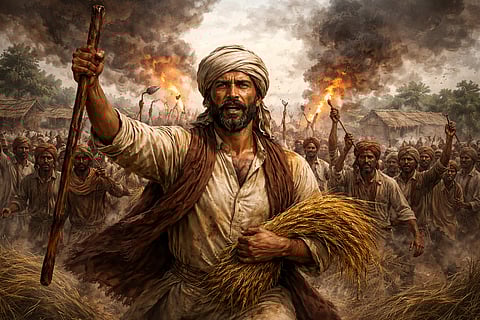


(This folktale written by Kranti was originally published in Hindi in Edition 6 of Bi-monthly Journal, “Nami Savair” and translated into English by “Kashmir Times”. This is the second in the series on Legendary Heroes and Revolutionaries of Jammu in collaboration with “Nami Savair”. The first of the series can be read here.)
Kranti*
Ballad in Dogri dialect:
Jerhe Lok Deyi Jande ethey Qurbaniyan,
Duniya Vich Rohdiyan Nee, Undhiyan Nishaniyan;
Vidhi Singh Mehta, Jis Jaarh Putwaya Eeh,
Bawa Jitto Kanhe, Zulm Kamaya Eeh;
Jitto Kanhe Kitiyan Nee, Uss Beimaniyan,
Duniya Vich Rohdiyan Nee, Undiyan Nishaniyan;
Jaarh Putti Jitto, Fasal Ujaya Ee,
Vidhi Singh Mehta Kanak Dikhne Gi Aaya Ee;
Vidhi Singhe Sochi Leyin Saariyan Shaitaniyan
Duniya Vich Rohdiyan Nee, Undiyan Nishaniyan;
Kanak Bani Shail Jadun, Baadiyan Bhi Kitiyan,
Paapiyen De Manen Vich Rehiyan Badnitiyan;
Lok Saare Gande, Bawa Jitto Diyan Kahaniyan,
Duniya Vich Rohdiyan Nee, Undhiyan Nishaniyan;
Kanakan Jadun Bawa Jitto Gahiyan Te Maroriyan,
Saari Kanak Vidhi Singhe, Bhari Leiyan Boriyan;
Maraya Katara Jitto, Deyi Gaya Qurbaniyan,
Duniya Vich Rohdiyan Nee, Undhiyan Nishaniyan;
Jerhe Lok Deyi Jande ethey Qurbaniyan,
Duniya Vich Rohdiyan Nee, Undhiyan Nishaniyan;
English Translation of the Dogri Ballad:
(Those who sacrifice their lives here,
they leave their indelible marks in the world;
Vidhi Singh Mehta, who got the forests cleared,
He committed oppression on Bawa Jitto;
He resorted to dishonesty with Jitto,
they leave their indelible marks in the world;
Jitto grew a crop after clearing forests,
Vidhi Singh came to see the wheat crop;
Vidhi Singh thought of Satanic behaviour,
they leave their indelible marks in the world;
Harvest of ripen shining crop was done,
The sinners had Satanic thoughts in their mind;
People sing ballads of Bawa Jitto,
they leave their indelible marks in the world;
Bawa Jitto winnowed the wheat grains after harvest,
Vidhi Singh filled all the grains in sacks;
Bawa Jitto struck the dagger and became a martyr,
they leave their indelible marks in the world;
Those who sacrifice their lives here,
they leave their indelible marks in the world;)
Rebellious Farmer Bawa Jitto
Martyr farmer Bawa Jitto was a farmer from the feudal era of Jammu, who sacrificed his life for his land rights. The oppression and tyranny of Jammu's feudal monarchy forced him to sacrifice himself. At that time, Jammu was one of the active states of medieval India. Like other parts of India, the main source of income for Jammu society was agricultural produce and animal husbandry. Jammu's ruling class extracted land revenue from farmers to run the administrative expenses of the state and for their luxuries. One part of the revenue collected was for the army's salary. Farmers knew very well that they had to work for the state and its military class. They could neither complain against excessive taxation nor could they speak out against the rulers' policy of oppression. During Bawa Jitto's time, there was a young king named Ajab Dev ruling Jammu. He was the grandson of King Mall Dev.
King Mall Dev is believed to have ruled from 1360 to 1410 CE. Despite the weakening of Ajab Dev's feudal power, small and regional feudals ruled as they pleased. Their oppression on the people kept increasing and arbitrary excessive taxes were collected. The administrative system had also become very corrupt. Maharaja Ranbir Singh's (1857-1885 CE) court poet Pandit Nilkanth wrote and published the life story of Jitto in a text called 'Katha Baba Jitto Di' in 1881 CE. Professor Ramnath Shastri says that in this narration, he explained that Hamir Dev's son Ajab Dev was only five years old. The responsibility of King Ajab Dev's administration was handled by his maternal uncles. Two chieftains (sardars) were appointed by them—one Mardana and the other Veer Singh. 'Veer Singh' lived in Amb Gharota (presently in Jammu district). This was the same Veer Singh 'Mehta' with against whom Bawa Jitto and Isso struggled.
During the 15th century, there was massive upheaval in the political system of the princely state of Jammu. As explained above, big landlords and feudal lords extracted very high levies/taxes from the people in exchange for their bit of land. Farmers had to give more than half of their agriculture produce to the king or feudal lord. In this monarchical era, especially people from Dalits and backward communities were exploited even more, because they did not have the right to own land and had to do bonded labour to survive. But the condition of small farmers was worse than the so-called upper castes. The story of Bawa Jitto inspires class unity by setting aside caste discrimination.
Bawa Jitto deserts native village Aghar
In the village 'Aghar' in present day Reasi district of the princely state of Jammu and Kashmir, two brothers Rupo and Sidho lived. Both brothers were married to two sisters from the same house. Rupo's wife's name was Jojla and Sidho's wife's name was Jojan. To Jojla, a son was born, who was named Jitmal (Jitto), while Jojan had seven sons. Some years later when Jitto's parents passed away, his aunt Jojan raised Jitto, but she had greed for his land. It is said that aunt Jojan also tried to kill Jitto in childhood, but she could not succeed. Jojan and her family believed that all the land should be divided into eight parts, not two, because if there were two parts, Jitto alone would get half—50 percent of all the land, and Jojan's sons would have to divide the 50 percent land into 7 parts.
Jitto got married and sometime later his wife gave birth to a daughter, and Jitto's wife died. Jitto's daughter was named Bua Kodi. Jojan's sons also made plans to kill Jitto, but they could not succeed in this either. The matter reached the panchayat regarding the distribution land. In front of the panchayat too, the same argument was put forward that Jojan has seven sons, while Jitto is alone and has more land. The feudal panchayat also decided against Jitto. And said that the land should be divided into eight parts. Jitto was very troubled and surprised by the panchayat's decision. He did not agree with the panchayat's decision. The land inherited from his father Rupo was divided into eight parts. Jitto felt very helpless and disgusted, and on top of that, he had a young daughter. Troubled by all these circumstances, Jitto decided to leave his village 'Aghar'. He decided to go to his friend Rullo, the blacksmith in Panjod village of Marh tehsil of Jammu district. The distance from Ghaghar to Panjod was about 30-35 kilometres. Pandit Nilkanth in his composition 'Katha Baba Jitto Di' has considered the main reason behind Jitto's leaving Aghar to be his aunt Jojan and has also called her a witch, because according to him, she had tantric knowledge. Feudalism has this characteristic that it is deeply misogynistic, which is why this allegation has been made against aunt Jojan, whereas the real dispute was about land. To get rid of this very dispute, Bawa Jitto decided to go to his friend Rullo.
Bawa Jitto’s Friend Rullo Lohar
Based on folk tales, Jitto has called Rullo his brother. This is mentioned in the ballad, from which it becomes clear that there was deep friendship between the two. Rullo was Jitto's friend—this fact has also been acknowledged by Pandit Nilkanth. But Pandit Shukdev Shastri in his composition 'Jitto-Charitra' describes Rullo as Bawa Jitto's servant. Whereas looking at Jitto's class position, it can be estimated that having a servant or slave for Jitto was impossible. Although with a little effort, Jitto could have also done priesthood, but instead of that, he chose the profession of farming. He was a hill farmer; he adopted farming.
When Jitto reached Panjod village, he took refuge at Rullo's house. Rullo fully hosted him for several days. Finally, Jitto told Rullo to arrange some land for him or get him some work so that Jitto would not be a burden on him. Rullo was also just a skilled laborer whose work was related to iron. The landlord of Amb Gharota was Veer Singh 'Mehta', whose behavior toward the people in general was very cruel. He often collected excessive taxes from the people, and if the tax was not paid, he would also usurp the entire crop. The people were familiar with his cruel behaviour and also feared him. People wanted to complain to the king of Jammu about him, but Veer Singh was the maternal uncle of Jammu's king, so no one dared to raise a voice against him. Most people in the village were farmers. Some people had their own land, and only a few people were given land by the landlord on contract. Veer Singh's agent was Ghaggi who lived in the village of Jassowan. Rulo spoke to Ghaggi and introduced Jitto to landlord Veer Singh. When Veer Singh first learned that Jitto is a Brahmin, he proposed to Jitto that he be seated in some temple or given priesthood. Jitto rejected Veer Singh's proposal because Jitto was a farmer. Perhaps he had no special knowledge of priesthood, architecture, etc. besides farming. When Jitto rejected Veer Singh's proposal, Veer Singh got angry too. His feudal ego was hurt because an ordinary person had refused to accept his word. Therefore, Veer Singh refused to give land to Jitto.
But after repeated requests and pleading by Rulo and Jitto, Veer Singh agreed. He gave Jitto such land that was completely barren, on which thorny bushes and wild grass had grown. Veer Singh gave land to Jitto on a one-fourth share basis, but he wanted Jitto to somehow abandon the land and flee. Although a total crop's 'one-fourth share' was very low collection tax. But Veer Singh kept such low rent because he was confident that Jitto would not succeed in growing crops on this land and would run away. The land that Jitto received for farming was guarded by a person named Isso, who was a Dalit landless farmer. He had no land of his own, but he earned some money from Veer Singh by guarding this bushy barren land, which sustained his livelihood. When Isso showed the land to Jitto, there were thorny bushes and barren-like forest. Who could know this land better than Isso, because he had been guarding it for many years and was familiar with every inch of this land and the entire area. Isso was well-versed with Veer Singh's deeds and intentions. Forget about growing crops on this rocky (barren-like) land, even cleaning it was no less than a trial by fire.
Bawa Jitto chooses farming over priesthood
Jitto took an axe from Rullo and the next day began clearing the bushes. Seeing him alone, Isso also started helping him. Seeing Isso helping like this, Jitto told Isso that instead of helping, if both of them cleared this rocky land, then in the end whatever be the crop and produce, they would divide it on 50-50 basis. When Jitto started cutting bushes, it took them more than a month just to clear the barren land, while preparing the land completely for cultivation was still pending. The rocky land that Veer Singh thought would make the hill farmer Jitto flee, that very land Jitto made fertile and valuable with the help of his companion Isso. But this process did not happen in one day; for this, backbreaking effort and continuous dedication were put in for about one to two months. Isso and Jitto consulted each other that a lot of time is wasted in commuting from the village again and again. Why not build a kulli (mud-thatched hut) near the fields so that time could devote more time on the land? They built a hut in the fields itself. From this, they started devoting more time to farming. Isso's contribution to this land was immense.
Jitto worked day and night and changed the face of the land. People were amazed when they saw how he had turned a bushy forest into fertile land. The same human labour that creates civilization separated humans from animals. Jitto also made the rocky land cultivable by working hard along with his companion Isso. When the time came to plough the land, those two oxen that Jitto had brought from his village 'Aghar' were now used, and all the land was ploughed well. Jitto had put in his sweat, labour, and emotions into the land. The ownership of the land was still not with Jitto, but he was working with dedication every day with the hope that he would get his rightful share of the crop and produce. After ploughing the fields, seeds were needed. To arrange seeds, Isso helped Jitto and told him about Mahant Nathuram in the other village Kanha Chak, who might help them. When Jitto went to Mahant Nathuram, Nathuram placed this condition that when the crop came, these seeds would be returned to him. Nathuram gave Jitto seeds as per requirement. Taking seeds, Jitto returned to his village. After sowing seeds, arrangements were also made for a large pit so that rainwater could be collected and irrigation could be done. The village people were now very surprised that how a hill farmer made this stone-like forest land so beautiful. In making this beautiful land ready, Jitto's friend Isso also had full contribution.
When Veer Singh's advisor 'Malli' learned of this, he became angry. Veer Singh was already angry with Jitto because Jitto had rejected his proposal of priesthood. He did not expect at all that Jitto would work so hard; rather, he thought that Jitto would abandon the land and flee. Now the exact opposite of his thinking had happened. Veer Singh announced that according to the agreement made with Jitto, what was to be taken as a one-fourth share by Veer Singh would now be half. That is, now half the share of the entire crop should be given to Veer Singh. Veer Singh believed that whatever labour his servant Isso had done on the land, its value would be deducted from the crop. It is clear here that in Indian feudalism, the caste system is so intertwined that it cannot be seen separately from the feudal structure. Therefore, this system is deeply intertwined in the economic-political structure even today. Now golden crop was growing in the fields from the labour and partnership of Isso and Jitto. In a way, heaven had been brought down to earth. The wheat crop was shining like gold. Throughout the village, word of Isso and Jitto's crop had spread. Seeing Isso and Jitto's crop, the whole village was amazed. The prose worthy discussion also reached landlord Veer Singh. Now he was waiting for the opportune time. After Baisakhi, the crop was harvested. In this too, both worked very hard again. When it was time for winnowing, i.e., cleaning the grain, Jitto informed landlord Veer Singh Mehta that he could take his one-fourth share. Jitto gave assurance to all the people from whom he had borrowed that as soon as Veer Singh took his share, he would settle all accounts. Especially Nathuram, from whom he had borrowed the seeds.
Struggle for land rights
After winnowing, heaps of grain were set and sacks were lying nearby. Jitto told Isso that he was going to the village Panjod and would be back, by which time Veer Singh's people would also come and be given their share. Whatever is left, both would divide equally. But shortly after Jitto left, Veer Singh arrived there. He had arrived much earlier than the scheduled time. At that time, only Isso was present there. Veer Singh was not only accompanied by Ghaggi and Malli but also brought his musclemen with him. When Isso asked him to sit, he immediately demanded his share. Isso told him to wait for Jitto, but he did not listen. On this, Isso also became stubborn that until Jitto came, he would not let the crop be taken. In response, Isso was tied up and also badly beaten up badly. When Veer Singh left with his men after filling sacks, he had gone quite far, then Isso somehow untied the rope and ran toward the village Panjod. He told Jitto everything, and both ran after Veer Singh. While going, Jitto took a katar (sharp, dagger-like weapon) with him. Both surrounded Veer Singh's convoy on the way. It is said that Jitto started tearing open sacks with the katar and grains started falling on the ground. Soon a large heap of grains was formed. Behind him, Isso kept telling Jitto not to do this.
At the same time, standing on the heap of grains, Jitto started talking about his land rights. He also called Veer Singh dishonest. He said that he would mix his blood and flesh in it. Saying this, Jitto stabbed himself in the stomach with the katar and martyred himself.
Seeing Jitto die, Veer Singh and all his men fled from there. Isso sat near Jitto's body crying. Isso ran shouting loudly toward the village. It was Isso who, while crying, told Jitto's daughter the whole story. Folk storytellers have presented this scene in a very touching way:
Bol Bua Bachan Karen, Isso Gi Gall Sunayi,
Jithen Mera Bapu Mareya, Leyi Chal Ungli Layi;
Rodan Kardi Bua, Royi-Royi Hosh Goayi,
‘Sehren-Simblen’ Aayi Bua Devi, Labmi Loth Namani;
Apni Chikha Banayi Bua Ne, Bapu Di Chikha Banayi,
Leyen Loth Galey Kanne Landi, Ahyu Bapu, Dhee Gamayi.
English Translation:
("Speaking to Bua slowly, Isso told her the story,
Where my father died, lead me there by handholding;
Bua Kodi started wailing, Lost Her consciousness While Crying,
Goddess 'Sahrai Simbalai' came, Bua bowed her head long;
Made a Pyre for her father, then made another for herself,
Bua hugged that body of her father, screamed and jumped into the pyre.”)
Bawa Jitto’s daughter commits ‘Sati’
It is written in this very ballad that Bua Kodi also committed sati with her father, which also reveals the practice of the evil custom of sati. It is said that before Jitto's pyre was lit, two traders Suddu and Buddu, who lived in Sialkot were going to Akhnur, they saw a crowd of people. They came near the crowd and saw up close that a daughter was organizing the last rites of her father. It is said that these two people later laid the foundation of temples for Bua Kodi and Jitto, and the hill farmer Jitmal 'Jitto' became 'Bawa Jitto'.
Several questions also arise on the facts explained by the storytellers about Bawa Jitto's struggle. The biggest question arises regarding Bawa Jitto's self-immolation. When the grain/wheat-filled sacks were torn apart by Bawa Jitto, then Veer Singh leaving him alive or not causing him any harm is unbelievable. If an ordinary farmer topples the loot done by a landlord in this way, then his staying alive is impossible. Killing that farmer is not a big deal for the landlord. It can also be estimated that Veer Singh himself martyred Bawa Jitto and later publicized that Bawa Jitto committed self-immolation. But since there is no other evidence in this regard, this story also cannot be narrated with certainty. Even today, there is a lot of respect and reverence for Bawa Jitto among people, and people come from far and wide to his place to pay their respects. But his sacrifice and his history have been limited to only spirituality.
Bawa Jitto's entire life was spent as a struggling farmer. His first struggle occurred when he had to face the oppression of the panchayat. Due to the injustice, he was forced to leave his home and land. The second struggle started when he was given rocky and barren forest-like land, which he made cultivable together with Isso, forcing them to work hard. And the third struggle is class struggle, in which Bawa Jitto had to martyr himself to save his crop. Bawa Jitto's story depicts the relationship between landlords and farmers. These are the relationships between master and slave, that is, between exploiter and exploited. Farmers are harassed like slaves and landlords' treasuries are filled. Whatever little the farmers produce through hard work, even that is snatched away by landlords. Farmers can barely sustain their families. But in exchange, they have to give more than half of the crop as tax every season. This system continued for a long time in the same way.
Bawa Jitto's story strikes at social injustice and gives birth to rebellion against it among the people. More than five centuries have passed since this incident of Bawa Jitto's sacrifice. But even today, people remember this sacrifice. Despite spiritualists limiting him to only devotion and worship, many writers and people have called him "Martyr Farmer Bawa Jitto". Bawa Jitto is that example of Jammu-Kashmir on the basis of which struggle can be waged against the injustice that has been imposed on farmers, labourers, and hardworking people for centuries. Bawa Jitto is the folk hero of the working people of Jammu-Kashmir who registered the first rebellion against feudalism in their time.
References:
Baba Jitto: The Story of an Honest Farmer and the Oppressive System - Ankush Kumar Badyal, Mrityunjay Prasad and Pallavi Gupta, 'The Logical Indian', March 18, 2016
Baba Jitto: The Great Kisan Revolutionary - Makhan Lal Sadhu
Duggar De Lok Nayak - Prof. Ramnath Shastri, Dogri Sanstha, Jammu 1990
Play - Bawa Jitto - Prof. Ramnath Shastri
Some verses from the hymn sung by singer Ghulam Mohammed 14 years ago
“Bawa Jitto” play first produced and staged by Natrang, Jammu and directed by Padma Shree Balwant Thakur in 1986
(*The author is a contributing writer to 'Nami Savair' and written this story in Hindi)
Have you liked the news article?
Support us now:
https://www.gofundme.com/manage/jammu-kashmirs-sole-independent-voice-under-threat