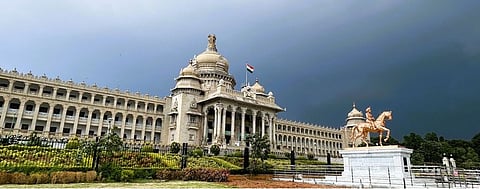


When the invitation arrived from Azim Premji University, Bengaluru, to participate in a two-day national conference titled “Dreams, Dilemmas, Discontent: Youth in Contemporary India” scheduled for 13th and 14th February 2026, I felt an immediate tug of emotion. The word Bengaluru rolled awkwardly on my tongue, for to me it would always remain Bangalore — a name loaded with childhood memory and a time when cities seemed slower, kinder, and less consumed by the clamour of reinvention.
Return to the City of Distant Memory
My mind instantly journeyed back to 1995, when I first visited the city as a child. It was an anxious time in Kashmir. The insurgency was at its peak; violence, fear, migration, and silence became the daily staple in the Valley.
My cousin, whose family could afford to send him away, was studying in Bangalore then. To his parents, the distant south felt like an assurance of safety. For us, that brief family visit became an encounter with another India which was seemingly untouched by curfews, crackdowns, and disappearances.
Back then, Bangalore had an easy charm. Streets were bordered by rain trees, their canopies breathing cool air. Rickshaw drivers spoke in slow Kannada-English hybrids, and the weather was gentle like a reprieve from the cold discipline of Kashmir’s winters. It was the first time I had seen a city that worked on both time and trust.
Thirty years later, I returned to a renamed Bengaluru: the city of start-ups, satellite towns, and relentless traffic: a metropolis that painfully mirrored how all Indian cities were transforming, for better or worse.
Even so, something oddly familiar bound Bengaluru to Srinagar. Both had the same civic absences that citizens had long learned to tolerate: missing streetlights, broken zebra crossings, traffic indifference. Both were spaces where civility thrived in conversation but faltered on the road. And yet, beneath the noise, warmth persisted.
A City of Quiet Reverence
Bengaluru was also, in a quieter way, the city of my intellectual upbringing. For as long as I can remember, copies of Islamic Voice and Young Muslim Digest both published from here graced our home in Srinagar.
In the restrictive climate of the 1990s, those monthly issues were like letters from a wider world. They debated reform, modernity, and faith with a balance rare in popular Muslim discourse. I grew up reading them not merely as journals but as lessons in articulation, how to think independently yet rooted, how to engage difference without defensiveness.
There was, moreover, a personal association. My mentor, Yoginder Sikand, once a formidable voice in interfaith dialogue and Islamic studies, lived somewhere in this city. But he had long withdrawn from academia, retreating into quiet anonymity. I had reached out years ago but sensed his reluctance to revisit old associations.
Entering the Campus
By the time my taxi pulled into Azim Premji University’s campus in Sarjapur, night had fallen. The driver, resigned to the city’s notorious congestion, remarked dryly, “Bengaluru teaches patience better than yoga.” I laughed and hauled my luggage to the guesthouse.
My room on the thirteenth floor offered a panoramic view of the city’s lights twinkling like constellations trapped in chaos as huge construction is going on as a part of expansion of university. It was quiet, clean, and well-kept an ideal perch for contemplation.
I fell asleep to the distant hum of the city, thinking of my paper to be presented the next morning. Its title “Youth Migration and Elderly Care: Intergenerational Negotiations in Contemporary Kashmir” seemed modest but carried personal weight.
I had watched this phenomenon unfold around me for years: sons and daughters flying out to Delhi, Dubai, or Doha, chasing ambition and security, while their aging parents tended to lonely homes in the Valley. Migration, in our context, isn’t mere mobility; it’s a moral wound. My paper sought to explore that wound through lived narratives of longing and absence.
The Day of the Presentation
The conference hall, modern and sunlit, buzzed with energy on the morning of the 13th. Students, researchers, activists, and faculty members shuffled between parallel sessions. When my turn came, I spoke less from prepared notes and more from memory and emotion.
I told stories of a retired teacher in Anantnag who spent her evenings on video calls with her son in Oman; of a Srinagar mother keeping her son’s study table untouched for years; of the many parents who say, “At least they are safe,” hiding their own solitude under the luxury of survival.
The discussion that followed was engaged and empathetic. Among those present was Dr Khalid Anis Ansari, a scholar whose writings on caste and critical theory I had long followed. We had corresponded occasionally, but this was our first face-to-face meeting. The conversations with audience were sharp yet kind, drawing attention to how notions of “care” intersected with class excess and emotional displacement.
Later, over tea, we conversed further. When I asked Dr Ansari about the book he was working on, he chuckled, “When every conspiracy theory seems to come true, what’s there left to investigate or imagine?” Beneath his sarcasm lay an exhaustion shared by many scholars who chronicle contemporary India. And yet, despite his disillusionment, his tone carried a warmth that exuded with a mix of withdrawal and resistance.
Conversations that Continue Beyond Papers
One distinctive virtue of Azim Premji University is its resistance to the global academic machination of “publish or perish.” Here, research is valued less for quantity and more for integrity. Faculty members often say, “We teach because thinking matters.” This philosophy radiated across sessions and hallways. I met young researchers whose curiosity was untainted by career anxiety, a rare sight in Indian academia today.
Among the participants I engaged with were Papia Khatun, Shraddha Sharma, Lasang Lepcha, Avishek Jha, and Supriya Ranjan – their work alive with originality.
Papia’s name intrigued me. Over a light lunch of vegetable biryani, I teased, “You know, Paapi in Hindi means sinner, and Khatoon in Urdu means lady. So, your name could mean ‘sinful woman!’” She burst into laughter and replied, “In Bengali, Papia means a bird—the sweet-voiced cuckoo. My parents named me for its song.” The linguistic irony delighted us both. It’s remarkable how words that condemn in one language redeem in another.
In that laughter, India itself seemed summarised, diverse, delicate, and dancing between meanings.
Lunch hours, I have always believed, are when conferences breathe. The formality of presentations dissolves; ideas turn conversational. Our table discussed everything from caste inequality in universities to the declining reading habits among urban youth. Between bites of spicy dal and curd rice, we exchanged notes, contacts, and book suggestions that would sustain us long after the formal sessions ended.
Of Roads, and Reflections
By evening, the Bengaluru sky threatened rain. The breeze that carried across the open courtyard smelled faintly of earth, reminding me of Srinagar’s spring showers. I took a short walk after dinner. The city lights shimmered like liquid gold beneath a restless mist. Some students were still talking in the quadrangle, their laughter echoing against the walls of classrooms where boards still bore remnants of diagrams and unfinished thoughts.
Conferences are often remembered not for the papers one presents but for the people one meets. The two days at APU proved precisely that. By the end of the first day, I realised that the conference’s title—Dreams, Dilemmas, Discontent—was not just academic framing; it mirrored our lived realities as scholars and citizens of a country in flux. We were all negotiating between the ideal and the possible.
Encounters with a New India
The second day brought more sessions, more interactions, and a series of moments that stitched themselves into quiet reflection. During the tea break, I spoke to two undergraduate students Akash and Amit, whose energy was infectious. They told me about their journey to APU: cracking the competitive entrance exam and securing full scholarships that covered tuition, food, boarding, and even laptops.
“This place changed everything,” Akash said. “Back home, I’d probably still be fixing motorbikes.”
Their gratitude was genuine, but what struck me most was their awareness. They were not overwhelmed by privilege; they were moved by purpose. The university’s inclusive structure ensured that no economic background became a barrier to education. In a nation where inequality defines identity, this model felt revolutionary.
Nearby, I met a girl from Doda, her voice tentative but eyes thoughtful. In the course of our conversation, she mentioned being told by a student from the Valley that she wasn’t a “real Kashmiri.” It saddened me.
This old debate of ‘who gets to claim Kashmiri-ness’ has long divided us. I told her softly, “If you speak the language, live its sorrows, and know its songs, you are Kashmiri enough. Our diversity is what keeps the Valley alive.” She smiled, though her silence carried generations of hurt.
Of Sweets, Satire, and Sincerity
As the conference closed, a familiar melancholy set in the post-event quiet that makes the mind both heavy and inspired. Akash and Amit insisted I shouldn’t leave without exploring the city. So, that evening, we took an auto to buy Mysore Pak, the iconic South Indian sweet, as my younger cousin back home had instructed. The air inside the sweet shop was intoxicating with a thick mix of ghee and sugar. I bought a few boxes, packed neatly.
Amid chatter, I had heard earlier, that, some groups wanted to rename Mysore Pak because the word Pak sounds too… foreign. I informed them and they chuckled, shaking their heads. We laughed, but the laughter felt hollow.
It was another absurd reminder of how fragile language and culture have become in the hands of the insecure. In a city that once celebrated cosmopolitan grace, such fragility hinted at a shrinking tolerance.
We rode back. The roads shone, slippery with light. Bengaluru’s skyline, stitched by flyovers, looked both futuristic and fatigued. But for three travellers—two young dreamers and one reflective researcher—it was a city that pulsed with the promise of story.
A Night Among Books
That evening, a Master’s student named Pramod invited a few of us to visit what he described as “the soul of APU”—the Dr Gulbanoo Premji Library. It was an architectural marvel: six stories of glass, steel, and silence. As we entered, a subtle chill greeted us. The vast atrium glowed under soft lights. Each corridor branched into thematic sections; and the faint scent of paper and polish filled the air.
Pramod, quite a bright guy, explained that the library was not only a resource but a repository of legacy. One entire floor was devoted to collections donated by retired academics, lawyers, social workers, and public intellectuals from across India. It was like walking through multiple lifetimes of thought stacked neatly in rows. The generosity of intellectual inheritance was humbling.
I ran my fingers along the spines of books donated by names I admired. The silence made reading feel sacred. If time allowed, one could spend years traversing those six floors. “Students here can borrow as many books as they want,” Pramod added, “but they must renew them every fortnight.” I smiled. Indulgence tempered with responsibility—how fitting an academic ethic.
Looking around, I imagined my mentor Sikand perhaps once donating me few tomes, leaving behind quiet traces of thought. Even in retreat, the scholar never truly disappears. His voice continues through the words that survive him.
Farewell Mornings
On the final morning, the sky was pale gold, the wind tender. Before heading to the airport, I took a slow walk across the campus. The mess workers were cleaning tables, students in casual clothes carried mugs of tea; somewhere a group sat rehearsing a street play. I watched the indefatigable rhythm of youth unfold and thought about how fragile yet resilient it seemed.
In that hour, I recognised how travel changes the traveller—not through sights alone, but through the reflections it stirs. Bengaluru had given me more than conference notes, it had made me aware of India’s vibrant, conflicted heart, beating simultaneously in idealism and anxiety.
Homeward Reflections
The return flight to Srinagar sliced through evening clouds. Below, the Deccan plateau faded from green to grey. Inside the plane, I revisited Dr Khalid’s words: “When every conspiracy theory comes true, what’s left to investigate?” Perhaps what’s left, I noted in my diary, is not discovery but the courage to keep thinking, observing, and writing without surrendering to despair.
As the plane descended over snow-dusted mountains, I felt the familiar tightening of the heart that always precedes coming home. Srinagar was wrapped in winter calm. From above, Dal Lake shimmered like a silver scar, beautiful and silent. Kashmir awaited—its parents, its students, its dreams deferred and dreams reborn.
That night, sitting with my family, I opened the box of Mysore Pak. Its sweetness, rich with ghee, was more than culinary. A taste from another part of India had travelled with me across regions and languages to dissolve on Kashmiri tongues. That, I thought, is how nations survive: not through slogans or silos, but through such quiet exchanges of sweetness and meaning.
Epilogue
As I packed away the conference materials, my mind lingered not on PowerPoint slides or quotations but on faces—Akash, Amit, Papia, the Doda girl, Dr Khalid, Pramod. Each represented a fragment of a diverse, divided, yet deeply humane India.
Bengaluru had changed from the garden city of my childhood to a restless metropolis, yet beneath its neon skyline still flowed an undercurrent of thought and generosity.
Perhaps that is the real beauty of travel. It teaches us that memory and motion need not cancel each other out. The child who had once visited Bangalore in 1995 returned thirty years later not just as a researcher, but as a witness to time, transformation, and the tenacity of youth in an age of uncertainty.
And somewhere between the thirteenth-floor guesthouse, the taste of Mysore Pak, and the glow of the Gulbanoo Premji Library, I realised that even in our collective discontent, the dream of understanding persists.
Have you liked the news article?
Support us now:
https://www.gofundme.com/manage/jammu-kashmirs-sole-independent-voice-under-threat