

As the stars begin to fade in the pre-dawn chill, against the backdrop of the Pir Panjal mountains that look like silhouettes, Altaf Ahmad is ready at work, stacking hundreds of wooden boxes, that buzz with the energy of millions of restless inhabitants, on a battered mini truck.
It’s like moving a city of bees. By sunrise, the vehicle winds down from the Kashmir Valley towards the warmer plains of Punjab where he will be greeted by the season’s bloom of mustard fields and the farmers. Bees are natural catalysts to help pollination.
“We are not just honey collectors,” says Ahmad and adds, “We are also pastoralist and our maps are sketched by flowers.”
Beekeeping in Jammu and Kashmir is not a static entrepreneurship. It involves an annual voyage between the high-altitude meadows and subtropical plains that weaves together the region’s disparate geographies.
Anantnag, standing at the crossroads, is a crucial connector, bridging the Kashmir Valley with the Jammu division, and beyond to Punjab and elsewhere in northern India.
Jammu & Kashmir's honey production shows a significant surge, nearly doubling from around 1,300 tonnes in 2019 to over 2,700 tonnes by 2024-25, driven by government schemes and youth interest, boosting rural economies and placing J&K among top Indian producers, transforming its apiculture landscape with increased entrepreneurship.
Anantnag alone contributed 4,029 quintals, topping the charts, followed by Ramban and Kupwara. This growth is propelled not by state enterprise, but by private beekeepers like Altaf.
Of the 214,504 functional beehives across Jammu and Kashmir, government-supported production is a marginal 39.75 quintals. This is a telling statistic in an area where public initiative is often awaited.
“The migratory system of beekeeping is more economical,” note researchers Devinder Sharma, D.P. Abrol, and other colleagues from Sher-e-Kashmir University of Agricultural Sciences and Technology (SKUAST), in a study that lays bare the anatomy of this practice.
“It not only helps in boosting the income of individual beekeeper but also helps in increasing productivity of cross-pollinated crops and generates employment,” the study elaborates.
The contrast is stark. A stationary hive might yield 10-20 kg per year. A migratory hive, shuttling from the saffron fields of Pampore to the mustard fields of Rajasthan, can produce 50-60 kg. Commercial keepers, using modern Langstroth hives, secure 4-5 harvests annually.
“The beekeepers are able to harvest 50-60 kg honey per colony per year which is about five times more than obtained with stationery beekeeping,” the study confirms.
The Bloom Calendar
The annual cycle is a masterpiece of logistical precision shaped by the seasons. As winter loosens its grip on the higher hills in February, around Chenab and Pir Panjal Valleys where winters are a bit warmer, bees forage on early blossoms like Brassica and wild Prunus.
By late spring, colonies are driven down to the plains of Jammu, then onwards to the plains of Punjab and Rajasthan, even Uttar Pradesh, as a normal practice for better nectar.
Sorghum and Eucalyptus plants in Rajasthan provide early-season nectar, after which mustard and coriander fields in Punjab are ready for pollination. Come summer, the bees are back to Kashmir valleys for buckwheat; or the famed Plectranthus flow in Banihal and Ramban, which alone can yield 20-25 kg per hive.
“We are following a calendar written by the earth itself,” explains Sayar Mustafa , a third-generation beekeeper from Devsar, Kulgam.
“My grandfather used logs and clay pots for the native Apis Cerana bees. We now use Italian Apis Mellifera in modern hives and move them 800 kilometres. The principle is the same: go where the feast is.”
This migration is not merely for honey. It is vital for the colonies’ survival. Colony strength improves “more conveniently than by artificial feeding,” and beekeepers report multiplying their hives by at least 20% through these journeys. Furthermore, this mobile pollination service is a silent boon to agriculture.
Apple orchards in Kashmir, litchi groves in the lower hills, and mustard fields across the plains all benefit from this orchestrated movement of pollinators.
Opportunities in a Jar
The potential, researchers insist, is vast and under-realised. “The state has a large and as yet unrealised, beekeeping growth potential that exceeds the actual production level by at least four times,” the SKUAST University study claims.
The opportunities are multifaceted. These include:
Product diversification: Beyond bulk honey, there is a growing market for single-origin, floral varietals. “The diversified flora, like Prunus, Trifolium, and Plectranthus have a high reputation in the market and can be sold by their floral brand name,” the same study suggests, like Plectranthus honey from the Ramban.
But the unique honey derived from saffron (Crocus Sativus) flowers in the Pampore area of Pulwama is a rare and prized product, distinguished by its potential high content of the antioxidant crocin.
Crocin, the water-soluble carotenoid responsible for saffron’s vibrant colour, can impart special bioactive properties to the honey, enhancing its therapeutic value. This results in a honey with exceptional antioxidant, and possibly anti-inflammatory, qualities.
However, saffron honey production is intrinsically linked to a successful flowering season. Failed or poor flowering, caused by climatic irregularities, inadequate rainfall, or soil degradation, directly and severely impacts honey generation.
With fewer blossoms, bees have drastically reduced access to the primary nectar and pollen source. Consequently, honey yield plummets. More subtly, the honey's composition changes. With limited saffron nectar, bees forage on alternative flora, diluting the unique crocin content and altering the honey’s flavour, colour, and medicinal profile.
Thus, failed flowering not only diminishes quantity but also compromises the very uniqueness that defines Pampore's saffron honey, threatening both a niche agricultural product and local beekeeping livelihoods.
Forest honey: With over 20,000 sq km of forest cover and negligible pesticide use on vast tracts, the region has vast potential scope for producing organic honey and pollen for the world market. Tapping into the wild, diverse flora, from Acacia to Toona, for a non-timber forest product could create sustainable revenue streams for fringe communities and promote conservation.
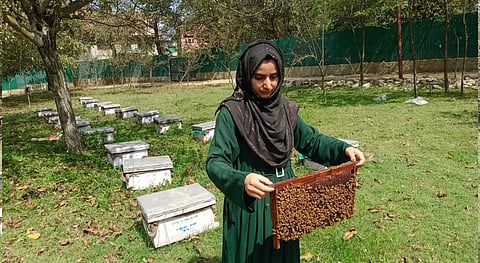
Women’s participation: While the image of the beekeeper is often male, the industry offers significant avenues for female entrepreneurship. The tasks of honey extraction, bottling, labelling, wax processing, and marketing are increasingly being taken up by women’s self-help groups.
It is a low-investment, high-skill enterprise that can be operated from homesteads. Many women honey entrepreneurs having dynamism, potential and confidence are entering into the business. Although, the beekeeping is a potent low investment enterprise in J&K, essentially for women with limited access to land or capital, they are now managing a few stationary hives for leading value-addition, the initiatives have proven transformative.
Ladakh: The High-Altitude Frontier
While the Kashmir Valley and Jammu hills hum with activity, the cold arid deserts of Ladakh present a different landscape of niche potential. Here, beekeeping is not about migration but about adaptation. Pilot projects have successfully produced specialty honeys like “Alfalfa” honey in Leh, demonstrating that even in extreme conditions, with temperatures plunging to -45°C, apiculture is possible.
The focus is on overcoming environmental hurdles—extreme cold, short seasons—to produce low-volume, high-value honey for a luxury market. It is a testament to resilience, but large-scale production statistics remain elusive.
The Gathering Storms
Yet, this thriving ecosystem faces profound threats due to a combination of ecological challenges at the local and global levels and bureaucratic inertia.
The precise timing of the migratory schedule is everything. Climate change, with its erratic winters, early springs, and unpredictable rainfall, is scrambling the bloom calendar. A warm spell can cause flowers to blossom before the bees are ready. A late frost can wipe out a nectar source entirely. The delicate synchrony between bee movement and plant flowering is being disrupted.
“Winters are not what they were,” observes Altaf. “It’s erratic. The bees are confused, and so are we.” Warmer temperatures also allow pests like the Varroa mite to thrive at higher altitudes, threatening colony health.
The very agriculture that benefits from bees is also poisoning them. The increased use of pesticides and fungicides in apple orchards and other cash crops is a major concern. “Neurotoxic pesticides applied when crops are in bloom are devastating,” says a local agronomist, Mohammad Akram from Dialgam, Anantnag.
“A beekeeper can move his hives into an area and find half his colonies dead in a week from chemical drift.” This not only causes immediate loss but also contaminates honey and wax.
Perhaps, the most consistent lament is the lack of public and private support, weak research and development, and insufficient support for small beekeepers. While schemes like the National Beekeeping & Honey Mission (NBHM) exist, their reach and effectiveness on the ground are marked by gaps. The government production is a minuscule fraction of the total support accessible to the beekeepers.
This 'lackadaisical approach,' as one keeper put it, manifests in poor infrastructure, no dedicated loading zones or waystations for migratory trucks, limited access to health services for bees, and scant insulation against market volatility.
There is a glaring absence of a cohesive policy that views migratory beekeeping as the complex, logistics-heavy industry it is.
While demand for pure honey rises, beekeepers often remain at the mercy of intermediaries who control pricing and market access. Building direct brands, obtaining organic certification, and accessing export markets require capital and guidance that individual keepers lack.
The Future in the Bees
The path forward for Jammu and Kashmir, including Ladakh beekeepers, requires a coalition of effort. Firstly, climate resilience must be built through research into drought-resistant bee flora and adaptive migration schedules. Secondly, a strict, enforceable policy on pesticide use near flowering crops is non-negotiable. Thirdly, the institutional gap must be filled.
This means not just subsidies for hives, but investments in cold chains, honey testing labs, processing units, and genuine market linkages. It means creating a “Bee Corridor” with logistical support for migration.
Finally, the story needs to be told. The narrative of Kashmir’s migratory beekeepers, their entrepreneurship, their deep ecological knowledge, and their connection to a changing landscape is powerful. It is a story of resilience and quiet economic revolution, of individuals navigating not just political contours but the very rhythms of nature to build a livelihood.
Last spring in Kashmir, Altaf secured the hives on his mini-truck successfully and happily caught the first light of the snow on the peaks. His journey, like that of his bees, was a search for sustenance and sweetness in a rugged, beautiful, and uncertain land was a hope that will continue come what may. The hum of the beehive is a sound of industry, of tradition, and of a future that, with the right support, could be as golden as the honey it produces.
Have you liked the news article?
Support us now:
https://www.gofundme.com/manage/jammu-kashmirs-sole-independent-voice-under-threat