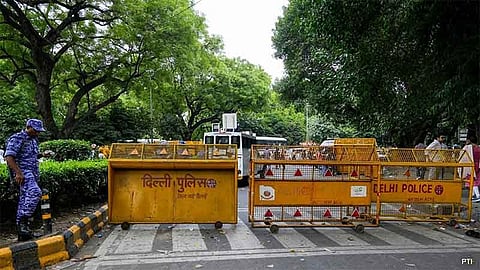


A paranoid state is laying siege – in the heart of India’s capital. From political leaders, Cockroach Janta Party (CJP), student activists, lawyers, social media influencers and journalists to anyone walking on two legs have been rounded up and detained – not only in Delhi but even beyond: picked up from homes, streets, airplanes, trains, even public toilets.
When a government must lock down its own capital, switch off the internet, deploy 7,000 police in and around Jantar Mantar, and activate a nationwide security grid against anyone suspected of even the faintest sympathy for the CJP's protest call, it is admitting defeat. It is also confessing that it cannot answer questions of accountability, uphold democratic norms, or honour the constitutional right to protest. Only a frightened government answers a restless public with force.
The Narendra Modi government is doing what it does best: crushing dissent, criminalising it, demonising those who take part, and then papering over the damage with a narrative that all is well.
Allegations of voter fraud against the Election Commission of India (ECI) have led to demands for the resignation of Chief Election Commissioner Gyanesh Kumar, an investigation into his alleged misconduct, and a cleansing of the electoral system. Why does this rattle the government so badly?
Not merely because Gyanesh Kumar is a favourite it wants to shield. It is because if he is probed and tried, the party alleged to have benefited most from the irregularities, the BJP, would face scrutiny too.
The Kashmir comparison
The scale of Saturday's operation, with thousands of arrests, curfew-like restrictions, an internet shutdown, and voices gagged before they could speak, has led many to invoke Kashmir. The mechanisms are similar, and the template may well have been refined in Kashmir's laboratory. But the comparison ends here. Beyond this, it is a case of false equivalence.
Kashmir has endured decades of violence, human rights violations, and suppression. Its people live with daily suffering under a state machinery that systematically strips them of agency. A day of barricades in central Delhi cannot be measured against that. Unless Saturday's measures become permanent, with continuing detentions, disappearances, communication blackouts, and militarised streets, what Delhi saw was only a trailer.
The motives differ too. In Kashmir, suppression and surveillance are aimed less at quelling rebellion than at controlling a region and taming its people into obedience. What is happening in Delhi springs from the arrogance of arbitrary power and the cowardice of evading accountability. Above all, it is a desperate bid for survival.
It is telling that the Indian imagination reaches for Kashmir whenever something goes wrong, as though Kashmir were a synonym for abnormality. That abnormality is acknowledged only when it arrives at one's own doorstep. Otherwise, it is denied or, when admitted, justified in the name of security and national interest. But a wrong excused in one place does not stay there. It travels, and it is tried out elsewhere.
Would this serve as a lesson for the common masses in India misled into believing that suppression in Kashmir is morally, right? Or would they go back to their convenient positions -authoritatively vetting an exception model of control in Kashmir or oscillate between the ‘maybe, maybe not’ lukewarm empathy, once the dust settles down? That’s a hypothetical question.
For now, the crucial question is this: can the Indian state replicate a full-fledged Kashmir-style architecture of suppression, surveillance and control? The answer is an emphatic no.
Why it will not work
The state hopes to wish resistance away, and it may achieve some temporary success. But mainland India is not Kashmir. Kashmir's demonisation is so deeply embedded in the national psyche that whatever the state does there is presumed right, and silencing people behind a "normalcy" narrative becomes easy, almost automatic. India as a whole is too vast and diverse to be managed with the same tactics for long.
That lesson was delivered by the resistance to the CAA-NRC, by the farmers' protests, and more recently by the CJP-GenZ protests against examination scams. The anger now directed at the ECI, which stands accused of seeking to erase and disenfranchise 60 million voters, more than the population of most European countries, runs deeper than any of these earlier movements.
It is a tide that cannot be wished away, and it will not recede. Suppression will only feed rebellion. The harder the hammer strikes, the fiercer the anger, against the hammer and against what it was meant to hide.
Have you liked the news article?
Support us now:
https://www.gofundme.com/manage/jammu-kashmirs-sole-independent-voice-under-threat