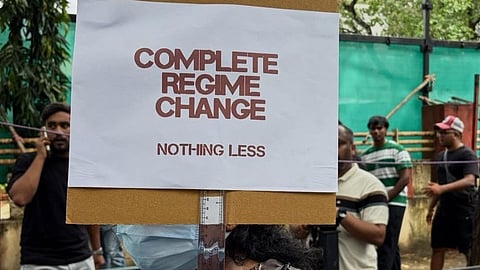


What stood out most during the Gen Z protests at Jantar Mantar in Delhi was the use of social media platforms, particularly Instagram, to criticise and satirise the Prime Minister of India. The online campaigns, memes, and creative messaging became a defining feature of the students’ movement.
Having gathered significant international attention, the Gen Z protests have evolved into something far larger than demonstrations over an examination scandal. They have become the expression of a generation's growing frustration with governance, unemployment, and what many perceive as the shrinking space for accountability.
The spark was lit after the Chief Justice of India reportedly described the country's unemployed youth as "cockroaches" and "parasites", remarks that many young people found deeply offensive, and yet embraced satirically. The outrage intensified over the National Eligibility cum Entrance Test (NEET) paper leak, eventually creating enough public pressure to force the government to remove Education Minister Dharmendra Pradhan.
Beyond Paper Leak
But this movement was never just about a paper leak. The examination controversy was merely the tip of the iceberg. Beneath it lies years of accumulated anger over unemployment, rising inflation, and erosion of social justice under the Narendra Modi-led NDA government in the last twelve years.
Inflation, unemployment, and increasingly polarising political rhetoric have deeply affected the daily lives of ordinary citizens. For many young Indians, the promise of opportunity has been replaced by uncertainty, while economic hardships continue to grow.
Schemes like MNREGA that provided rural employment guarantee have been renamed and hollowed out. The Agnipath recruitment scheme that has reduced the tenure of new recruits to four years, has resulted in increased uncertainty for many young people seeking long-term employment in the armed forces.
The common man who earns 500 rupees a day contributes to the country's economy through his labour and taxes. Yet many feel they receive little in return in terms of public welfare or economic security. Rising inflation has placed enormous pressure on ordinary families, making it increasingly difficult for many to afford basic necessities.
As the cost of living continues to rise, the gap between the rich and poor is widening.
Policies favouring the wealthy have widened social and economic inequalities. Powerful institutions have become increasingly concentrated in the hands of a privileged few.
A vast section of the media has lost independence, and those who still continue their work committedly are targeted. Democratic values steadily weaken when the press that can hold the government accountable is purged.
Vulnerable Communities
The incidents of violence and discrimination, particularly against marginalised communities, economically weaker sections, and religious minorities have become routine: mob lynchings, attacks over alleged ‘beef’ consumption and so-called "love jihad.
The introduction of laws such as the CAA and the proposed NRC triggered widespread anger and opposition to the NDA government, leaving many sections of society feeling vulnerable. Those who protested against these measures also faced intimidation, harassment and vindictive actions.
This communal disharmony is at odds with India’s centuries of history of pluralism and syncretic culture and many people – across communities – feel that loss.
Region Specific Woes
Apart from the common nation-wide grievances over issues of unemployment, economic growth and communalism, several parts of the country are bogged down by their own set of crises that remain unaddressed.
Since 2023, Manipur has been engulfed in ethnic violence. The Central Government has failed to take sufficient steps to bring about a lasting resolution. Assam, meanwhile, continues to suffer from devastating floods almost every year. For those living there, it has become a recurring crisis, and many complain that no long-term solution has been implemented.
In Uttar Pradesh, the bulldozer culture has expanded significantly, and religious minorities have increasingly alleged that they are being targeted. According to critics, even places of worship and religious institutions have not been spared.
In parts of West Bengal and Assam, there have been reports of people whose families have lived in India for generations being asked to prove their citizenship. Some have alleged that they are unfairly labelled as infiltrators or Bangladeshis.
Residents of the frontier villages of Arunachal Pradesh along the Line of Actual Control (LAC) continue to live under constant security concerns because of Chinese territorial claims, frequent military build-ups, and the persistent fear of border tensions.
In Punjab and Haryana, those who raise their voices over agrarian distress are often labelled as Khalistanis. The year-long farmers' movement against the three farm laws reflected what many see as a growing disconnect between rural communities and the Centre, leaving behind a sense of mistrust that continues to shape public sentiment. Farmers argue that despite their hard work and immense contribution to feeding the nation, they are not receiving the support or compensation they deserve.
Ladakh is reeling under an acute sense of alienation. Even as the Centre is engaging Ladakh in talks for the last two years, the outreach is punctuated by stringent policies and crackdown on agitations as was witnessed last year when four people were killed and Sonam Wangchuk, one of the most prominent faces of the movement both in Ladakh as well as in Jantar Mantar, was arrested and remained in custody for months.
Meanwhile, alienation in Kashmir refuses to go. It further aggravates when Kashmiris are treated differently from citizens elsewhere in the country. They experience it in their daily lives in the form of security responses that are often far more stringent than anywhere else.
Following the killing of a police officer by unidentified gunmen in Anantnag district recently, more than 3,000 people were reportedly detained, and two houses allegedly linked to suspected militants were demolished, which many critics view as collective punishment and detrimental to the interests of restoring peace.
Kashmir’s grievance goes beyond the government. Its people feel betrayed when the public response over use of pellet guns, known to kill, injure and blind people, in Delhi and Kashmir differs. What is seen as unacceptable in the rest of the country is justified on the pretext of security, or at best met with indifference.
Accumulation of Anger
A silent anger was brewing for a long time against the silence and indifference of the government to economic distress, and glorification of acts of communal violence by those in and close to the corridors of power, instead of ensuring accountability. This perception has further weakened public trust in institutions and left vulnerable communities feeling even more insecure.
None of these problems have emerged only under the current regime. Even though there has been an exacerbation in communal and caste-based discrimination, most of these problems have existed under previous governments as well. People have also forever struggled with unemployment, poor governance, inadequate public services, and administrative failures for decades.
The difference, however, is that today there is no accountability. While critics are silenced or co-opted, much of the mainstream media, now under the influence of the ruling establishment, is no longer consistently highlighting these issues. Instead, it dutifully amplifies the government’s narrative and helps its image-building, paying no attention to the everyday concerns of ordinary citizens.
Whether one agrees with the Gen Z protesters or not, the emergence of this movement reflects a deeper crisis. It is a reminder that when unemployment, inequality, and perceptions of injustice remain unaddressed, public anger eventually finds its voice. The Gen Z protests are, therefore, not simply about an examination or a minister's resignation; they represent a wide range of demands for accountability, dignity, equal opportunity, and a democracy that listens to all its citizens.
The momentum at Jantar Mantar has given a voice to many others who are now pushing against what they see as an increasingly authoritarian approach to governance under which their concerns remain unheard or unaddressed.
History has repeatedly shown that when governments fail to address unemployment, inequality, discrimination, and public discontent, frustration does not disappear—it accumulates. Eventually, it finds expression in the streets, on social media, and through public movements. Similarly, the anger beneath the surface is not merely the anger of students; it is the anger of countless citizens who believe their voices have gone unheard.
Whether this movement ultimately brings lasting political or social change remains to be seen. What cannot be ignored, however, is that it has forced a national conversation about governance, accountability, justice, and the future that India's young generation believes it deserves.
Have you liked the news article?
Support us now:
https://www.gofundme.com/manage/jammu-kashmirs-sole-independent-voice-under-threat