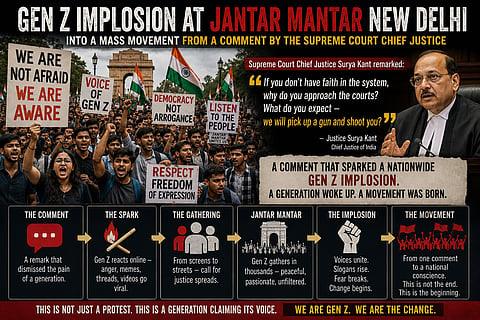


South Asia’s rulers have a youth problem. Not the demographic inconvenience discussed at conferences by men who have not spoken to anyone under thirty since their nephews stopped returning their calls.
The problem is political: a generation raised amid collapsing economies, rigged institutions and industrial quantities of official lying has begun to understand that obedience is merely oppression with better public relations.
In Bangladesh, that realisation helped bring down Sheikh Hasina. In India, it has crawled into national politics under the magnificently insolent banner of the Cockroach Janta Party (CJP). In Pakistan, it has appeared everywhere except in the imagination of the liberal intelligentsia, which remains too enchanted by uniforms, missiles and geopolitical theatre to notice the young people being arrested outside its drawing-room windows.
Cockroaches in India
The Cockroach Janta Party is proof that authoritarian contempt often provides rebellion with its finest branding. A movement born from examination leaks and administrative fraud has converted an insult into an identity. Young Indians, treated as disposable applicants in a bureaucratic lottery, have turned humiliation into solidarity. The rulers called them cockroaches; the cockroaches marched on Parliament.
The symbolism is perfect. India’s examination system promises meritocracy while too often delivering a black market in futures.
Millions study for years, families mortgage their security, and young people compress their lives into answer sheets - only to discover that the paper may have been sold before they entered the hall. This is not merely cheating. It is the collapse of the social contract at its most intimate point. The state tells the young that discipline will be rewarded, then auctions the reward.
When even the examination cannot be trusted, merit becomes mythology. And when mythology fails, politics begins.
Bangladesh Revolt
Bangladesh demonstrated the explosive possibilities of that transition in 2024. A movement against discriminatory job quotas became an indictment of an entire authoritarian order. The regime answered students with repression, apparently believing bullets possessed persuasive powers unavailable to arguments. Instead, violence widened the revolt.
Hasina’s government discovered too late that fear governs efficiently only until people become more frightened of silence than punishment.
India now stands somewhere along that dangerous continuum. The Cockroach movement is not yet a revolution, and declarations of imminent regime collapse are usually written by people safely distant from the tear gas. Its importance lies in the universality of its grievance.
Ideological disputes can be quarantined by caste, religion, party or region. Administrative betrayal travels freely. Corruption is ecumenical.
Where is Pakistan’s Gen Z?
And then there is Pakistan, where commentators still ask when the youth will rise, as though Gen Z has spent the past decade reviewing restaurants on Instagram. They have risen repeatedly. They have marched for the disappeared in Balochistan, resisted militarisation in Pashtun regions, mobilised in Kashmir, organised against canal projects in Sindh, joined women’s marches, labour protests and student movements, and confronted the post-2023 political crackdown as lawyers, journalists, activists and digital organisers.
Most dramatically, they mobilised for Imran Khan.
The state imprisoned the country’s most popular political figure, dismantled his party’s electoral machinery, removed its symbol, censored its message, arrested its workers and treated association with him as a form of sedition. Yet young Pakistanis turned social media networks into political infrastructure and the 2024 election into an insurgency at the ballot box. They voted for PTI-backed candidates under conditions designed not merely to defeat them, but to humiliate them into political disappearance.
They refused to disappear.
Imran Khan’s imprisonment is therefore not simply the confinement of one politician. It is the regime’s attempt to imprison the political imagination of a generation. His persecution has become a national lesson in how power behaves when popularity escapes its control. Courts become instruments, elections become theatre, dissent becomes criminality and the constitution becomes decorative upholstery for coercion.
Pakistan’s youth did not fail to appear. The state succeeded in preventing their struggles from converging.
Convergence Versus Fragmentation
That is the decisive distinction. Bangladesh produced a national uprising because dispersed anger fused into a common struggle.
Pakistan’s coercive order survives by keeping resistance geographically divided, ethnically compartmentalised and ideologically suspicious of itself.
The Baloch mother searching for her disappeared son, the Pashtun resisting war, the Sindhi opposing dispossession, the worker confronting predation and the PTI voter demanding electoral sovereignty are all fighting different faces of the same architecture of unaccountable power.
The regime’s greatest weapon is not repression alone. It is fragmentation. Pakistan’s liberal elite assists this fragmentation with the solemn stupidity of people who mistake access for insight. It can identify authoritarianism in Delhi with forensic precision and celebrate unrest against Modi with adolescent excitement. Yet when Pakistanis are beaten, abducted, prosecuted or tried by military courts, the same voices suddenly discover nuance.
Evidently, a baton becomes geopolitically complicated when manufactured at home.
The question is not whether Pakistan possesses revolutionary energy. It is whether its movements can recognise themselves in one another.
A generation of Memes and Satires
South Asia’s rulers still imagine Gen Z as non-nserious because it speaks in memes, edits videos and weaponises ridicule. This is the vanity of decaying regimes: they mistake unfamiliar language for absent thought.
But satire is not the opposite of politics. Under authoritarianism, it is often politics after fear has lost its dignity.
The cockroach is an excellent revolutionary mascot. It survives poisoned environments, adapts rapidly and terrifies those who believed the building belonged exclusively to them.
Bangladesh’s rulers learned that a dismissed generation could become ungovernable.
India’s rulers are learning that examination fraud can become a referendum on the state. Pakistan’s rulers may yet learn the most unpleasant lesson of all: they can imprison Imran Khan, manipulate elections and censor every screen, but they cannot permanently imprison the generation that now sees its own captivity in his.
The cockroaches are not coming.
They are already inside the palace.
Have you liked the news article?
Support us now:
https://www.gofundme.com/manage/jammu-kashmirs-sole-independent-voice-under-threat