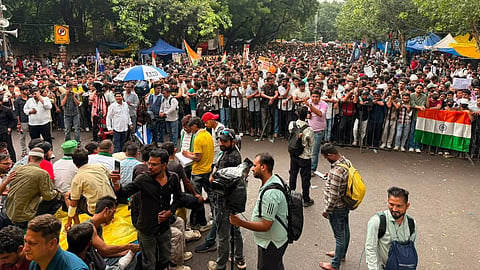


An offline generational protest against a system that views young Indians as unworthy has quickly developed from what started as online fury over exam leaks. This protest aims to hold the government accountable for its actions. On July 20, thousands of people flocked to Central Delhi's streets to join the Cockroach Janta Party's (CJP) march to Parliament in support of the resignation of Education Minister Dharmendra Pradhan, turning Jantar Mantar into a wave of outrage.
Abhijeet Dipke founded the CJP in May in response to Chief Justice Surya Kant's remarks in which he referred to unemployed youth as "cockroaches," causing indignation throughout the country, however, CJI later clarified what he meant. Nonetheless, the "party" has organised large-scale rallies and amassed a sizable internet following among young Indians. Early in June, the CJP held its first offline protest. Dipke came back from the United States to spearhead the protest, initially in Delhi and subsequently at various locations throughout the nation. Later that month, CJP supporters staged their second significant protest in Delhi, where they vowed to stay put until Pradhan resigned.
Later, Sonam Wangchuk, a renowned engineer and education activist who was held by the government under terror legislation last year due to his activism, joined the protesters. On Monday, the government was clearly startled. It most likely didn't anticipate that students and young people from all around the nation would go beyond social media and show up in large numbers in the nation's capital to support Wangchuk and the CJP.
JP Nadda, the minister of health, had to meet with a delegation from the CJP, who presented him with a list of three demands: Wangchuk's release, Pradhan's resignation, and a compensation of Rs One crore to all NEET aspirants who committed suicide as a result of the NEET 2026 paper leak. The police's use of tear gas and lathi-charge did not appear to deter the young protesters. The only other instance in which the Modi government buckled up was when farmers' protracted protests on Delhi's borders forced it to scrap the farm rules.
In fact, until Wangchuk and members of the All-India Students' Association (AISA)—Neha Bora, Manish Kumar, and Ameen Amitoj—started a fast until death, the CJP protest at Jantar Mantar had been dwindling. However, after a 23-day hunger strike, the three AISA members ended their fast on Monday in response to an appeal from academics and members of civil society. Wangchuk, who had been fasting for three weeks before being forcibly taken against his will to a government hospital, although the Delhi High Court had only ordered that his health be "monitored" every day, was unable to join the protestors because he declared himself to be under "illegal detention".
Prime Minister Narendra Modi gave his usual address prior to the commencement of the session, despite thousands of students trying to get past police barricades to the Parliament. Just a few hundred metres away from where he stood, he said nothing about what was happening to India's youth.
The CJP protest and the public unrest behind it were disregarded by the government for days. There was a notion that the CJP was destined to fade due to its relative lack of coverage in the mainstream media. The most recent trigger is the NEET paper leak. The massive gathering appears to be the result of a number of small issues that have been developing.
Protesters are merely expressing their dissatisfaction with a system in which they have no authority when they discuss the government's unwillingness to interact with young people. The public's lack of fear is what makes this time truly different. The sheer number of common people dispelled the atmosphere of intimidation, even in the face of extensive police presence, surveillance cameras, and the use of force and tear gas.
Through identity-based vilification, the Modi government and Godi Media controlled or delegitimised earlier popular movements. The campus protest was referred to as "anti-national" or "Urban Naxal"; protesting farmers were branded as "Khalistanis", and the anti-Citizenship Amendment Act protests were framed as "Muslim" disturbances. However, the current uprising is centred on issues that transcend caste, religion, and location, such as exam integrity, unemployment, and institutional trust. The students are expressly staying extremely vigilant to ensure complete peace and have made it clear that they will not allow Godi Media to characterise them as violent mobs. After decades, a protest that awakens the people and forms a collective voice.
The Modi government must rethink its position. Pay attention to what these young protesters have to say. These teenagers and young people have been outraged by the government's failure to even interact with Wangchuk and protesting students. It would be incorrect for the government to attribute the crowds on the roadways to the political opposition, even though certain opposition parties did bring in their followers.
Have you liked the news article?
Support us now:
https://www.gofundme.com/manage/jammu-kashmirs-sole-independent-voice-under-threat