

ANKARA: In August 2010, a Turkish data analyst examining the results of a national recruitment examination stopped at a number that seemed mathematically impossible: 350 candidates had answered all 120 questions correctly.
The examination was the Public Personnel Selection Examination, widely known by its Turkish acronym, KPSS. It was the gateway through which teachers, administrators and other civil servants entered Türkiye’s public institutions. Like India’s Union Public Service Commission (UPSC) exams, millions of young people spent years preparing for it, often at considerable financial and emotional cost.
A perfect score in the educational sciences section had previously been an extraordinary rarity. Now, 350 candidates had achieved it in the same examination.
The discovery immediately raised suspicion. As educationists, journalists and investigators began cross-checking the names, addresses and family connections of these supposed academic prodigies, the statistical miracle began to look like an organised conspiracy.
A report prepared by Türkiye’s Higher Education Supervisory Board later found that among the 350 perfect scorers, 70 were married to one another, 23 were related and 52 lived at the same address, in the same building, residential complex or street.
Among 3,227 candidates who scored above 100, investigators uncovered hundreds of marital and family connections and nearly 1,000 overlapping addresses.
The examination papers reportedly supplied another curious detail.
Professor İlyas Doğan, a Turkish academic and lawyer who later examined the scandal, noted that many candidates had produced flawless answer sheets without making the sort of corrections normally expected in a demanding test.
“They scored full marks without even a scratch on their papers,” he said, describing the unnaturally clean answer sheets as another indication that the candidates had known the correct responses beforehand.
When public outrage forced authorities to cancel the compromised educational sciences section and conduct it again, the miracle disappeared. Of the candidates who had originally obtained exceptionally high marks, many either stayed away or performed dramatically worse. The number of candidates scoring above 100 reportedly fell from more than 3,200 to just 76 in the re-examination.
For Turkish education unions, this was not an innocent statistical irregularity. İsmail Koncuk, the former head of Türkiye Kamu-Sen, a confederation of public employees’ unions, was among those who persistently argued that the figures demonstrated organised cheating. He publicly pressed the authorities to explain how candidates connected through families, residences and social networks could simultaneously produce unprecedented scores.
Deeper Layer and Indian Connection
Yet the deeper significance of the 2010 episode became clear only years later. What initially appeared to be an exceptionally large cheating or scandal was eventually investigated as part of an alleged attempt by the movement led by cleric Fethullah Gülen to place selected followers inside Türkiye’s bureaucracy.
It was the difference between stealing an examination paper for profit and stealing it for power.
That distinction now deserves serious examination in India. Is any powerful organisation engineering these leaks to allow its cult followers to join the system and rule in case their political leadership is edged out of power in the elections?
The cancellation and re-testing of NEET-UG 2026 after allegations of a large-scale leak threw the lives of more than 2.2 million aspiring medical students into uncertainty.
Investigators found that confidential questions had allegedly circulated before the examination through a multilayered network involving insiders, translators, teachers, coaching interests and intermediaries operating across several states.
At least 12 aspirants died by suicide during the 37 days between the May 12 cancellation and the June 21 re-examination, according to an investigation by The Indian Express. Other reports linked at least 14 student deaths to the emotional upheaval surrounding the examination, its cancellation and the fear of having to undergo the gruelling process again.
These deaths unfolded amid a much wider mental-health crisis. The National Crime Records Bureau’s Accidental Deaths and Suicides in India 2024 report recorded 14,488 student suicides. Students constituted about 8.5 percent of the 170,746 people who died by suicide across the country that year. Their share had risen from 6.7 percent in 2015.
The figures do not mean that examinations caused every death. They do, however, reveal the enormous pressure borne by a generation confronting unemployment, expensive coaching, family expectations and a recruitment system in which a single examination may determine an entire future.
India’s repeated paper leaks have now produced something more dangerous than administrative embarrassment. They have created a crisis of public faith.
“A paper leak is not just a ‘systemic lapse’ or an ‘administrative error,’” an Indian Express analysis observed. “Institutional failure stops being abstract. It becomes personal.”
Political scientist and commentator Pratap Bhanu Mehta has placed the problem within a broader collapse of accountability. Government officials, he wrote recently, can describe policy objectives and express sympathy with aggrieved citizens, but “the one thing missing in all that writing is the fixing of accountability.”
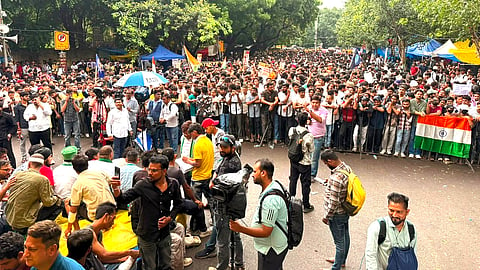
That absence has helped fuel the extraordinary rise of the Cockroach Janta Party, a satirical, youth-led movement that has taken repeated examination failures to the streets. Its supporters are demanding the resignation of Education Minister Dharmendra Pradhan and an enforceable system of accountability for officials responsible for protecting examinations.
The movement’s deliberately provocative name was adopted as a badge of anger by young Indians who believe that the political establishment treats job-seekers as expendable creatures. Its rapid spread shows that the NEET controversy is no longer confined to medical aspirants. It has become a symbol of a system that demands years of sacrifice from students but rarely imposes consequences upon those who fail them.
Leak Never Meant For Sale
A conventional paper-leak gang operates according to a simple commercial calculation. It acquires confidential questions and sells them to the highest bidders. The more customers it finds, the greater its profit.
The network exposed in Türkiye was accused of following a different logic. Investigators alleged that the 2010 KPSS questions were not placed in an open underground market. They were supplied selectively to candidates associated with the Gülen movement. Recipients were chosen because they were considered loyal, disciplined and suitable for eventual placement inside public institutions.
One defendant later told a Turkish court that he had been shown the stolen questions at a movement-linked residence. Another account described questions being carried through a special courier and studied under controlled conditions. Candidates were allegedly instructed not to leave documentary or electronic traces.
Turkish prosecutors said the questions had been extracted from the computer systems of ÖSYM, the state Assessment, Selection and Placement Centre. The alleged operation therefore required access from within the very institution responsible for protecting the examination.
Once obtained, the material reportedly moved through a compartmentalised chain. Questions were carried to selected residences, cultural organisations or preparatory centres. Candidates could be separated from their telephones and asked to memorise the answers rather than retain copies that might later expose the operation.
An ordinary examination mafia wants circulation. A political-placement network requires secrecy. Uncontrolled distribution would not only expose the theft but also dilute the advantage enjoyed by carefully selected candidates.
The ultimate reward was not the money paid by an aspiring teacher or police officer. It was the placement of an indebted follower inside the state.
Gülen Movement’s Rise & Erdoğan
Fethullah Gülen’s movement had spent decades developing the social infrastructure needed for such an operation.
Gülen drew intellectual inspiration from Türkiye’s tradition of Islamic social organisation, including the Nur movement associated with Kurdish Islamic scholar Said Nursi, popularly known as Bediüzzaman. At a time when religious conservatives faced restrictions under Türkiye’s assertively secular political order, Gülen avoided building a conventional political party.
Instead, the movement invested in education. It established schools, student residences, charitable organisations, businesses, media institutions, cultural associations and private preparatory centres. Its representatives identified academically promising children, including those from poor or conservative provincial families, and offered them accommodation, scholarships and intensive academic support.
A student arriving in Ankara, Istanbul or another university city might be given a place in a movement-run residence, help with tuition and access to a network of older professionals. In return, the student entered a closely supervised community shaped by Gülen’s religious teachings and organisational discipline.
Promising students were guided towards universities and, eventually, careers in the police, judiciary, armed forces, education system and civil administration. Successful members could then help those who followed them.
The movement publicly described this network as Hizmet, or service. Its institutions undeniably provided educational opportunities to many young people. Its schools, including those established in Africa, Central Asia, India, Pakistan and Afghanistan, often acquired reputations for discipline, science education and strong academic performance.
But Turkish scholars also warned that education gave the movement access to something more valuable than schools themselves: an educated and loyal elite.
Erdoğan rose to national prominence after serving as an effective and highly visible Mayor of Istanbul from 1994 to 1998. He emerged from Necmettin Erbakan’s Islamist Welfare Party, which was closed by Türkiye’s Constitutional Court. Its successor, the Virtue Party, was also dissolved in 2001.
Erdoğan and younger reformists then separated from Erbakan’s traditionalist leadership and established the AK Party in August 2001.
The claim that Gülen personally persuaded Erdoğan to break with Erbakan has circulated in Turkish political circles for many years. What is well established is that the Gülen movement supported the AK Party and provided it with organisational and professional resources.
The political conditions were favourable for a new force. The August 1999 İzmit earthquake, which officially killed more than 17,000 people, had exposed corrupt construction practices and profound failures of governance. The financial crisis of 2001 further destroyed confidence in Türkiye’s established parties.
From Bonding to Fallout
The AK Party swept the November 2002 election. Erdoğan was initially unable to enter parliament because of an earlier criminal conviction and political disqualification. Abdullah Gül became prime minister. After parliament removed the legal obstruction and Erdoğan won a March 2003 by-election, he took over the premiership.
The AK Party possessed votes, popular legitimacy and political leadership. The Gülen movement possessed trained personnel, schools, businesses, media influence and networks inside parts of the police and judiciary.
Both also faced a common adversary: Türkiye’s secular military-bureaucratic establishment, which had repeatedly intervened in politics and regarded religious conservatives as a threat to the Kemalist Republic.
The alliance helped Erdoğan weaken military tutelage. It also opened space for movement-affiliated professionals to rise further within public institutions. Recommendations for appointments could travel through informal political and religious channels. Loyalty to a network increasingly competed with loyalty to the institution.
Once the power of the military establishment had been curtailed, the interests of Erdoğan and Gülen began to diverge.
Disagreements emerged over foreign policy, control of the bureaucracy and the movement’s large network of private preparatory schools. These centres were not merely businesses.
Although rupture had begun when the 2010 exam leak scandal surfaced, it became open warfare in December 2013, when police officers and prosecutors considered close to the movement started targeting ministers, business figures and members of Erdoğan’s circle.
Erdoğan called the investigations an attempted “judicial coup” by a “parallel state.” His government removed or transferred thousands of police officers, prosecutors and other officials accused of belonging to the Gülen network.
Institutions whose members had once cooperated against common enemies now turned their files, surveillance capabilities and legal powers against one another.
Then came July 15, 2016.
Sections of the Turkish armed forces attempted to overthrow Erdoğan’s government. Fighter aircrafts flew over Ankara. Tanks blocked roads and bridges. Parliament was bombed. More than 250 people were killed as civilians, and loyal security forces and the public resisted the coup.
The Turkish government accused Gülen and his followers of organising the attempted takeover with the help of Western powers. Trials subsequently established the involvement of numerous military officers associated with the movement.
The defeated coup was followed by a vast purge. Soldiers, judges, prosecutors, police officers, teachers, academics and civil servants were dismissed, detained or prosecuted. Schools, universities, charities, media outlets and businesses were closed or confiscated.
Türkiye's Experience and Warnings
Türkiye’s experience therefore contains concerns about the danger of a secretive network penetrating state institutions.
There is presently no publicly established evidence that India’s paper leaks form part of a centrally directed operation run by any organisation backed by the Modi government, the BJP or the Rashtriya Swayamsevak Sangh. But the existence of such a network cannot be completely overruled.
The Gülen movement and the RSS find similarities in their histories, structures and methods.
Nevertheless, a structural resemblance deserves examination. Both recognise that durable influence does not come from elections alone. It is cultivated through schools, hostels, cultural organisations, student bodies, charities, coaching networks and professional associations. Promising young people can be identified, educated, ideologically shaped and directed towards strategic professions.
There is nothing unlawful about encouraging members of any social or religious organisation to join public service. The constitutional boundary is crossed when examination questions are supplied, recruitment lists are manipulated, interview marks are adjusted, or officials protect preferred candidates.
India’s investigations must therefore travel beyond the brokers caught selling papers.
Investigators need to ask whether beneficiaries were merely unrelated customers or whether clusters can be found around particular political organisations, coaching centres, hostels, caste networks, government employees or ideological groups.
Who selected the candidates who received the questions? Were the papers offered to anyone able to pay, or only to trusted individuals? Where did successful beneficiaries subsequently obtain appointments? Did they later recruit, promote or protect others connected to the same network? Who prevented earlier complaints from being pursued?
Computer-based testing alone cannot resolve these issues. Indian examination specialists have warned that digitisation may stop papers from being stolen during printing or transportation, but cannot eliminate compromises involving question banks, translators, software vendors, servers or insiders.
As one recent expert assessment concluded, technology cannot secure an examination if “insider compromises, coaching linkages and institutional weaknesses persist.”
The answer lies in limiting access to complete papers, rotating personnel, enforcing conflict-of-interest rules and placing sensitive functions under genuine academic and judicial oversight.
Most importantly, India needs data analysis connecting leaks with their eventual beneficiaries. Investigators should compare names, addresses, family relationships, digital communications, organisational affiliations and later appointments across multiple examinations and several years.
Such an inquiry must be supervised independently. An executive government investigating whether recruitment systems have been politicised cannot be the sole judge of its own conduct.
Türkiye discovered too late that an examination paper could be more than a commodity. In organised hands, it could decide who became a future judge, police commander, military officer, teacher, prosecutor or civil servant.
That is the question India must now confront. Not simply who stole the paper or how much money changed hands, but who was intended to enter the state through that theft, who protected the operation and whom the successful candidate was ultimately expected to serve.
Have you liked the news article?
Support us now:
https://www.gofundme.com/manage/jammu-kashmirs-sole-independent-voice-under-threat