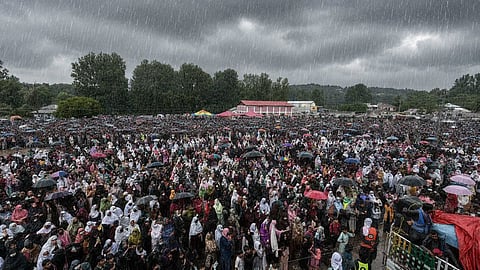


RAWALAKOT: The significance of the present crisis extends well beyond the immediate confrontation between the government and the Joint Awami Action Committee.
Political analysts in Pakistan-administered Jammu and Kashmir (PaJK) say the movement reflects a deeper erosion of trust between citizens and state institutions. While the immediate grievances revolve around recent events, the protests have evolved into a broader expression of dissatisfaction with governance, political representation and decision-making.
One notable aspect of the movement has been its organisational structure.
Unlike conventional political campaigns led by established parties, much of the mobilisation has been driven by local committees, traders, lawyers, transporters, students and civil society groups. Although political parties have attempted to position themselves around the crisis, none can credibly claim ownership of the movement.
That has complicated the government's response.
Negotiating with recognised political parties follows established channels. Negotiating with a broad-based citizens' movement, with multiple local leadership structures and no single political patron, presents a far more complex challenge.
The unrest has also exposed divisions within the mainstream political class.
Rather than presenting a united approach, major parties have adopted sharply different positions on how the crisis should be handled.
Pakistan Tehreek-e-Insaf (PTI) has chosen to boycott the elections, arguing that the political environment is neither free nor fair.
The Pakistan Peoples’ Party has continued campaigning while simultaneously advocating dialogue and calling for a Truth and Reconciliation Commission to investigate the recent violence.
The Pakistan Muslim League (N), on the other hand, insists that postponing elections would create a constitutional vacuum and further deepen uncertainty.
These competing approaches underline a larger dilemma confronting the territory: whether political stability is best served by adhering to the constitutional timetable or by first restoring public confidence through negotiations and de-escalation.
The protests have also reopened a long-standing debate about the relationship between elected institutions and administrative authority in Pakistan-administered Jammu and Kashmir.
Successive governments have frequently faced criticism for failing to address local grievances before they escalate into wider political confrontations. Analysts note that recurring cycles of protest suggest institutional mechanisms for dialogue have weakened, allowing disputes to build until they spill onto the streets.
The latest crisis has again highlighted the importance of sustained political engagement rather than reactive crisis management.
Equally significant is the challenge of rebuilding public trust.
The conflicting accounts surrounding casualties, arrests and security operations have created an information vacuum that has fuelled rumours and competing narratives.
Protest leaders accuse the authorities of excessive force, while the government maintains that law enforcement agencies acted to restore order in the face of violent attacks.
Without an independent and transparent accounting of what occurred during the past six weeks, these competing versions are likely to persist long after the protests subside.
That is why Bilawal Bhutto Zardari's proposal for a Truth and Reconciliation Commission has attracted attention beyond partisan politics. Whether or not such a body is ultimately established, the suggestion reflects growing recognition that the events of recent weeks cannot simply be resolved through policing alone.
The economic consequences are likely to outlast the political confrontation.
Weeks of disrupted transport, repeated shutdowns and uncertainty have placed considerable pressure on local businesses. Tourism, an important source of seasonal income for many families, has also suffered during what would ordinarily be a busy summer period.
Business owners in Rawalakot say recovery will depend not only on roads reopening but also on the return of public confidence. Many fear that prolonged instability could discourage investment and further strain an already fragile local economy.
Yet despite the tensions, the willingness of both sides to engage in negotiations offers a narrow opening for a political solution.
The suspension of the long march has reduced the immediate risk of a wider confrontation, but it has not resolved the issues that brought thousands of people onto the streets. The continued sit-ins serve as a reminder that the movement remains active and that public expectations of meaningful progress are high.
With only days remaining before the July 27 elections, Pakistan-administered Jammu and Kashmir stands at a critical political crossroads.
The question is no longer confined to whether polling will take place on schedule.
It is whether an election conducted amid ongoing protests, heightened security, internet disruptions and competing political narratives can command the legitimacy needed to govern a deeply polarised society.
For many residents of Rawalakot, the answer will depend less on who wins the election than on whether the next government is able to restore confidence between citizens and the institutions that govern them.
The current crisis has demonstrated that political stability cannot rest solely on security measures or electoral schedules. It requires institutions that enjoy public trust, mechanisms capable of resolving disputes before they erupt into confrontation, and a political culture that accommodates dissent rather than allowing it to harden into conflict.
Whether the recent negotiations represent the first step towards that outcome or merely a temporary pause in a much longer confrontation will become clear in the days ahead.
For now, the mountains around Rawalakot are quieter than they were a week ago. The roads are slowly reopening, election banners flutter once again in parts of the town, and political parties have resumed campaigning.
But beneath that appearance of normalcy, the questions raised over the past six weeks remain unanswered.
As polling day approaches, Pakistan-administered Jammu and Kashmir is not simply preparing to elect a new assembly. It is confronting a broader test of governance, democratic legitimacy and the relationship between the state and the people it seeks to represent.
(This news article is being published in three part series. This is Part-III and 'The Crisis Unfolds-I' and Crackdown, Negotiations and an Election in Limbo-II can be read.)
Have you liked the news article?
Support us now:
https://www.gofundme.com/manage/jammu-kashmirs-sole-independent-voice-under-threat