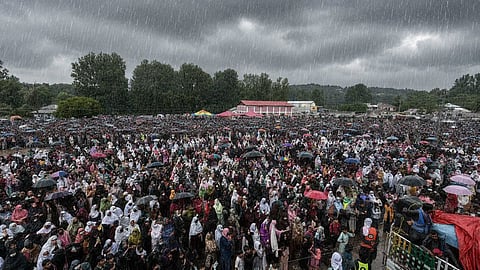


RAWALAKOT: As the protests expanded beyond Rawalakot, the state's response also intensified.
The Joint Awami Action Committee (JAAC) alleges that immediately after the announcement of the election schedule on June 5, authorities declared the committee unlawful, suspended internet services across large parts of the territory and launched an extensive security operation. It also claims that more than 22,000 additional security personnel were deployed from Pakistan to reinforce local law enforcement.
Government officials have not publicly confirmed these figures but have consistently defended the security measures as necessary to maintain law and order, protect public property and ensure that constitutional governance continues.
According to the JAAC, hundreds of homes were searched in Rawalakot, Kotli, Bagh and other districts. Protest leaders allege that activists were arrested during late-night raids, businesses associated with the movement faced financial restrictions, and cases under anti-terrorism laws were registered against dozens of participants.
Human rights organisations have also expressed concern over the scale of the crackdown. While many allegations remain difficult to verify independently because of communication restrictions and limited official disclosure, rights groups have called for transparent investigations into reported deaths, arbitrary detentions and the use of force during crowd-control operations.
For ordinary residents, however, the political arguments matter less than the daily consequences.
Weeks of intermittent shutdowns have disrupted trade, transport and education across much of Pakistan-administered Kashmir. Fruit growers have struggled to transport produce to markets. Shopkeepers in Rawalakot describe the past month as one of the worst business periods in recent memory. Passenger transport between Islamabad, Rawalakot, Bagh and Muzaffarabad has remained unpredictable, while government offices have functioned only partially in several districts.
One of the movement's most striking features has been the unprecedented participation of women.
Across Rawalakot, Muzaffarabad, Bagh and Kotli, women have not only joined demonstrations in significant numbers but have also addressed rallies, led marches and organised protest camps.
Political observers note that while women have participated in previous political movements in the region, they have rarely occupied such a visible leadership role. Their presence has broadened the social base of the protests beyond traditional political activists and given the movement a distinctly community-driven character.
The crisis reached its most dangerous phase on July 15.
Following reports of security operations near Rawalakot and in parts of Sudhnoti district, violent clashes erupted between protesters and security personnel. Various official and unofficial accounts differ on the sequence of events and casualty figures.
Multiple reports indicated that at least nine people, including police personnel and protesters, were killed in separate incidents during the day. Authorities said security forces came under attack while carrying out law enforcement operations. Protest leaders accused security personnel of using excessive force against demonstrators.
As competing narratives emerged, one fact remained beyond dispute: the violence marked one of the deadliest days since the unrest began.
Ironically, it was this escalation that appears to have created momentum for negotiations.
Back Channel Negotiations
The intervention of Overseas Pakistanis Foundation Chairman Syed Qamar Raza, acting as the Field Marshal's representative, provided both sides with an opportunity to step back from direct confrontation.
The decision by the JAAC to suspend its planned long march significantly lowered immediate tensions. Yet it stopped well short of ending the movement.
The sit-ins continue. The protest camps remain. So does the political uncertainty.
The timing of the crisis could hardly have been more consequential.
Pakistan-administered Jammu and Kashmir is scheduled to elect a new Legislative Assembly on July 27. Under ordinary circumstances, election campaigns would now dominate political discourse. Instead, security, protests and negotiations have overshadowed nearly every campaign issue.
Several political parties themselves disagree on whether elections can proceed under current conditions.
Pakistan Tehreek-e-Insaf has announced a boycott, arguing that the prevailing environment does not permit meaningful democratic participation.
The Pakistan Peoples’ Party, despite continuing its campaign, has questioned whether elections should proceed without first restoring normalcy. During a campaign visit to Muzaffarabad on July 16, PPP Chairman Bilawal Bhutto Zardari described the recent violence as a "national tragedy" and proposed establishing a Truth and Reconciliation Commission to investigate the unrest. While condemning attacks on security personnel and calling the armed forces a "red line," he urged political dialogue instead of coercion, warning that prolonged instability could damage both Pakistan's international standing and the broader Kashmir cause.
The Pakistan Muslim League (N), meanwhile, maintains that constitutional timelines should be respected and elections should proceed as scheduled.
Former Prime Minister Sardar Tanveer Ilyas, who recently joined the Istehkam-e-Pakistan Party, has also publicly questioned whether genuinely competitive elections are possible under prevailing circumstances.
For voters, however, the central question extends beyond whether polling will take place on July 27.
The larger concern is whether candidates from across the political spectrum will enjoy equal opportunities to campaign, whether voters will be able to participate freely, and whether an election conducted amid prolonged protests can produce a result that commands broad public confidence.
(This news article is being published in three part series. This is Part-II and 'The Crisis Unfolds-I' and Beyond the Protests-III can be read.)
Have you liked the news article?
Support us now:
https://www.gofundme.com/manage/jammu-kashmirs-sole-independent-voice-under-threat