

ANKARA: When NATO leaders gathered in Ankara on July 8-9, the summit was remembered for discussions on European security, Ukraine, defence spending and the future of the Alliance.
Yet one of the most powerful images did not emerge from the conference hall.
It came from protocol.
As Presidents and Prime Ministers arrived at the Presidential Complex, Türkiye's First Lady Emine Erdoğan stood at the entrance, welcoming world leaders and their spouses. Throughout the summit, she hosted official receptions, attended diplomatic events and chaired the spouses' programme at the historic Çankaya Presidential Mansion, where discussions focused on "Children, Technology and Security."
For many international observers, these were ordinary diplomatic duties.
For millions of Turks, however, the photographs carried extraordinary historical significance.
Twenty-two years earlier, during the 2004 NATO Summit in Istanbul, the same woman had effectively been excluded from official summit protocol because she wore a headscarf, although she was the wife of the head of government.
The contrast illustrates not only the transformation of Turkish politics but also the changing place of religious identity within the Turkish state.
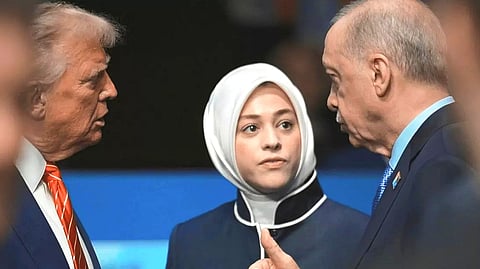
The symbolism became even stronger because another young woman wearing a headscarf was constantly visible beside President Recep Tayyip Erdoğan.
She was Fatima Gülham Abushanab, Erdoğan's trusted interpreter, translating conversations with leaders including US President Donald Trump.
Her own family story mirrors Türkiye's changing relationship with the headscarf.
The 2004 NATO Summit took place under very different political circumstances.
Recep Tayyip Erdoğan was prime minister, but Ahmet Necdet Sezer, a staunch defender of Türkiye's rigid secular establishment, was president.
Although no written NATO rule prohibited headscarves, Turkish state protocol reflected decades of restrictions imposed on women wearing Islamic dress in universities, government offices, parliament and official ceremonies.
When President Sezer hosted NATO leaders and their spouses at Istanbul's historic Dolmabahçe Palace, Prime Minister Erdoğan attended alone.
His wife was not included in the official programme.
Emine Erdoğan did not appear in the family photographs, state receptions or ceremonial events because she wore the Islamic headscarf.
The incident became one of the defining images of an era when the headscarf remained politically controversial within the Turkish Republic.
For decades, women wearing headscarves were denied access to universities, public employment and political office under policies intended to preserve the state's strict interpretation of secularism.
Completely Different Türkiye
The 2026 Ankara summit presented the opposite picture.
Instead of being absent from protocol, Emine Erdoğan became one of the principal faces of the host nation.
She personally welcomed Presidents, Prime Ministers and their spouses, represented Türkiye at official functions and chaired the spouses' summit.
Her appearance attracted little controversy inside Türkiye, reflecting how dramatically public attitudes and state policy have changed over the past two decades.
For observers who witnessed both NATO summits, the symbolism was impossible to miss.
Zeeshan Malik, lecturer at Ankara University and an expert on international strategic affairs, attended the 2004 Istanbul summit as a university student and also observed this year's gathering in Ankara.
"The difference between the two summits is like night and day," Malik told Kashmir Times.
"The strategic environment, the political atmosphere and Türkiye's self-confidence have all changed."
He recalled that during the Istanbul summit, Emine Erdoğan remained absent from official ceremonies, receptions, protocol events and photographs solely because she wore a traditional Islamic headscarf.
"At that time the prevailing thinking was that some Western leaders and even their spouses would be uncomfortable appearing alongside a woman wearing a headscarf," he said.
"The military-backed secular establishment viewed the headscarf as incompatible with official state protocol."
According to Malik, the 2026 summit projected an entirely different image.
"History had changed," he said.
"Emine Erdoğan, wearing her signature light green headscarf, welcomed presidents, prime ministers and their spouses and became one of the principal representatives of the host country."
Malik believes the symbolism went beyond protocol.
"This was not simply about one woman attending official events," he said.
"It reflected Türkiye's confidence in presenting its own cultural and religious identity without apology. Twenty-two years ago, Türkiye was still trying to prove itself acceptable to Europe. Today it engages with its allies with much greater confidence."
Another Headscarf at Summit
The symbolism did not end with the First Lady.
Throughout President Erdoğan's bilateral meetings, one young woman remained constantly at his side.
Fatima Gülham Abushanab translated conversations between Erdoğan and foreign leaders, including Donald Trump.
Her presence drew attention on Turkish social media because of her family history.
Fatima is the daughter of Merve Kavakçı, one of the most recognisable figures in Türkiye's headscarf debate.
In 1999, Merve Kavakçı was elected to parliament representing the Virtue Party.
When she entered the Turkish Grand National Assembly to take the parliamentary oath while wearing a headscarf, lawmakers shouted "Get out," preventing her from being sworn-in.
Then Prime Minister Bülent Ecevit declared that parliament was "not a place to challenge the state." She was subsequently stripped of her parliamentary position, and her Turkish citizenship was later revoked.
Following the controversy, Kavakçı moved to the United States, where she continued her academic career and raised her family.
Years later, Türkiye's political landscape had changed.
After the Justice and Development Party (AK Party) consolidated power and gradually dismantled many headscarf restrictions, Kavakçı regained her Turkish citizenship.
In 2017, President Erdoğan appointed her Türkiye's ambassador to Malaysia, making her the country's first ambassador to wear a headscarf.
Her daughter now serves as one of Erdoğan's most trusted interpreters during high-level diplomatic meetings and has accompanied him at major international summits in recent years.
For many Turks, the image carried a powerful historical irony.
A generation after her mother was expelled from parliament because of her headscarf, Fatima was translating conversations between the Turkish President and some of the world's most powerful leaders.
Wider Political Transformation
The headscarf controversy has long represented one of the deepest divisions in modern Turkish politics.
Following the military coup of 1980, restrictions on religious dress expanded across universities and state institutions.
Many conservative women abandoned higher education or pursued studies abroad because they refused to remove their headscarves.
Beginning in the late 2000s, successive reforms gradually lifted these restrictions.
Headscarves returned to universities, parliament, the civil service, the judiciary, police and eventually the armed forces.
Supporters viewed these reforms as restoring religious freedom.
Critics argued they weakened Türkiye's secular tradition.
Whatever one's political perspective, the transformation is unmistakable.
Turkish journalist Betül Tılmaç believes diplomatic protocol tells this story more clearly than political speeches.
"Twenty-two years ago, Emine Erdoğan could not attend the official NATO dinner because of her headscarf," she wrote after the Ankara summit.
"This time she hosted the spouses of 32 heads of state and government."
According to Tılmaç, protocol often reflects political realities more accurately than official declarations.
"Who is invited to the table and who remains outside sometimes says more than diplomatic communiqués."
She also notes that while Türkiye has gradually relaxed restrictions on religious dress, several European countries have moved in the opposite direction, maintaining or introducing limitations on conspicuous religious symbols in certain public institutions.
Beyond Domestic Politics
The Ankara summit therefore carried meaning beyond Turkish domestic debates.
Türkiye remains NATO's only Muslim-majority member and occupies a unique position between Europe, the Middle East and Asia.
By placing a headscarf-wearing First Lady at the centre of summit diplomacy and relying on a headscarf-wearing interpreter during meetings with global leaders, Ankara projected an image of a country comfortable presenting both its NATO identity and its conservative social traditions simultaneously.
Unlike 2004, neither image appeared to create diplomatic discomfort.
Instead, they became part of the summit's normal visual landscape.
For many Turks, that normality itself represented the biggest change.
The woman once kept outside official NATO photographs because she wore a headscarf became one of the summit's principal hosts.
The daughter of a parliamentarian once driven from the assembly chamber for the same reason translated conversations between Presidents.
Whether viewed as a victory for religious freedom, a reflection of Türkiye's changing political balance, or simply a sign of evolving democratic inclusion, the images from Ankara captured more than two decades of profound social transformation.
The story of the 2026 NATO Summit was, therefore, not only about defence, deterrence or diplomacy.
It was also about identity.
And for many in Türkiye, the headscarf that once symbolised exclusion had become a symbol of confidence, continuity and representation on one of the world's most important diplomatic stages.
Have you liked the news article?
Support us now:
https://www.gofundme.com/manage/jammu-kashmirs-sole-independent-voice-under-threat