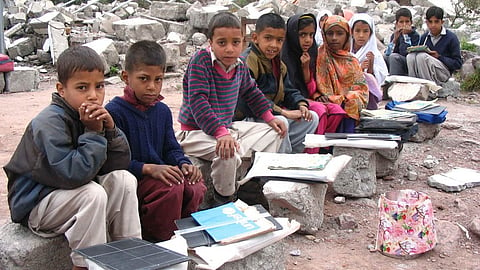


SRINAGAR: Jammu and Kashmir's schools present two very different pictures depending on which age group you look at. Among young children, the system is one of the strongest performers in India, with enrollment at the foundational level running well above the national rate. Among teenagers, it is one of the weakest, with a secondary-level dropout rate far above the national average and a government-school network that has lost more than 4,300 institutions in five years.
That picture comes from two official releases this summer. The first is the Ministry of Education's UDISE 2025-26 report the government's annual census of every school, student and teacher in the country. The second is a written reply the ministry gave the Lok Sabha on July 27, disclosing exactly how many government schools Jammu and Kashmir has lost over the past five years. Together, they offer a bleak picture of school education in Jammu and Kashmir.
At a glance
J&K had 24,228 schools in 2025-26, enrolling 26.58 lakh students and employing 1.66 lakh teachers with a pupil-teacher ratio of 16:1, better than the national average of 24:1.
The secondary-level dropout rate stood at 11.3%, against a national average of 7.0% - the 6th-highest among India's 36 states and Union Territories.
Only 39.1% of children who start Class 1 in J&K are still enrolled by Class 12, against 51.9% nationally.
J&K has 4,386 fewer government schools than it had in 2021-22 - a decline of 18.9% of its government-school stock, more than eleven times the national rate of contraction (1.7%).
188 schools reported zero enrolment and 1,544 functioned with a single teacher.
High Primary Enrollment and a Drastic Fall
The UDISE data shows J&K's real strength is getting young children into school. The Gross Enrolment Ratio (GER) at the Foundational level (pre-primary to Class 2) was 93.1% in 2025-26, more than double the national figure of 42.8%. At the Preparatory level (Classes 3-5) it was 107.2%, again well ahead of the national 91.7%. A GER above 100% typically reflects over-age or under-age children enrolled alongside migration effects, rather than an error.
That advantage disappears entirely by the time children reach their teenage years. GER at the Middle level (Classes 6-8) falls to 77.0%, already below the national 89.6%. By the Secondary level (Classes 9-12) it drops to 56.7%, a full 15 points below the national 71.7%.
The Net Enrolment Rate (NER), a stricter measure counting only children of the correct age for their grade, tells the same story. J&K's NER of 84.9% at Foundational level (versus 39.6% nationally) declines to 39.2% by Secondary level (versus 54.8% nationally), a gap of 15.6 points.
J&K gets children into school better than almost anywhere else in India but then loses a disproportionate share of them by the time they should be finishing school.
The dropout numbers by levels
At the Preparatory and Middle levels, J&K's dropout rates are actually better than the national average.
It is only at the secondary stage that the picture turns sharply negative placing J&K 6th-highest among all 36 states and Union Territories, behind only Ladakh (14.8%), Karnataka (14.3%), Chhattisgarh (13.8%), Gujarat (12.5%) and the combined Daman & Diu/Dadra & Nagar Haveli territory (11.5%).
The gendered gap is slightly higher than the national pattern. J&K boys drop out at 12.1% against a national boys' rate of 8.3%, while J&K girls drop out at 10.3% against a national girls' rate of 5.7%. This makes it 1.8 times the national female rate, higher than for boys - 1.5 times the national male rate.
Crisis predates this year's report
This is not a new problem. Parliamentary data in December 2025 showed J&K's secondary dropout rate climbing steadily for several years: from 5.96% in 2021-22, to 9% in 2022-23, to a peak of 13.4% in 2023-24, before easing slightly to 12.9% in 2024-25. It’s more than double in four years.
The new UDISE report marks the dropout to 11.3%. The Ministry of Education states explicitly in the report that, "with effect from 2025-26," the schooling structure used to calculate these indicators was reorganised to match NEP 2020's "5+3+3+4" model, under which "Secondary" now means the old Secondary and Higher Secondary stages combined (Classes 9-12) rather than Secondary alone (Classes 9-10) as in earlier reports.
Though this restructuring does not make the newest data perfectly continuous with the pre-2025-26 series, it remains fully comparable to this year's national average, since both numbers were calculated the same way in the same report.
Nationally, secondary dropout fell sharply this year - from 11.5% in 2024-25 to 7.0% in 2025-26, according to the new report. J&K's rate fell too, but by much less (12.9% to 11.3%, on the older count). J&K, thus, went from being only marginally above the national average in 2024-25 to being dramatically above it in 2025-26.
Only two in five make it to Class 12
The Retention Rate - the share of a student still enrolled at each subsequent stage since Class 1- is stark.
In J&K, retention falls from 92.5% at the Foundational stage to 80.3% at Preparatory, 75.3% at Middle, and just 39.1% by Secondary, against a national secondary retention rate of 51.9%. Only 74.7% of boys and 76.3% of girls who complete Class 10 in J&K go on to enrol in Class 11.
The vanishing government school
The dropout numbers correspond to a marked contraction in the number of government schools available to J&K's children. According to the Ministry of Education's written reply to the Lok Sabha on July 27, the number of government schools in J&K fell from 23,173 in 2021-22 to 18,787 in 2025-26, a net loss of 4,386 schools, or 18.9% of the total.
The table shows the decline was not gradual. Essentially the entire fall took place in the single transition from 2021-22 to 2022-23, after which the count has stayed almost perfectly flat for four consecutive years, edging up by only two schools in the most recent year.
Nationally, by contrast, the number of government schools fell by just 1.7% over the same five years (from 10,22,386 to 10,05,245). This shows that J&K's government-school network contracted at more than eleven times the national rate.
This is crucial because J&K also relies far more heavily on government schools than India as a whole. 77.5% of its schools are government-run, compared with 68.5% nationally. A policy that trims government schools disproportionately affects J&K's overall school access.
Responding to the same Lok Sabha question, Minister of State for Education Jayant Chaudhary reiterated that education sits on the Constitution's Concurrent List, and that decisions to open, merge or close schools, along with teacher recruitment and deployment, rest with state and Union Territory governments, not the Centre.
He said NEP 2020 permits school consolidation only when carried out "judiciously" and without cutting off students' access to a neighbourhood school, framing the policy around "school complexes" or clusters meant to pool resources and staff more efficiently. The Centre, he added, continues to fund school infrastructure, transport, textbooks, uniforms and enrolment drives in J&K through the Samagra Shiksha scheme.
An Administrative Decision at the Root
The contraction traces back to a specific administrative decision. In December 2021, J&K's School Education Department under Lieutenant Governor-led administration began compiling staffing and enrolment data across every primary and middle school as a prelude to a rationalisation drive.
Officials had identified roughly 2,000 schools with very low enrolment for review, split evenly between the Jammu and Kashmir divisions, and set a minimum enrolment threshold of 15 students for a government school to keep operating as a standalone institution.
By April 2022 the department had announced plans to merge an initial 720 schools, with students shifted to nearby institutions and surplus teachers redeployed.
The primary-school category was hit hardest. Government primary schools fell by close to 30%, from around 12,977 to 8,966, according to figures widely reported in 2024, alongside the removal of several hundred middle, high and higher secondary schools from the UDISE rolls.
Combined with a smaller decline in private and other institutions, J&K's total school count from government and private schools combined fell from roughly 28,800 to about 24,280 over the same stretch, broadly consistent with the 24,228 total schools recorded in the newest 2025-26 report.
In March 2025, J&K's current Education Minister, Sakina Itoo, told the Legislative Assembly that 4,358 schools had been merged in the Union Territory under the rationalisation scheme This figure, though slightly different from the Lok Sabha’s count, falls in the same range. The slight variation could be explained by different dates and reference points across the different official disclosures.
Empty classrooms, unfinished business
The rationalisation drive has not eliminated the underlying problem of very small schools. In a reply to the J&K Legislative Assembly in March 2026, the School Education Department said 3,192 schools across the Union Territory had reported fewer than ten, or zero, students at some point since 2022, even after 1,732 schools were closed or merged since 2019 (1,427 in Jammu division and 305 in Kashmir division).
Those under-enrolled schools together still carried 2,518 teachers on paper, and the government told the Assembly it had spent a cumulative Rs 13,816.66 crore over the years on salaries for staff in such low and zero-enrolment schools. The department told the Assembly it was continuing to redeploy surplus teachers and lean on Cluster Resource Coordinators to fill subject gaps in science, mathematics and English.
1,396 government schools have been merged across just three north Kashmir districts of Baramulla, Kupwara and Bandipora alone.
In the newest UDISE 2025-26 report itself, J&K recorded 188 schools with zero enrolment and 1,544 single-teacher schools serving 33,537 students between them. This points to the fact that, even after several years of mergers, a long tail of very small institutions remains part of the system.
The average J&K school enrols 110 students, well below the national average of 169, underscoring how much smaller and more thinly spread J&K's schools are compared with the rest of the country.
The infrastructure gap
Beyond enrolment and staffing, the report also shows J&K's schools trailing national averages on several facilities, even as a couple of areas buck the trend.
The gaps in disability access stand out in particular - a 42.5-point shortfall on ramps with handrails. Notably, the proportion of disabled population in Jammu and Kashmir is 2.87% , which is higher than the national average of 2.21%, as per 2011 census. The report also notes a 30.4-point shortfall on accessible toilets, alongside a 25.5-point gap in schools with working computer facilities. Solar panel coverage is one of the few areas where J&K outperforms the national figure, likely reflecting targeted rural electrification and renewable-energy schemes in the Union Territory.
How J&K ranks nationally
The Ministry of Education's companion Performance Grading Index (PGI) 2.0 for 2025-26, released alongside the UDISE data, placed J&K in the "Akanshi-1" band - a score of 21–30% on the index's 1,000-point scale. That is the lowest grade any state or Union Territory received this year. J&K's tier represents the bottom of the range actually achieved nationally. It shares that band with Uttar Pradesh, Bihar, West Bengal, Madhya Pradesh, Jharkhand, Nagaland, Arunachal Pradesh, Manipur, Mizoram and Meghalaya.
Taken together, the data paints a system that has largely solved the problem of getting young children enrolled but has not solved the harder problem of keeping teenagers in school, or of right-sizing a network of thousands of small government schools without leaving families in remote areas short of a nearby option.
Have you liked the news article?
Support us now:
https://www.gofundme.com/manage/jammu-kashmirs-sole-independent-voice-under-threat