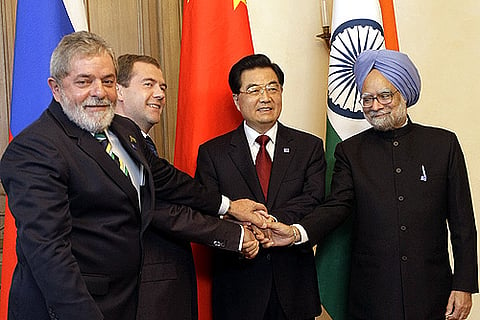


I have watched BRICS grow almost from its diplomatic infancy. I was part of Prime Minister Manmohan Singh’s media delegation to Yekaterinburg in Russia for the first summit of what was then simply BRIC: Brazil, Russia, India and China on June 16, 2009. South Africa had not yet supplied the final “S”.
Yekaterinburg itself was an appropriate setting for an experiment seeking to straddle worlds. The city sits just east of the Ural Mountains, close to the conventional geographical divide between Europe and Asia. It is also etched into Russian history as the place where Tsar Nicholas II, the last Russian emperor, and his family were killed by Bolsheviks in 1918.
The city that once witnessed the violent termination of an old order was now hosting four countries dissatisfied, in a very different way, with another established order.
The acronym BRIC had originally been coined by Goldman Sachs economist Jim O’Neill in 2001 to describe four large emerging economies expected to reshape the global economy. It was not conceived as a political alliance. But the financial crisis of 2008 transformed an investment-bank shorthand into something politically more interesting. The four countries wanted a greater voice in institutions such as the International Monetary Fund and World Bank, where the distribution of power continued to reflect the post-Second World War settlement rather than the economic balance of the 21st century.
From BRIC to BRIC+S
The first summit therefore concentrated heavily on reforming global financial institutions, recovery from the Great Recession, food security and increasing the representation of emerging economies in international decision-making. BRIC was not yet promising an alternative world order. Its argument was more modest: the existing one could no longer be run indefinitely as though economic power had not shifted.
Yekaterinburg in 2009 was memorable for another reason. The Shanghai Cooperation Organisation summit was taking place almost simultaneously, allowing for a meeting between Manmohan Singh and Pakistan President Asif Ali Zardari. It was the first meeting at that level after the November 2008 Mumbai attacks had frozen India-Pakistan relations.
Singh’s opening words were unusually direct. “Mr President, my mandate is to tell you that Pakistani territory should not be used for terrorism against India,” he told Zardari in front of journalists, who were still in the room taking pictures.
For those of us covering the meeting, that line almost overwhelmed the newly born BRIC summit in Indian news coverage.
The following April, I accompanied Singh again, this time to Brasília for the second BRIC summit. That meeting remains particularly vivid because it illustrated how India was opposed to expanding the organisation.
Brazilian President Luiz Inácio Lula da Silva was strongly interested in bringing South Africa into the grouping. South African President Jacob Zuma was in Brasília, and there was a widespread assumption around the summit that Africa’s largest diplomatic and political actor would soon become part of BRIC. India was reluctant.
My recollection from the summit was that the Indian side argued that BRIC was still a fledgling arrangement and needed consolidation before the doors were opened to new members. Zuma left without attending the summit.
Diplomacy on Airport Tarmac
There was, however, an extraordinary postscript to Brasília.
An Icelandic volcanic eruption had sent an ash cloud across Europe, disrupting air traffic. The Indian Prime Minister’s aircraft needed an alternative route home and a refuelling halt. There was no other place in the world except Johannesburg. Despite India annoying South Africa in Brasilia, Commerce Minister Anand Sharma, whose wife is of South African origin, used his contacts and helped facilitate the stop.
When the aircraft landed there late at night, Zuma had come to the airport with senior members of his government to receive Singh. But the Special Protection Group accompanying him would not initially allow the Prime Minister to disembark because the airport had not been cleared according to its security protocol. Eventually, South African Foreign Minister Maite Nkoana-Mashabane was allowed aboard to meet him.
Diplomacy sometimes turns on carefully drafted communiqués. At other times, its impressions are formed on airport tarmacs. This South African gesture, perhaps, dissolved India’s resistance to expand the grouping.
A year later, in the Chinese city of Sanya on April 14, 2011, Zuma sat at the summit table as a full member. The Sanya Declaration formally welcomed South Africa and spoke of a grouping representing nearly three billion people seeking a “more equitable and fair world”.
India had swallowed its reservations.
Expansion, which New Delhi once feared might dilute BRICS, is today the principal source of the grouping’s claim to global importance.
From Five to Eleven
For more than a decade after South Africa joined, BRICS remained a five-member club. It accumulated institutions, most notably the New Development Bank, and gradually extended cooperation into trade, health, technology, development finance and political coordination. But it remained manageable.
At Johannesburg in 2023, the members agreed to admit a new group. Egypt, Ethiopia, Iran, Saudi Arabia and the UAE entered the expanded framework, followed by Indonesia in 2025. India, which had once urged caution, backed expansion by consensus.
Brazil, Russia, India, China and South Africa, joined by Egypt, Ethiopia, Iran, Saudi Arabia, the United Arab Emirates and Indonesia, are now members of the grouping. Expansion has nevertheless created a serious problem. Every new member adds weight but also imports its conflicts.
The sharpest example in Delhi was West Asia.
Iran is now a BRICS member. So are Saudi Arabia and the UAE. The United States-Israel war with Iran had therefore entered the summit room rather than merely appearing on its agenda.
In May, BRICS foreign ministers meeting in Delhi had been unable to produce a joint statement. By September the possibility of a leaders’ declaration was therefore by no means assured.
India eventually obtained consensus.
The New Delhi Declaration expressed grave concern over the deterioration in West Asia, urged maximum restraint, defended dialogue and diplomacy and criticised unilateral sanctions and trade restrictions. Yet its wording remained deliberately general. It did not provide the explicit assignment of blame Tehran would have preferred.
The organisation could keep Iran and its Gulf rivals sitting around the same table. It could find language all were prepared to sign. It could not transform their conflicting strategic interests into a common foreign policy.
Iranian President Masoud Pezeshkian met Abu Dhabi Crown Prince Sheikh Khaled bin Mohamed bin Zayed Al Nahyan on the sidelines. Against the background of regional war and deep strategic rivalry, their meeting gave Delhi an opportunity to play host to precisely the kind of conversation that BRICS advocates.
Iran, in fact, appeared to understand the diplomatic possibilities of the summit better than almost anyone else.
Iran’s Delhi Theatre
While many visiting leaders largely remained inside the carefully controlled summit circuit, Pezeshkian turned the visit into a wider exercise in public diplomacy.
One of the most striking gatherings took place at the Oberoi hotel. What made it memorable was not merely the presence of an Iranian President but the composition of the room: Pandits, Muslim religious figures, Sikh Gyanis, the Mirwaiz of Kashmir, businessmen, diplomats and intellectuals rubbing shoulders.
On the sidelines of the BRICS Summit, a delegation of Kashmiri leaders led by Mirwaiz Umar Farooq met with Iranian President Dr. Masoud Pezeshkian and Foreign Minister Abbas Araghchi, with Shia leaders Aga Syed Hassan Moosvi and Molvi Imran Reza Ansari also in attendance. The interaction marked a significant diplomatic development, coming after a long hiatus in which New Delhi had permitted a Kashmiri leadership delegation to meet with a visiting foreign head of state.
During the meeting, the Kashmiri leaders expressed deep concern over the volatile situation in the Middle East, the ongoing crisis in Palestine and Lebanon, and acts of aggression against Iran, while reaffirming their solidarity with the Iranian people. They emphasized that a lasting resolution to conflicts can only be achieved through diplomacy and dialogue rather than confrontation. In view of rising Islamophobia, the Mirwaiz stressed the imperative of mutual unity across the Muslim Ummah by setting aside sectarian and political divides. As a symbol of the centuries-old historical and cultural ties between Kashmir and Iran, the delegation presented the Iranian President with a finely carved walnut-wood replica of Srinagar's historic Jamia Masjid.
In an Indian public sphere increasingly separated into political and religious compartments, it was an unusually plural gathering.
Tehran clearly had more than bilateral diplomacy in mind.
Iran has spent years being depicted in Western political discourse as isolated, sanctioned and disruptive. Delhi offered Pezeshkian an international stage from which to contest that image. He appeared not merely as the leader of a country at war but as the representative of an old civilisation, a major Asian state and a full participant in a bloc comprising nearly half the world’s population.
His daughter Zahra added another layer to the charm offensive. She visited the BRICS Bazaar, interacted with artisans and toured the Prime Ministers’ Museum along with family members of other visiting dignitaries.
Pezeshkian’s meeting with Modi was their second in roughly two weeks. For Tehran, the visit was plainly designed to produce political legitimacy well beyond India.
New Delhi had its own balancing act. It could give Iran diplomatic space without endorsing every Iranian position; maintain close relations with Israel without allowing those relations to dictate its BRICS diplomacy; and continue cultivating Washington while hosting leaders whom Washington either sanctions or treats as adversaries.
That, perhaps more than any declaration, illustrated what India wants BRICS to be.
China in the Room
Xi Jinping’s presence was equally consequential.
It was his first visit to India in nearly seven years and therefore itself constituted an important political signal after the deadly 2020 border confrontation and years of frozen relations.
The Modi-Xi meeting did not produce a dramatic reconciliation, nor was one realistically possible.
The two sides spoke about business, mobility, cultural exchanges, market access and managing differences. India raised its enormous trade imbalance and continued concern over the boundary. Both recognised that differences should not automatically become disputes.
Putin’s visit reaffirmed a relationship India is unwilling to abandon despite Western pressure. Russian oil, military cooperation and a decades-old strategic relationship continue to matter. But India has also carefully declined to embrace the Russian argument that BRICS should become the institutional nucleus of an explicitly anti-Western order.
Terrorism: India’s Permanent Paragraph
For the Indian media, however, one measure of diplomatic success was immediately familiar. The New Delhi Declaration specifically condemned the April 2025 terrorist attack in Pahalgam in which 26 people were killed.
It was the second consecutive BRICS declaration to mention the attack. The text reiterated zero tolerance for terrorism, called for accountability and action against terrorist safe havens, and stated that terrorism should not be associated with any religion or nationality. It did not, however, name Pakistan or endorse Operation Sindoor. The paragraph was understandably welcomed in India.
But it also brought back memories of an old diplomatic ritual. For years, Indian delegations have expended considerable energy ensuring that bilateral and multilateral declarations include strong language condemning terrorism.
Nobody seriously objects to condemning terrorism. The more difficult conversation begins afterward.
A German diplomat once remarked to me that India invariably celebrated getting the word “terrorism” inserted into a communiqué, but showed much less enthusiasm to follow up when discussion moves towards causes, political remedies or concrete mechanisms for preventing radicalisation and violence.
Ask a member of the Indian delegation where terrorism directed at India originates, and Pakistan is identified almost instantly. Ask what process could ensure that Pakistani territory is no longer used against India, and the conversation becomes considerably more complicated. Dialogue itself is often portrayed as a concession.
The contradiction is obvious. If Pakistan is indeed the central external source of terrorism affecting India, there ultimately has to be some mechanism, coercive, diplomatic, or preferably both, for changing Pakistani behaviour.
One cannot permanently substitute identification of the problem for a policy to solve it.
I was reminded of this again in 2016 when I was included among Indian editors and senior journalists in a BRICS Media Forum delegation before the Goa summit.
During one discussion about creating BRICS “centres of excellence”, a Chinese delegate suggested Beijing for technology and finance, Brazil for sports, South Africa for culture and Moscow for security.
Then he came to India. He said for two days, almost every Indian intervention he had heard had been about terrorism and nothing else, which means India does worry about any other thing, be that architecture of global finance, security or art and culture etc. He therefore suggested that India should get the centre devoted to terrorism. There was an awkward silence in the room.
Then some Indian editors began quietly asking one another whether we were allowing terrorism to crowd out every other subject: development, trade, financial structures, technology and institution-building.
The anecdote may have been humorous, but the question remains serious.
Terrorism is a grave security challenge. But diplomatic success cannot be measured indefinitely by the number of communiqués in which the word appears. The causes that generate discontent also need to be addressed.
Dialogue Abroad, Paralysis Next Door
This leads to a larger contradiction in Modi’s international posture.
At BRICS, the Prime Minister repeatedly advocated connectivity, dialogue and diplomacy. India presents itself as a country able to talk simultaneously to Russia and Ukraine, Iran and Gulf monarchies, Israel and Palestine, the United States and China.
Its preferred international vocabulary is peace, consensus, pluralism, inclusivity and reform.
But apply those principles within South Asia, and the picture becomes less comfortable.
The South Asian Association for Regional Cooperation has effectively been comatose since the cancellation of the Islamabad summit in 2016.
There are understandable reasons for New Delhi’s frustration with Islamabad, especially over terrorism. Yet the irony remains. India argues globally that adversaries must remain at the same table while the principal regional organisation in its own neighbourhood cannot meet because its two largest members will not do so.
Similarly, Modi’s international declaration that this should not be an era of war sits uneasily beside a regional doctrine increasingly built around punitive military retaliation. Operation Sindoor was presented domestically as establishing a “new normal”, in which India reserved the right to strike targets inside Pakistan following terrorist attacks.
The issue is not whether a state possesses a right to defend itself. The question is whether dialogue and diplomacy are universal principles or prescriptions primarily offered to conflicts elsewhere.
India wants Russia and Ukraine to negotiate. It urges restraint between Iran and its adversaries. It facilitates a conversation between Tehran and Abu Dhabi. It asks China to manage differences rather than allow them to become disputes. Why should such logic stop at Wagah and LoC?
There is a similar tension between India’s international celebration of pluralism and the argument over pluralism at home.
At BRICS, India correctly insisted that no single political model should dominate the international system. Civilisations have different histories. Countries must respect one another’s sovereignty and diversity. Global institutions should become more representative.
But a country aspiring to become one of the principal voices for pluralism abroad inevitably invites examination of how comfortably it practises pluralism domestically.
The Citizenship Amendment Act, “bulldozer” demolitions that courts and rights groups have questioned, anti-conversion laws, shrinking space for civil-society organisations and increasingly communal language during election campaigns all negate the assertions made at high tables.
Likewise, India demands democratisation of international institutions and rightly asks why the United Nations Security Council should continue reflecting the power distribution of 1945. Yet its own Parliament has frequently witnessed major legislation pushed through amid bitter complaints from the opposition about inadequate scrutiny and debate.
This should not obscure what New Delhi achieved at this summit. Getting 11 members with profoundly different strategic interests to agree on a substantial declaration was not trivial.
Iran and the UAE found common language on West Asia. Russia and states close to Washington signed the same document. Former Foreign Secretary Nirupama Rao captured it neatly after the summit: India seeks “reform without rupture”. It wants greater representation for developing countries, protection from unilateral economic coercion and room for the Global South to manoeuvre, but it has no interest in abandoning Western markets, capital or technology.
But after days of declarations about civilisational diversity, the final irony could be found on the dining table.
The gala dinner hosted by Modi at Bharat Mandapam was entirely vegetarian.
The menu was certainly inventive: Khandvi Mille-Feuille, Khumb Galouti, Paneer Lababdar, Gucchi Marmik, Carrot Bean Poriyal, Thakkali Belle Saaru, Millet Pulao, Beetroot Raita, Old Delhi fruit cream with jalebi and Shahtoot Phirni topped with mulberries and gold leaf.
The dishes were sophisticated. But they also reflected the peculiar evolution of official Indian hospitality under Modi.
India’s increasingly elaborate vegetarian diplomatic tables are testing the limits of soft power.
Chinese President Xi Jinping skipped the gala dinner, as did Abu Dhabi Crown Prince Sheikh Khaled bin Mohamed. No official explanation linked their absence to the menu. Perhaps neither leader wished to sacrifice an entire evening deciphering Khandvi Mille-Feuille, Khumb Galouti, Gucchi Marmik, Thakkali Belle Saaru and Shahtoot Phirni.
With no famed Delhi biryani or nalli nihari in sight, the menu seemed curiously detached from the culinary map of a country in which a large majority of people consume non-vegetarian food.
Food diplomacy may appear trivial beside war, sanctions and global financial reform. It is not entirely so. A summit is also theatre. Nations choose what parts of themselves they display.
Iran used Delhi to project religious and social plurality. China projected economic ambition. Russia projected strategic endurance. India had a chance to project its civilisational confidence and immense diversity through the food.
That is perhaps the central paradox left by the New Delhi BRICS summit.
India wants an international order large enough to accommodate Iran and the UAE, Russia and its critics, China and India, authoritarian governments and democracies, rival economic models and competing civilisations.
The next step may be to demonstrate that the same generosity towards difference can flourish in South Asia, in India’s domestic politics and, occasionally, even on its banquet tables.
(This news article has been updated with some additional information)
Have you liked the news article?
Support us now:
https://www.gofundme.com/manage/jammu-kashmirs-sole-independent-voice-under-threat