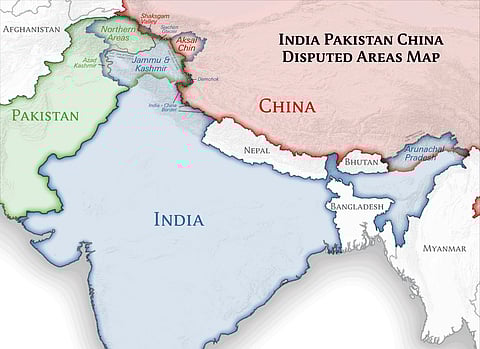


Recent reports of Track-II meetings between eminent Indian and Pakistani personalities, including former officials meeting Pakistani military and ISI representatives, produce a quietly encouraging development in a bilateral relationship long defined by hostility and mistrust.
Even more significantly, the Rashtriya Swayamsevak Sangh (RSS), the ideological parent of India's ruling BJP, has signalled openness to dialogue with Pakistan. Kashmir's chief preacher, Mirwaiz Umar Farooq, has added his voice to this growing chorus, asserting that dialogue remains the only viable path to resolving issues. More than 100 eminent citizens from both countries have jointly appealed to Prime Minister Narendra Modi and Pakistani Prime Minister Shehbaz Sharif to resume structured dialogue.
This convergence of voices—from the ideological right in India to religious leadership in Kashmir to civil society across the subcontinent—demands attention. The time has come to move beyond sporadic, unofficial exchanges and establish a structured, institutionalised dialogue mechanism — one that includes Afghanistan and leverages China's unique position as a constructive facilitator.
The futility of the status quo
India and Pakistan have tried everything except genuine, sustained dialogue. They have fought wars, fuelled insurgencies in each other's territories, exchanged hostile rhetoric, and engaged in military confrontations—most recently the four-day conflict in May 2025 following Operation Sindoor. None of these approaches has resolved a single outstanding issue. From Siachen to Kashmir, from water-sharing to cross-border terrorism, the fundamental disputes remain intractable.
Every time there is some progress in talks, a violent incident unravels it. Formal dialogue has been virtually non-existent since the 2008 Mumbai attacks. The relationship has been frozen, punctuated only by crises and confrontations. Meanwhile, the people of the subcontinent—particularly in Kashmir, Balochistan, Khyber Pakhtunkhwa and Afghanistan — bear the heaviest cost of this perpetual hostility.
A remarkable confluence of voices
What makes this moment significant is the breadth of support for dialogue across traditional divides. The RSS, long regarded as a hardline organisation, has made a strong case for dialogue with “the people of Pakistan”. RSS general secretary Dattatreya Hosabale has advocated for keeping “the doors of dialogue” open, while RSS chief Mohan Bhagwat has endorsed this position.
Kashmiri leadership has consistently called for dialogue. Mirwaiz Umar Farooq has urged India and Pakistan to return to the negotiating table, asserting that friendship between the two offers the best path toward resolving longstanding issues, including Kashmir. Over 100 prominent citizens from both countries have appealed to their prime ministers to take “meaningful and sustained steps” towards restoring peace. As former Chief Minister of Jammu and Kashmir, Mehbooba Mufti, has noted, even senior RSS leadership now supports dialogue.
This is not a fringe position. It reflects a growing consensus that the current trajectory is unsustainable and that dialogue, however difficult, is the only viable alternative.
From Track-II to structured dialogue
Track-II meetings serve an essential purpose. The recent Colombo meeting, which brought together former Indian Army chief General MM Naravane, senior RSS leader Ram Madhav, and Pakistani officials, including Foreign Ministry Director General Sajjad Haider Khan, covered critical issues such as cross-border terrorism, water-sharing, and reducing the risk of military escalation.
However, Track-II diplomacy alone is insufficient. The Indian government has made it clear that it does not officially participate in or support such engagements. While this position is understandable, it also means these exchanges lack the institutional backing necessary to translate into meaningful progress.
What is needed is a structured dialogue mechanism—one that builds on Track-II exchanges but elevates them to a level where they can produce tangible outcomes. It should include clear terms of reference, agreed agendas, regular schedules, and mechanisms for implementation and verification. It should address outstanding issues comprehensively: Kashmir, Siachen, water-sharing, cross-border insurgency, trade normalisation, and people-to-people contacts.
The case for including Afghanistan
No discussion of India–Pakistan relations can ignore Afghanistan. The country shares borders with Pakistan and China and has been a theatre of competition, proxy warfare, and instability for decades. The trilateral forum between China, Pakistan, and Afghanistan has already demonstrated the value of structured engagement. In April 2026, representatives from the three sides held informal talks in Urumqi, Xinjiang, to discuss relations and identify core issues.
Including Afghanistan in a broader quadrilateral framework with India, Pakistan, and China would address security concerns regarding cross-border militancy, create a platform for regional connectivity and economic cooperation, and reduce the zero-sum dynamics that have long characterised South Asian geopolitics.
China’s unique role as facilitator
China is uniquely positioned to play a constructive role. It shares borders with India, Pakistan, and Afghanistan and maintains significant relationships with each. Beijing has already demonstrated its capacity for diplomatic mediation, hosting talks between Pakistan and Afghanistan to alleviate tensions. The “Urumqi Process” aims to reduce tensions, counter security threats, and strengthen political trust. Chinese officials have consistently called for dialogue and stability in South Asia.
India has been cautious about accepting third-party mediation, rejecting China’s claim that it helped de-escalate tensions following Operation Sindoor. This caution is understandable given India’s preference for bilateral engagement. But the complexity of the issues and the involvement of multiple stakeholders suggest that a broader multilateral framework may be necessary.
China need not serve as a formal mediator. It could offer advisory and secretarial services, provide logistical support, and use its leverage with all parties to encourage constructive engagement. Its interest in regional stability, driven by economic investments including the China–Pakistan Economic Corridor and potential extensions into Afghanistan, aligns with the goal of reducing tensions.
A moment that must not be wasted
The confluence of support for dialogue from across the Indian political spectrum, Kashmiri leadership, and civil society represents a rare opportunity. As the joint letter from over 100 eminent citizens urged, the two governments should “choose engagement over isolation, dialogue over hostility and cooperation over confrontation”.
The path forward is clear: institutionalise the dialogue process. Move beyond sporadic Track-II meetings to a structured, regular, and comprehensive mechanism. Include Afghanistan to address regional dimensions of conflict and cooperation. And leverage China’s unique position as a constructive facilitator — not as a formal mediator, but as a partner in creating the conditions for lasting peace.
The alternative is more crises, more hostility, and more suffering for the people of the subcontinent. Dialogue — structured, sustained, and inclusive — is the only way forward.
Have you liked the news article?
Support us now:
https://www.gofundme.com/manage/jammu-kashmirs-sole-independent-voice-under-threat