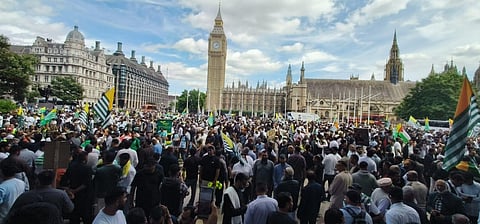


London did not merely witness a protest on Sunday. It felt a rupture, a tectonic crack in the city’s political calm. A historic surge of Kashmiri defiance swept through its streets, a roar so vast that many are already calling it the largest Kashmiri demonstration since the early 2000s.
By conservative counts, nearly 10,000 people poured into central London—a breathtaking leap from the scattered hundreds who once gathered under the quiet patronage of the Pakistan Embassy. Today’s uprising, however, carried none of that orchestration. It was raw, unfiltered, unmistakably organic—a thunderclap born from the ground itself.
This was not a rally; it was a pilgrimage of endurance. Under a merciless sun, thousands marched nearly 3 kilometers from the lawns behind Parliament to the gates of the Pakistan Embassy. Volunteer stewards in high‑visibility vests moved like a quiet choreography through the crowd, guiding a river of humanity through temporarily shuttered London roads. The procession didn’t stumble; it flowed.
And what a river it was. The youth formed its blazing core, but the march was a tapestry of generations. Middle‑aged men, mothers balancing toddlers, elderly citizens leaning on crutches—all pressed forward through the heat. The image that will linger longest: ninety‑three-year‑old Jabbar Bhat, resolute in his wheelchair, pushed gently toward the frontlines of a struggle he has carried in his bones for decades. His presence alone felt like a poem.
A solemn police cordon flanked the route, managing the closure of major arteries with a respect that matched the gravity of the moment.
The Message Strikes Like Lightning
What set today apart wasn’t just the scale—it was the ferocity of the voice. The chants for azadi didn’t echo; they detonated. They rose with a cohesion rarely heard in diaspora streets, a single, burning exhale of collective rage. One of the participants, jaw clenched, captured the mood with brutal clarity: “People are angry—the Pakistani military has killed more people today.”
The visual landscape was a gallery of grief. Placards bearing the faces of Showkat Nawaz Mir, the leading face of the Jammu Kashmir Joint Awami Action Committee, more popularly known as the Joint Awami Action Committee (JAAC), and dozens of others slain over the past four weeks turned the march into a moving memorial. And in a bitter twist of irony, some carried signs demanding freedom for “Azad” Kashmir—a paradox that perfectly mirrors the region’s tangled, aching reality.
Blame, Fury, and the Coming Political Earthquake
Across conversations with participants young and old, one verdict rang out with chilling unanimity: the Pakistan Army is blamed for pushing the people past their breaking point. When asked why no one mentioned the Pakistan-administered Jammu and Kashmir (PaJK) government, the response was swift and dismissive: “They have no power.”
Among the crowd were Kashmiri intellectuals, writers, and community leaders from across the UK. People from all walks of life and different political persuasions and biradaris unified in their desire to support their besieged brethren in PaJK. Many participants had endured five‑to‑six‑hour bus journeys just to stand on London’s asphalt for a few hours and register their dissent. Their exhaustion showed, but so did their resolve.
Everyone I spoke with agreed on one stark prediction: this month‑long uprising is not a passing storm. It is a fault line. It will send tremors through PaJK’s political landscape and permanently strain its relationship with Islamabad. The public consciousness ignited today will not cool; it will smoulder, reshape, and harden. And the Pakistani military establishment now faces a crisis it can no longer manage with its old, comfortable scripts of control.
The landscape has shifted. The old narrative is fraying. And the worn‑out script may finally be collapsing under the weight of a people who refuse to be choreographed any longer.
Have you liked the news article?
Support us now:
https://www.gofundme.com/manage/jammu-kashmirs-sole-independent-voice-under-threat