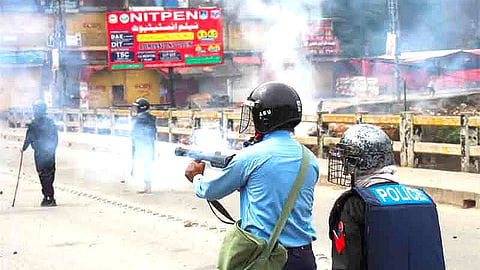


When a state runs out of arguments, it reaches for its most overused political crutch: blame an outsider. Cornered by its own failures in Pakistan-administered Jammu and Kashmir (PaJK), euphemistically called 'Azad' Jammu and Kashmir (AJK), Islamabad has once again deployed this script. When dissent becomes inconvenient, call it treason and blame India.
But the crisis unfolding in the mountains of PaJK has nothing to do with New Delhi. It is Pakistan's latest political crisis, unfolding far from Islamabad, where a broad-based civilian uprising has exposed the fragility of the state's authority. Since June 2026, the Joint Awami Action Committee (JAAC), a coalition of traders, transporters, lawyers, students, and civil society groups, has mobilized tens of thousands against decades of economic exploitation and political manipulation.
The movement's demands are modest: affordable electricity, fair wheat subsidies, hydropower royalties, and the abolition of 12 refugee seats that Islamabad has long used to engineer governments in Muzaffarabad. Yet the state's response has been anything but modest.
When the PaJK government, acting under Islamabad's direction, failed to implement the 2025 Muzaffarabad Agreement and instead banned JAAC under the Anti-Terrorism Act, the result was predictable: mass protests, a communications blackout, and lethal force. Dozens of civilians, including women and children, were killed.
The Treason Template
Pakistan's ministries, pro-establishment media, and a swarm of anonymous social media accounts have accused JAAC leaders of maintaining secret links with India's intelligence agency, RAW. Sedition charges against JAAC leader Shaukat Nawaz Mir cite "anti-state activities" but offer no evidence because none exists.
JAAC's 38-point charter is a catalogue of domestic grievances. Not a single demand touches foreign policy. The ban notification itself cites only vague threats to "peace and security." If Islamabad had even a shred of proof of Indian involvement, it would have broadcast it with the zeal of a state desperate for vindication.
Instead, it has recycled the same script used against Baloch activists, the Pashtun Tahaffuz Movement, and political opponents at home.
The so-called "cipher" allegedly linking JAAC to India's Geneva mission was dismissed by AJK's own Prime Minister in 2025. It surfaced on the dark web; the media sensationalized it; the state weaponized it. That is the entire story.
The second pillar of the state's narrative - that Indian currency was recovered from JAAC protestors - is even more absurd. Pro-establishment accounts circulated images of Indian notes, including demonetized bills, supposedly found in JAAC offices.
Yet no AJK police statement mentions such a recovery; no Home Department notification cites it; and no reputable Pakistani or international media outlet has verified it.
This allegation survives only on WhatsApp forwards and hyperventilating talk shows. It collapses under basic logic: why would a movement demanding the abolition of refugee seats, which is Islamabad's favourite tool for political manipulation, be an Indian proxy?
Pakistan's propaganda ecosystem is a disinformation machine running on auto-pilot. The output follows a pattern. Audio leaks of JAAC leaders discussing routine protest logistics are manufactured and produced as evidence of treason. Deepfake videos of India's Amit Shah, already debunked by BOOM, are pushed into circulation to whip up nationalist hysteria. Memes of Indian currency are seeded through anonymous accounts, designed to breed suspicion while leaving no fingerprints.
It is the behaviour of a state in panic, improvising stories after the fact to justify violence it has already inflicted.
What Islamabad Is Really Hiding
A Broken Social Contract: The Muzaffarabad Agreement promised subsidies, reforms, and inquiries into police brutality. Islamabad reneged. When JAAC resumed protests after the missed deadline, the state chose repression over responsibility.
A Region Treated as a Colony: PaJK produces hydropower yet pays crippling tariffs. Wheat subsidies lag behind Gilgit-Baltistan. Refugee seats distort democratic representation. These are not Indian talking points; they are structural inequities baked into Islamabad's governance model.
A Brutal Crackdown: Nearly 14,000 troops were deployed from mainland Pakistan. Communications were shut down. Live ammunition was fired on unarmed mourners. JAAC offices were sealed. Civil society leaders were arrested. Children and pregnant women were reportedly killed.
International concern, from Amnesty International to British MPs, is rising. Disinformation is the state's attempt to buy time before accountability arrives.
The Truth Pakistan Can’t Face
Islamabad's narrative is collapsing because it is built on sand. The allegations of Indian links are unproven. The "cipher" was debunked. The Indian currency story is a farce. Deepfakes and doctored audio are the last refuge of a state that has run out of arguments.
JAAC is not an Indian conspiracy. It is a mirror reflecting decades of neglect, exploitation, and contempt for the people of AJK. The citizens of AJK are not foreign agents. They are Pakistan's most honest critics. And that is precisely why the state fears them the most, and seeks to silence them at any cost.
Have you liked the news article?
Support us now:
https://www.gofundme.com/manage/jammu-kashmirs-sole-independent-voice-under-threat