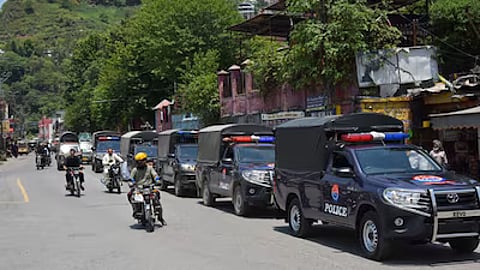


Police Fire on Protesters Ahead of Planned March
MUZAFFARABAD: Clashes erupted in Rawalakot, a district in Pakistan-administered Jammu and Kashmir (PaJK), on Sunday, leaving at least eleven people dead and more than seventy injured. The violence pitted police and paramilitary forces against activists of the Joint Awami Action Committee (JAAC), a civil society alliance that has been demanding political and economic rights for the people of the region.
According to Sardar Waheed Khan, Commissioner of the Poonch sector, as reported by Reuters, four police officers and a passerby were killed when, he said, "miscreants shot at them." He added that six protesters were killed in the security forces' response. The AJK (PaJK) Inspector General of Police, Liaqat Ali Malik, confirmed to Dawn that 23 security officials and 50 protesters were among the injured, and that 30 people had been arrested.
The violence came just days before a planned protest long march to Muzaffarabad, the region's capital, that JAAC had called for June 9. JAAC leader Shaukat Nawaz Mir described the events in a video message as "a massacre of our people in Rawalakot." The commissioner rejected that characterisation, saying the state's action was aimed at restoring law and order, and that protesters had used automatic rifles, petrol bombs, and other weapons against security forces.
A Trader's Death Sets Off a Chain of Events
The immediate trigger for Sunday's violence was the death of a local trader who was allegedly shot during a confrontation with law enforcement officers on Friday night. His family initially announced plans for his burial on Saturday, but later changed course, bringing his body back to the Combined Military Hospital (CMH) in Rawalakot, reportedly for a post-mortem examination, and deferring the funeral to Sunday.
The body was kept in the hospital's mortuary, but the post-mortem was not conducted. In the meantime, scores of people gathered outside CMH in a sit-in. When a police party arrived to disperse the protesters, tensions boiled over. Riot police used batons and tear gas, and protesters responded with stone-pelting. The situation then escalated sharply.
The trader's family declared they would not bury him until the government withdrew a notification it had issued days earlier, proscribing the JAAC under anti-terror law.
Communication Blackout and Unverified Claims
The flow of information from PaJK has been severely disrupted. Mobile phone and internet services have been cut across many areas, making it very difficult to independently verify the full extent of casualties or the sequence of events.
Local sources have alleged that Pakistani Rangers opened direct fire on unarmed civilians, and that a pregnant woman being taken to CMH for delivery was killed by gunfire. These claims have not been independently confirmed. Reports circulating on social media about the use of drones and helicopters firing on protesters also could not be verified.
Some local sources have alleged that hundreds of people may have been killed during overnight operations in Rawalakot, a figure far higher than the official count. Given the communications blackout, the exact number of casualties remains unclear.
A curfew has reportedly been imposed in Rawalakot, and movement restrictions are in force — with no more than two people allowed to enter the city at the same time. Section 144 of the CrPC (Prohibitory Orders) is in effect.
Clampdown and Reinforcements
Before the Sunday clashes, the regional government had already taken sweeping action against the JAAC. On Friday, it declared the alliance a proscribed organisation under an anti-terror law, accusing it of being "engaged in terrorism" and acting in a manner "prejudicial to peace and security." On Saturday, authorities launched a crackdown, arresting scores of JAAC leaders and activists across different areas. AJK (PaJK) police also sealed the JAAC's head office, state broadcaster Radio Pakistan reported.
The regional administration has advised both domestic and foreign tourists to leave the region before June 9 and asked all intending visitors to postpone their trips until June 20, citing security concerns.
Islamabad has also dispatched federal paramilitary forces to reinforce the region's police. Reports suggest that approximately 14,000 security personnel have been deployed to PaJK from Pakistan, including Rangers, Federal Constabulary, Islamabad Police, and Sindh Police personnel.
What JAAC Is Demanding — And Why
The JAAC is a civil society alliance that has previously led campaigns over issues including electricity tariffs, wheat flour prices, and broader economic rights in the region. The current flashpoint is a specific electoral demand: the abolition of 12 seats reserved for refugees in the upcoming elections to the AJK (PaJK) Legislative Assembly, scheduled for July 27.
The AJK (PaJK) assembly has 45 seats in total. Of these, 33 are territorial constituencies in which residents of PaJK vote for candidates who live among them. The remaining 12 are "non-territorial" seats, reserved for refugees from the former state of Jammu and Kashmir who fled to mainland Pakistan — primarily after 1947 and, in some cases, after the 1965 and 1971 wars.
JAAC's core complaint is that these 12 seats are contested by candidates who do not live in Kashmir at all. They live elsewhere in Pakistan, yet they win seats in the PaJK assembly and can play a decisive role in forming the government that governs the people of the region.
The Numbers Behind the Grievance: A Stark Imbalance
To understand the depth of resentment, the electoral arithmetic matters.
According to the latest voter registration data from the Election Commission of PaJK, the 33 territorial constituencies represent approximately 3.37 million registered voters, meaning each territorial MLA represents around 102,000 voters on average.
The 12 non-territorial constituencies represent approximately 438,500 registered voters in total. But the imbalance within this group is even more striking. Six of these seats are reserved for refugees originally from the Kashmir Valley, and they contain just 33,598 registered voters in total. That means each Valley Refugee MLA represents roughly 5,600 voters — compared to the 102,000 represented by a territorial MLA.
The remaining six non-territorial seats represent refugees from Jammu, Mangla Dam affectees, and other displaced State Subjects residing elsewhere in Pakistan, with a combined voter base of around 404,948. Each MLA in this category represents approximately 67,500 voters.
The result is a striking inequality: a voter in a Valley Refugee constituency exercises more than 17 times the voting power of a voter in a regular territorial constituency. Legal analysts and reform advocates have called this arrangement one of the most extreme cases of disproportionate representation found in any democratic system.
A Tool of Political Control? What Critics and Analysts Say
The JAAC's demands are not simply about electoral arithmetic. Many in PaJK believe these seats have been used by mainstream Pakistani political parties to control political outcomes in the region without being accountable to the people who live there.
Justice (Retd.) Syed Manzoor Hussain Gillani, a former Chief Election Commissioner and Vice Chancellor of the University of Azad Jammu and Kashmir (PaJK), has written that over decades of close observation, he has "rarely encountered an informed observer who does not believe that the refugee seats reserved for Jammu and Kashmir migrants have become a mechanism through which Islamabad exercises decisive influence over political outcomes in the territory."
He notes that the issue divides Pakistan's major parties along lines of electoral self-interest. The Pakistan Peoples’ Party has generally opposed the refugee seats because it has rarely won them, while the Pakistan Muslim League (N) has historically benefited from them and therefore supports their continuation. A remark attributed to senior PML-N leader Rana Sanaullah — that his party's majority in PaJK should effectively "begin with eleven seats" — widely reinforced the public perception that refugee seats are tools of government formation, not genuine refugee representation.
Justice Gillani argues that the core principle at stake is straightforward: people ought to exercise political and administrative rights where they actually live. Democratic legitimacy flows from residency, participation, and accountability. When elected representatives depend on voters who live outside the territory, the connection between the government and the people it governs is fundamentally weakened.
The Historical Background: How Refugee Seats Came to Exist
To understand why these seats exist, one must go back to 1947. When British India was partitioned and the subcontinent's map was redrawn, hundreds of thousands of people from the princely state of Jammu and Kashmir were displaced, with many settling in different parts of Pakistan. These communities — which included people from the Kashmir Valley, the Jammu region, and areas affected by the construction of the Mangla Dam — retained legal recognition as "State Subjects" of Jammu and Kashmir under PaJK's Interim Constitution.
The creation of reserved seats for these communities was originally framed as a way of preserving their connection to the unresolved Kashmir dispute and ensuring their voice was not lost in the political process. The Kashmir question — over which India and Pakistan have fought multiple wars and which remains contested to this day — gives these seats a symbolic dimension beyond ordinary electoral representation.
JAAC and its critics do not dispute that refugees and displaced State Subjects deserve representation. What they dispute is whether the current structure of that representation remains fair — or whether it has drifted far from its original purpose.
The Case for Reform, Not Abolition
Analysts who have examined the issue in detail argue that abolition of refugee seats is not the only option — and may not be the right one. A more measured path would be electoral reform that preserves constitutional protections while correcting the extreme imbalance.
One such proposal involves amending Article 22 of PaJK's Interim Constitution and applying the principle of proportional representation to current voter registration figures. Under this approach, the existing 12 non-territorial seats could be reduced to 4, which would still constitute a constitutionally protected voice for refugees and displaced communities — but without the extreme over-representation that currently distorts the democratic system.
The eight seats freed up through such reform need not be lost. They could be reassigned to create representation for other underrepresented communities: young people, persons with disabilities, overseas Kashmiris, or other groups whose voices are largely absent from the formal political process. This would reframe the debate from one focused on taking seats away to one about expanding democratic inclusion.
A Region With Limited Rights, Outsized Stakes
PaJK's political situation carries an additional layer of complexity. The territory is not formally incorporated into Pakistan. Its residents do not enjoy all the rights available to Pakistani citizens. In certain official contexts, PaJK has even been described as separate from Pakistan's constitutional framework.
Yet despite this ambiguous constitutional status, Islamabad wields significant influence over the region's political life — a fact that the refugee seat controversy throws into sharp relief. Critics argue that allowing non-resident voters to shape government formation in a territory they do not live in, whose roads they do not use, whose schools their children do not attend, and whose problems they do not share, amounts to a democratic deficit that is difficult to justify.
The consequences are felt beyond politics. The current arrangement influences how government jobs are distributed, how federal quotas are allocated, and how admissions to professional institutions are managed. For many residents of PaJK, this is not an abstract constitutional debate. It affects the opportunities available to their children.
What Happens Next
As of the time of writing, the situation in Rawalakot remains tense. A curfew is in force, mobile data services remain cut, and security forces continue to be deployed in large numbers across the region.
JAAC has vowed to press ahead with its June 9 lockdown and march to Muzaffarabad despite the crackdown. The regional government, backed by Islamabad, appears determined to prevent it. The question of whether further violence can be avoided depends on whether any space opens up for negotiation between the two sides.
Beneath the immediate crisis, however, lies a deeper question that will not go away: whether a region of over four million people can be governed in a way that genuinely reflects their will — or whether outside interests will continue to shape their political life from a distance.
The killings in Rawalakot are a sign of how urgently that question demands an answer.
Have you liked the news article?
Support us now:
https://www.gofundme.com/manage/jammu-kashmirs-sole-independent-voice-under-threat