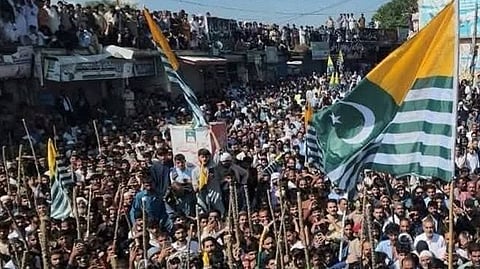


LONDON/BIRMINGHAM: The British Kashmiri diaspora brought the crisis in Pakistan administered Jammu and Kashmir (PaJK) directly into the Palace of Westminster. Constituent letters flooded MP inboxes across the country. An Early Day Motion was tabled and signed. The chair of the All-Party Parliamentary Group on Kashmir wrote personally to the Foreign Secretary. And a formal briefing paper was placed in the hands of MPs and Lords before the day was out.
The timing was deliberate. Overnight, security forces had opened fire on mourners gathered for the funeral of a civil-rights activist in Rawalakot, killing at least eleven people. Families across Britain woke to find they could not reach relatives in PaJK. Phone lines were down. WhatsApp was cut. The internet was off. The diaspora’s response was to act.
The Kashmiri diaspora members held protest demonstrations outside the Pakistan High Commission office in London. Similar protest was organised in Birmingham and Bradford and called upon the Pakistan government to stop use of force against the protestors in different towns of Pakistan administered Jammu & Kashmir. They expressed their concern over police firing in Rawalakot, where about a dozen persons were reported to have been killed since Friday evening.
Early Day Motion tabled in the House of Commons
Imran Hussain MP, the Bradford East MP who chairs the All-Party Parliamentary Group on Kashmir, tabled Early Day Motion 310 in the House of Commons today. By the close of business, it had been signed by six Members of Parliament.
The motion expresses grave concern at the communications blackout, lockdown, mass arrests and raids in PaJK. It condemns any excessive or unlawful use of force against peaceful protesters and civil society representatives. It notes the distress caused to British Kashmiris who have been unable to contact relatives, including British citizens currently in PaJK. It calls for:
• Immediate restoration of communications
• Lifting of restrictions on contact between families
• Safe medical access for all injured persons
• Protection of peaceful assemblies
• Release or prompt production before court of all detainees
The motion urges the Governments of Pakistan and PaJK to end the lockdown and resume dialogue and calls on the UK Government to use all appropriate diplomatic channels to facilitate a peaceful resolution and provide enhanced consular support for affected British nationals.
Letter to the Foreign Secretary
Separately, Imran Hussain MP wrote today to Foreign Secretary Yvette Cooper at the Foreign, Commonwealth and Development Office (FCDO), asking the Government to account for its response to the unfolding crisis.
In his letter, he described the situation as one of deep concern: a communications blackout, a broader lockdown, arrests including those of British nationals, and a breakdown in dialogue between the authorities and the Joint Awami Action Committee. He told the Foreign Secretary that parliamentarians had been contacted by numerous constituents unable to reach relatives in PaJK, causing significant anxiety and distress across the British Kashmiri community.
He asked the Foreign Secretary to clarify five specific points:
1. What assessment the FCDO has made of the reported communications disruptions as part of a broader lockdown in PaJK
2. What steps the UK Government is taking to ensure British nationals in the region can access support and maintain contact with loved ones
3. What representations the UK Government has made, or intends to make, to the Governments of Pakistan and PaJK regarding the immediate lifting of the blockade and restoration of communications
4. What engagement the FCDO has undertaken to encourage the resumption of peaceful negotiations and dialogue with the JKJAAC
5. What steps the UK Government is taking to monitor developments and support efforts aimed at preventing further escalation
The letter concluded with a direct appeal: “The people of Pakistan administered Jammu and Kashmir, and the many British Kashmiris with deep family and community ties to the region, deserve peace, stability, and the opportunity for their concerns to be addressed through dialogue rather than confrontation.”
Hussain urged the Government to engage proactively and use all appropriate diplomatic channels to encourage de-escalation and a peaceful resolution.
Imran Hussain confirmed on Monday evening that the letter had garnered the support of 50 Parliamentarians.
Constituent letters sent to MPs across the country
Simultaneously, a coordinated constituent letter campaign got underway. A template letter, drafted and circulated by the JKJAAC Advisory Council UK, was sent by British Kashmiris to their own MPs in constituencies across England, Scotland and Wales.
The letter asked MPs to take immediate action on several fronts. First and most urgently, it called on them to table or sign an Early Day Motion and to write without delay to both the Foreign Secretary and the Minister for South Asia. It also pressed MPs to ask the FCDO directly what consular support is being made available to British nationals currently in PaJK.
On the ground situation, the letter urged MPs to call on Pakistan to restore internet, mobile and WhatsApp communications immediately, and to seek firm assurances that there would be no violent crackdown on peaceful protesters, mourners, journalists, lawyers and civil society leaders. It further called for guaranteed medical access for the injured, due process for all those detained, and a commitment to implementing the Muzaffarabad Agreement through peaceful dialogue.
The campaign drew directly on the scale of the British Kashmiri community’s ties to PaJK. More than one million people of Kashmiri origin and heritage live in the UK. Thousands of British citizens, dual nationals, pensioners and visitors are believed to be currently in PaJK for family events, holidays or business. With the internet and mobile networks cut, many UK families have had no word from relatives since the crackdown began on June 5.
Formal briefing papers placed before MPs and Lords
Meanwhile, the JKJAAC Advisory Council also prepared and circulated two formal briefing documents to Members of the House of Commons, Members of the House of Lords and officers of the APPG on Kashmir.
One was a briefing paper for UK Parliament and the APPG on Kashmir giving details about the ‘AJK Crisis, 8 June 2026’. It is a detailed eleven-page document covering the immediate crisis, British national safety concerns, FCDO travel advice implications, the background of JKJAAC as a civil-rights movement, the Muzaffarabad Agreement and its non-implementation, the constitutional and electoral reform dispute, and a full suite of draft parliamentary tools including a proposed Early Day Motion, suggested oral questions and a draft letter to the Foreign Secretary.
Another three-page emergency update focused specifically on the deteriorating situation in Rawalakot following the attempted funeral prayers of Shahzeb Habib on 7 June. This paper set out nine immediate humanitarian demands, a revised draft Early Day Motion and a suggested urgent oral question for Parliament.
Both papers were prepared for immediate use in Parliament.
What happened in Rawalakot overnight
The lobbying campaign was given its immediate urgency by events that unfolded in Rawalakot, District Poonch, PaJK, on the night of June 7–8.
Shahzeb Habib, a local activist and JKJAAC member, had been killed by security forces. When mourners gathered, with reports of more than 10,000 people converging on the Combined Military Hospital where his body was being held, security forces moved in.
Police and paramilitary troops opened fire, killing at least eleven civilians and wounding more than seventy. A curfew was imposed. The Pakistan Army cordoned off the area.
Official figures were lower. The Poonch Commissioner confirmed seven civilian deaths and thirty arrests. But with the internet and mobile networks cut across large parts of PaJK, independent verification of any figures remained impossible.
The JKJAAC Advisory Council issued an urgent open letter to Pakistan’s President, Prime Minister and all political party leaders demanding an immediate ceasefire, Red Cross access, restoration of communications, and implementation of the Muzaffarabad Agreement of 3–4 October 2025.
Political dispute behind the crisis
The immediate crisis sits within a longer political dispute. JKJAAC - the Jammu Kashmir Joint Awami Action Committee - is a civil-rights movement that grew from grievances over electricity tariffs, wheat subsidies and resource justice, and developed into a campaign for democratic reform. Its central demand is reform of the 12 non-territorial “refugee” seats in the PaJK Legislative Assembly.
The movement argues that these 12 seats, which make up 26.7% of the Assembly, represent only 11.5% of the registered electorate, a disproportion it frames as a fundamental democratic inequality. Some refugee constituencies have as few as 5,600 registered voters per MLA, against around 67,000 in the largest territorial constituencies.
Following unrest in late 2025, the Government of Pakistan intervened as guarantor and the Muzaffarabad Agreement was signed on 3–4 October 2025. It committed to implementation within three months. The JKJAAC memorandum of April 2026 recorded that many core demands remained unimplemented, delayed or disputed.
A High-Powered Legal and Constitutional Committee had been established to address the electoral seat question but had stalled. JKJAAC kept the door open for dialogue until 31 May 2026, then confirmed the 9 June Long March to Muzaffarabad would go ahead.
The crackdown on JKJAAC activists began on 5 June, before the march could take place.
What happens next
The parliamentary pressure is expected to continue into the coming days. With EDM 310 now on the parliamentary record and constituent letters landing in MP offices across the country, community organisations are urging British Kashmiris to follow up directly with their own MPs to ask whether they will sign the motion and write to the Foreign Secretary.
The FCDO has not yet issued a public statement specifically on the Rawalakot events or the situation of British nationals in PaJK. The APPG on Kashmir is expected to seek an urgent meeting with FCDO officials and British Kashmiri community representatives.
The June 9 Long March, originally planned as a peaceful march on Muzaffarabad, is due to take place tomorrow. The FCDO has warned it may bring further road closures, disruption and suspension of services.
(This news article has been updated with reports of protest demonstrations organised by Kashmir diaspora in London, Bradford and Birmingham)
Have you liked the news article?
Support us now:
https://www.gofundme.com/manage/jammu-kashmirs-sole-independent-voice-under-threat