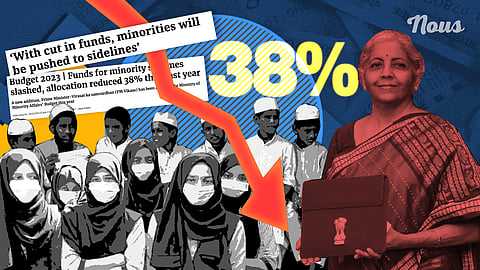


NEW DELHI: India’s minority affairs budget has remained largely stagnant in recent years, even as actual spending has fallen sharply and educational indicators for Muslims show continued decline.
A new policy paper and a parliamentary intervention have together highlighted what analysts and opposition leaders describe as a widening gap between allocations and outcomes.
A detailed analysis by policy researcher Jawed Alam Khan of the Institute of Policy Studies and Advocacy says the government’s approach toward minority welfare has become increasingly restrictive.
The report notes that Muslim students account for only about 4.6 percent of higher education enrollment, despite forming nearly 14 to 15 percent of the country’s population. This gap, it says, reflects persistent under-representation and limited upward mobility in education.
Khan’s study points out that the Ministry of Minority Affairs received ₹3,400 crore in the 2026–27 budget, only a marginal increase from ₹3,350 crore in the previous year. Over the last five years, the budget has shown little growth, while actual utilisation has dropped sharply.
The figures reveal a steep fall in spending.
In 2023–24, ₹3,098 crore was allocated, but only ₹154 crore was spent.
In 2024–25, ₹3,183 crore was allocated, yet only ₹715 crore was used, amounting to just 22 percent of the total.
The report notes that utilisation had earlier remained above 90 percent in some years, but dropped to 16 percent in 2022–23, 5 percent in 2023–24, and 22 percent in 2024–25.
According to the study, the primary reason for the decline is the Cabinet Committee on Economic Affairs' non-approval of major scholarship schemes since 2021–22. As a result, large portions of allocated funds have remained unspent. The report says several programmes have also been discontinued, including the Maulana Azad National Fellowship, Nai Udaan, and assistance schemes for madrasas.
Khan writes that the unit cost of minority scholarships has not been revised since their introduction in 2007–08, making them inadequate to meet rising education expenses. He warns that reduced allocations and under-utilisation of funds for pre-matric, post-matric, and merit-cum-means scholarships could have serious consequences for minorities' education.
He argues that the situation contradicts the government’s stated goal of building a “Developed India” by 2047. The report recommends restoring discontinued schemes, approving scholarship programmes immediately, and increasing allocations to match the scale of deprivation among minority communities.
Owaisi Flags Dropout Crisis
The concerns raised in the policy paper were echoed in Parliament by AIMIM MP Asaduddin Owaisi, who criticised the government over declining minority enrollment and under-utilisation of funds.
Citing official data, Owaisi said that Muslim enrollment declines steadily as students move to higher classes. He told the House that Muslim enrollment in Uttar Pradesh stands at about 15 percent at the primary level, falls to 14 percent in upper primary, 12 percent in secondary, and drops further to 10 percent in higher secondary. “That means a decline of five percentage points by the time students reach higher secondary,” he said.
He also cited higher education figures, saying Muslim participation rose to 5.45 percent in 2019–20 but fell to around 4.64 percent in the following year.
Owaisi accused the government of neglecting scholarship schemes. He said three major minority scholarship programmes had not received Cabinet approval for the past five years, leading to large amounts of unspent funds.
“You are passing budgets here, but for five years, you have not spent the money. Why? Because the Cabinet Committee on Economic Affairs is not approving these schemes,” he said.
He argued that educational exclusion would undermine national development. “You want to build a developed India. But do you think by keeping 14 percent of the population uneducated you can build a developed India?” he asked.
Owaisi also said scholarship amounts had not kept pace with rising costs. “The unit cost of scholarships has not been revised since 2007 or 2008. In more than a decade, you have not increased them by even 10 percent,” he said.
He demanded the restoration of the Maulana Azad Fellowship and called for broader scholarship coverage to address high dropout rates among Muslim students.
Referring to budget figures, he said that although ₹5,000 crore had been allocated to the ministry in 2022–23, only about 16 percent was spent. He added that utilisation remained extremely low in the following years as well.
Policy Concerns Deepen
Khan’s report and Owaisi’s speech point to the same structural problems: stagnant budgets, falling utilisation, discontinued schemes, and declining participation of Muslims in higher education.
The policy paper also highlights the weak implementation of credit and vocational programmes run through the National Minorities Development and Finance Corporation, which was set up to support the poorest sections of minority communities. It notes that the reach of such schemes remains limited, despite modest increases in allocations.
While ₹2,000 crore has been earmarked for the Pradhan Mantri Jan Vikas Karyakram this year, the report says earlier allocations were reduced at the revised estimate stage, limiting the programme’s impact in minority-concentration areas.
Khan concludes that minority welfare spending needs a significant overhaul. He calls for higher allocations, demand-driven scholarships, revised income ceilings and restoration of discontinued programmes. Without such measures, he warns, the gap in educational and economic outcomes between minorities and the national average is likely to persist.
With both independent policy analysis and parliamentary debate now focusing on the issue, minority welfare funding is emerging as a key point of contention in the broader discussion on India’s development priorities.
Have you liked the news article?
Support us now:
https://www.gofundme.com/manage/jammu-kashmirs-sole-independent-voice-under-threat