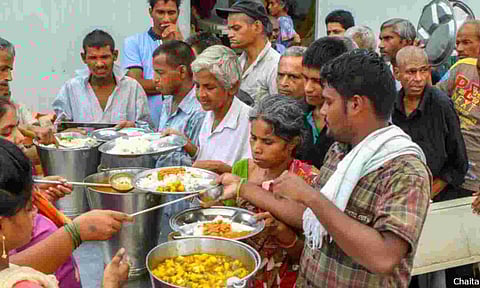


NEW DELHI: Individual donations in India remain heavily concentrated around faith-based institutions and direct almsgiving, with religious organisations receiving about 46 percent of contributions and beggars or destitute individuals receiving 42 percent, according to a new national study on household philanthropy.
The findings are part of the How India Gives 2025–26 report prepared by the Centre for Social Impact and Philanthropy (CSIP) at Ashoka University, with support from Artha Global. The study, authored by researchers at CSIP, draws on one of the largest datasets on everyday giving in India, comprising more than 7,200 surveys and qualitative interviews conducted across 20 states in 11 languages.
The report offers a rare glimpse into how ordinary households contribute to social causes, revealing both the depth of India’s giving culture and the structural limitations that prevent much of this philanthropy from reaching organised social sector institutions.
A ₹540-Billion Giving Economy
According to the report, India’s everyday giving economy, consisting largely of small individual donations, is estimated at roughly ₹540 billion annually.
Nearly two-thirds of respondents in the survey reported having given money, goods, or time to charitable causes during the study period. In-kind donations such as food, clothing, or other essential items were the most common form of giving, accounting for nearly half of all contributions. Cash donations followed closely, while nearly one-third of respondents reported volunteering their time.
The authors say this demonstrates that charitable giving is deeply embedded in Indian society and cuts across income groups.
Even among lower-income households with monthly spending between ₹4,000 and ₹5,000, around half reported giving in some form. As household consumption rises, both the likelihood and amount of giving increase significantly.
Informal Charity Dominates
Yet the report also highlights a major structural challenge: most donations in India take place informally and therefore remain outside formal nonprofit institutions.
Many donors prefer giving directly to people in need or to religious institutions rather than to registered charities or non-governmental organisations. Only about 15 percent of respondents said they supported non-religious organisations such as NGOs.
According to the researchers, this reflects long-standing traditions of faith-based charity and community support.
“In India, giving is often personal, immediate, and rooted in social or religious obligations,” the report notes. People frequently donate when approached directly by individuals or during religious gatherings and festivals.
While such generosity sustains community networks, it also means that organised social sector organisations capture only a small share of India’s philanthropic resources.
Different Types of Indian Donors
To better understand giving behaviour, the researchers classified Indian donors into four categories based on education and household consumption levels.
The largest segment, termed “grassroot givers”, represents about 55 percent of the population. These donors typically have modest incomes and education levels but regularly contribute small amounts, often to religious causes or individuals in distress. Despite limited means, this group contributes an estimated ₹220 billion annually.
“Aspirational givers,” who account for about a quarter of the population, tend to have higher levels of education but relatively modest incomes. Their giving is often shaped by social awareness and empathy.
Another segment, called “practical givers,” consists of households with higher consumption levels but lower educational attainment. Their contributions are often motivated by spiritual beliefs or a sense of moral duty.
Finally, “well-off givers,” who represent about six percent of the population, have both higher incomes and higher levels of education. They are the most likely to donate regularly and are more inclined to support organised charitable institutions.
The report notes that education tends to influence where people donate, while income levels largely determine how much they give.
Personal Appeals Still Drive Giving
The study also sheds light on how donors discover opportunities to contribute.
Direct, in-person appeals remain the most effective channel for mobilising donations. Nearly one-quarter of respondents said they learned about giving opportunities through personal interactions, community events, or direct requests.
Social media platforms are emerging as an additional source of awareness, particularly among younger and more educated donors, though their overall influence remains limited compared with traditional networks.
Researchers say the dominance of direct appeals reflects the strong role of interpersonal trust in Indian philanthropy.
“In many cases, people donate because someone personally approaches them or because they witness an immediate need,” the report says.
Structural Challenges for Nonprofits
The authors argue that India’s nonprofit sector faces a significant challenge in mobilising everyday donors because much of the giving ecosystem remains informal.
While everyday donations represent a large and growing pool of philanthropic capital, only a small fraction currently reaches formal organisations working on social development.
The report notes that foreign philanthropic funding has declined in recent years due to regulatory restrictions, while large-scale donations from ultra-wealthy individuals remain relatively limited compared with global standards.
As a result, the future of India’s philanthropic sector is likely to depend increasingly on ordinary citizens rather than a small group of large donors.
Recommendations for Unlocking Giving
The report suggests several steps that could help strengthen India’s everyday giving ecosystem and channel more donations toward organised social initiatives.
First, it recommends that nonprofit organisations build stronger trust with grassroots donors by increasing transparency and demonstrating clear impact.
Second, the authors suggest developing fundraising models that align with India’s existing culture of community-based and faith-driven giving rather than attempting to replace it.
Third, greater use of digital platforms and social media could help nonprofits reach younger donors and expand awareness about social causes.
The report also calls for better data and research on household philanthropy, noting that everyday giving remains poorly understood compared with corporate social responsibility and large philanthropic donations.
Finally, policymakers could consider creating incentives that encourage individuals to donate through formal channels, making it easier for NGOs to mobilise resources at scale.
A Culture of Generosity
Despite these challenges, the report concludes that India possesses a strong and enduring culture of generosity.
Small acts of giving, whether donating food to a neighbour, contributing to a religious institution, or helping someone in distress, continue to play a central role in social life across the country.
Researchers say recognising and strengthening this grassroots tradition could significantly expand the resources available for tackling poverty, inequality, and other social challenges.
As the report notes, everyday donors, rather than large philanthropists, may ultimately prove to be the backbone of India’s future philanthropic landscape.
Full Report of Centre for Social Impact and Philanthropy 2025-26 of Ashoka University:
Have you liked the news article?
Support us now:
https://www.gofundme.com/manage/jammu-kashmirs-sole-independent-voice-under-threat