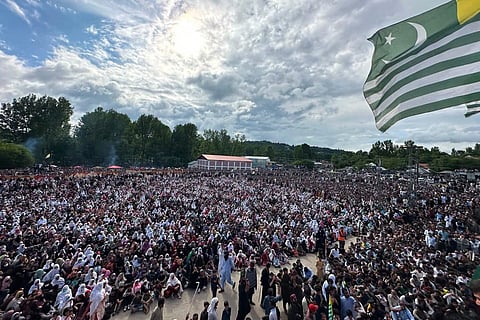


RAWALAKOT: The immediate question confronting Pakistan-administered Jammu and Kashmir is no longer whether protests will continue, but whether the political process can regain enough credibility to absorb the grievances that brought tens of thousands of people onto the streets in the first place.
The current crisis did not emerge overnight. It has evolved through several distinct phases, each reshaping the objectives of both the protest movement and the administration.
When demonstrations first gathered momentum earlier this year, they were largely driven by economic demands. Protesters challenged rising electricity tariffs, increasing wheat flour prices and the deteriorating cost of living. Many of these concerns resonated across political affiliations because they reflected everyday hardships rather than ideological divisions.
However, the movement gradually transformed into something much broader.
The government's decision to ban the Jammu Kashmir Joint Awami Action Committee (JAAC) on June 5, following an assassination attempt on its leader Umar Nazir Kashmiri, fundamentally altered the nature of the agitation.
What had begun as a campaign around economic relief increasingly became a political movement centred on civil liberties, governance and representation. Internet shutdowns, arrests of activists and criminal cases against protest leaders reinforced perceptions among many supporters that the administration had shifted from engagement to coercion.
It is against this background that the present negotiations assume significance.
Unlike earlier contacts between officials and protest representatives, the present talks are addressing not merely economic concessions but the political consequences of the confrontation itself.
Reports that negotiators have moved closer to agreement on compensation, detainees, criminal cases and humanitarian issues suggest that both sides recognise that confidence cannot be restored without addressing the fallout from weeks of unrest.
Yet the two remaining issues, lifting the ban on JAAC and determining legal accountability for killings during the protests, also happen to be the most politically difficult. Neither side can easily retreat without risking criticism from its own constituency.
That explains why negotiations have simultaneously generated optimism and caution.
JAAC has deliberately avoided declaring victory, insisting that only a written agreement can establish whether commitments will be honoured. The government, meanwhile, has refrained from announcing any major concession before the talks conclude. Both appear determined to avoid creating expectations that may later prove impossible to fulfill.
Another issue that continues to shape the political debate is the controversy surrounding the twelve Legislative Assembly seats reserved for refugees from Jammu and Kashmir living elsewhere in Pakistan.
Although the reserved seats have existed for decades, they have acquired unprecedented political importance ahead of the present elections. JAAC and several civil society groups argue that these constituencies enable political parties headquartered in Pakistan to influence the composition of the Assembly in ways that dilute the political preferences of residents living within Pakistan-administered Kashmir itself. The administration, on the other hand, maintains that these seats represent displaced populations whose constitutional rights must also be protected.
Broader Debate
Regardless of which argument ultimately prevails, the controversy illustrates a broader debate over political representation and the balance between local autonomy and Pakistan's institutional role in the territory. It also explains why an issue that once attracted relatively little public attention has become central to the current movement.
The phased election schedule announced by the Election Commission reflects another consequence of the unrest.
Polling will begin in Mirpur Division on July 27, followed by Muzaffarabad Division and the refugee constituencies on August 2 before concluding in Poonch Division on August 10. Officials have presented the staggered schedule as a practical response to security requirements and administrative considerations. Critics, however, argue that phased elections inevitably invite questions about whether early results could influence later voting patterns.
The proposal advanced by former prime ministers Sardar Atiq Ahmad Khan and Sardar Tanveer Ilyas that all results should be announced only after voting concludes across the territory reflects these concerns precisely. Whether or not the Election Commission accepts that suggestion, it demonstrates that confidence in electoral procedures has itself become part of the wider political debate.
Equally revealing is the behaviour of mainstream political parties during the crisis.
Rather than distancing themselves from the unfolding events, the principal parties have intensified campaigning despite continuing uncertainty. The Pakistan Muslim League (Nawaz) has organised major public meetings, while the Pakistan Peoples Party has welcomed the restoration of internet services as an essential step towards credible elections. Both parties appear determined to ensure that the prolonged agitation does not overshadow the electoral contest.
Yet they also face a difficult balancing act.
Expressing excessive support for the administration risks alienating voters sympathetic to the protest movement. At the same time, openly endorsing JAAC's demands could place them in conflict with state institutions that continue to regard the organisation as banned. Consequently, most mainstream politicians have adopted a middle course, welcoming dialogue while avoiding direct involvement in the negotiations themselves.
Another noteworthy development has been the emergence of professional groups as participants in the broader debate.
The territory-wide strike observed by lawyers represents more than symbolic solidarity with detained activists. Throughout Pakistan's political history, bar associations have frequently played influential roles during constitutional and political crises. Their intervention tends to broaden public debate beyond street mobilisation by introducing questions concerning legal process, constitutional safeguards and institutional accountability.
Whether that pattern will be repeated in Pakistan-administered Kashmir remains uncertain. Nevertheless, the legal fraternity's participation indicates that concerns surrounding the present crisis are no longer confined to activists directly associated with JAAC.
Cultural Education
The inauguration of the military-supported "Kashmiri Baithak" in Muzaffarabad also deserves attention in this context.
Officially, the project seeks to familiarise younger generations with Kashmir's history, culture, traditions and the freedom movement. Students visiting the centre were introduced to exhibitions highlighting the region's heritage and historical identity. On its own, such an initiative might have attracted little controversy. Introduced during an election campaign and amid continuing negotiations with a banned political movement, however, it inevitably carries broader political symbolism.
Supporters regard it as an investment in cultural education. Critics interpret it as part of a wider effort to shape the public narrative at a time when competing political narratives are already dominating public discourse.
What, then, are the possible trajectories after the elections?
The most optimistic scenario is that negotiations conclude successfully before polling gains momentum. Such an agreement would not resolve every political disagreement, but it could reduce tensions sufficiently to allow elections to proceed with greater public confidence.
A second possibility is that elections are held while negotiations remain incomplete. Under such circumstances, political competition may continue, but the unresolved status of JAAC and continuing legal disputes could remain sources of instability long after votes are counted.
The third and least desirable outcome would be the collapse of negotiations altogether. Umar Nazir Kashmiri has already warned that any perceived breach of commitments could trigger a renewed long march. If talks fail, the administration may again face the difficult choice between accommodating further protests or relying more heavily on security measures, potentially reversing the limited normalisation now under way.
Ultimately, the developments of the past week demonstrate that Pakistan-administered Jammu and Kashmir has reached an important political transition.
For almost two months, public attention focused largely on confrontation, arrests, communication blackouts and security operations. Today, negotiations, elections and political dialogue have begun sharing that space. This does not mean the crisis has ended. Rather, it suggests that both the government and the protest movement increasingly recognise that neither coercion nor street mobilisation alone can provide a lasting solution.
Whether the present moment becomes the beginning of political reconciliation or merely another pause before renewed confrontation will depend on decisions taken over the coming days. The elections will undoubtedly shape the immediate political landscape. Yet the more enduring question concerns whether the underlying issues that fuelled the protests, including governance, representation, civil liberties and public trust, can be addressed through democratic institutions rather than repeated cycles of confrontation.
The answer to that question will determine not only the success of this election but also the direction of politics in Pakistan-administered Jammu and Kashmir for years to come.
(This news article is in two part series, Part-I can be read here.)
Have you liked the news article?
Support us now:
https://www.gofundme.com/manage/jammu-kashmirs-sole-independent-voice-under-threat
