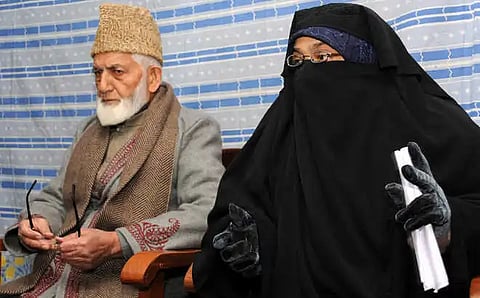


NEW DELHI: The National Investigation Agency has urged a special court in Delhi to sentence Kashmiri women's leader Asiya Andrabi, 64, and her two associates - LitigationNahida Nasreen, 58, and Sofi Fehmeeda, 40 - to life imprisonment, arguing before Judge Chander Jit Singh at Karkardooma Courts that anything less would "undermine public confidence in the efficacy of law."
The defence, in written submissions filed on March 12, responded with a contrasting portrait of the three accused - educated, unwell, elderly women who have already spent nearly eight years imprisoned 800 kilometres from home, one of whom has been denied a spinal surgery she urgently needs, and none of whom the court itself found guilty of a single act of violence.
A reading of both sets of arguments together offers a window into the unresolved legal, political and human tensions at the heart of how India deals with Kashmir's dissenting voices.
The Court’s Findings
The single most important fact in this case, almost entirely absent from the NIA's sentencing arguments, is what the court chose not to convict the women of.
In its judgment of January 14, 2026, the special NIA court acquitted all three on Section 121 IPC, the charge of waging war against India, as well as on charges of funding terrorism and membership in a terrorist organisation.
The court, after examining 53 prosecution witnesses and 186 documents over years of trial, found no evidence of violence, no evidence of raising funds for terror, and no evidence of terrorist membership.
What the women were convicted of offences of conspiracy, association, speech and advocacy under Sections 18, 38 and 39 of the UAPA and Sections 120B, 121A, 153A, 153B and 505 of the IPC. They were convicted, in essence, for what they said, wrote, organised around, and believed.
The NIA is now seeking life imprisonment on that basis.
The defence submission pointedly notes that "the prosecution was unable to demonstrate any concrete consequence, harm, or disturbance directly attributable to the acts in question"; and that the judgment itself records this absence.
The NIA's Case: Speech as War
The NIA's arguments, filed through advocate Kanchan of the Delhi Legal Aid office, are built on a sweeping characterisation of the women's political activities as an existential threat to India.
The agency argues that Andrabi, as chairperson of Dukhtaran-e-Millat (DeM), Fehmeeda as its press secretary, and Nasreen as its general secretary, were "actively working to recruit, radicalise and motivate women and youth in J&K to join militancy and wage war against the Government of India."
It cites an interview in which Andrabi stated: "I think more and more youth will join the militants and our armed struggle will be stronger by the day. Killing and abuses by Indian occupational forces will only increase the militancy. The gun is one of the means of achieving our goal, but we must make our political struggle strong too."
The NIA also cites Andrabi's public declaration: "We will not desist from whatever we are doing, because this is something which is our conviction that Kashmir is to be freed from its illegal occupation... India has illegally occupied Kashmir and India has no right on Jammu and Kashmir, and India has used fake accession papers, saying that Kashmiris have done accession with India. So, Kashmiris have already rejected India's occupation on Kashmir."
These statements, the NIA argues, constitute not political speech but direct incitement, "a call to war" that "threatened the unity, integrity, security and sovereignty of India."
The agency invokes the "collective conscience of society" to argue that leniency would send the wrong message, that "conspiring against the State will invite the harshest penalty" must be the court's message, given "rising secessionist movements and terror funding."
It further argues that Andrabi's alleged contact with Hafiz Saeed, the founder of Lashkar-e-Taiba, "transforms their conspiracy from a domestic matter into a cross-border collusion against the sovereignty, security and integrity of India."
Significantly, the NIA also mentions that Andrabi "slaughtered a cow during a protest possession" as evidence of her intent to promote communal enmity.
The agency lists Andrabi as facing 33 FIRs registered against her in Jammu and Kashmir, Fehmeeda as facing 9 cases, and Nasreen as facing 5; and calls them "habitual offenders."
It asks the court to impose maximum sentences consecutively, not concurrently This means the sentences for each separate charge would run one after another rather than simultaneously, dramatically extending the total period of incarceration.
The Defence's Case: Eight Years for Words
The defence submission, filed by advocate Shariq Iqbal, opens with a principle that has guided Indian sentencing jurisprudence since the 1970s; that punishment must be individualised, proportionate, and not mechanical. He then systematically applies it to the specific circumstances of three women whose actual situation the NIA's arguments largely ignore.
The defence notes that even the court, during arguments before reserving judgment, itself raised the question of what actual consequence resulted from the women's alleged acts. The prosecution, it submits, could not answer that question. "The absence of demonstrable harm is a significant mitigating factor."
The NIA's attempt to portray the women as hardened repeat offenders is directly addressed by the defence. The defence points out that the government itself directed that the women not be taken out of Delhi, while most of the pending cases are before courts in Jammu and Kashmir, meaning those cases have remained procedurally frozen not through any fault of the accused but because the state prevented them from appearing.
Two cases in Kashmir have already resulted in discharge. Most significantly, in the NIA's own case related to Hafiz Saeed, Andrabi was discharged of allegations of terror funding from Pakistan and terror activities including stone pelting. The NIA does not challenge this, giving it finality. Yet the NIA now seeks to use the association with that case to imply the most sinister motives in its sentencing arguments.
The prosecution relies heavily on DeM's status as a proscribed organisation. But the defence reveals that the women's petition challenging that very proscription was stopped within the prison mail system for nearly two years. It was only after the High Court intervened that the petition was forwarded to the Ministry of Home Affairs, which has still not responded. The women were, in effect, legally prevented from challenging the designation that is now being used to justify their punishment.
The defence relies on a detailed account of the educational and social background of the convicts. Andrabi holds a B.Sc. in Home Studies and an M.A. in Arabic. Nasreen holds an M.Sc. in Zoology and an M.A. in Islamic Studies. Fehmeeda is a graduate.
The defence notes their "orientation towards social and intellectual engagement rather than criminal conduct" and lists their community contributions: running schools and educational initiatives, working through NGOs for social reform, campaigning against drug abuse among Kashmiri youth, promoting girls' education, and speaking against extravagant marriage practices that burden families financially.
Medical Neglect Behind Bars
The significant section of the defence submission concerns the health of the three women and what has happened to them during their eight years in Tihar Jail.
Andrabi, at 64, suffers from diabetes, asthma, arthritis, and bronchospasm. Fehmeeda, at 40, requires spinal surgery that she has been denied throughout her entire period of incarceration. Nasreen, at 58, has been refused adequate medical care.
All three were held in solitary confinement for a considerable period. It was only after the High Court intervened that they were moved to regular cells.
The NIA's submission makes no mention of any of this.
The defence argues that the prolonged incarceration, isolation from family 800 kilometres away in Kashmir, the harsh custodial conditions, and the serious and deteriorating health of all three constitute "significant mitigating circumstances" that the court must weigh. Their conduct in jail, it notes, has been reported as good throughout.
Political Speech and Anti-terror Law
Read together, the two statements reveal a fundamental tension in the use of anti-terror law against political speech.
The NIA argues that because the UAPA and IPC prescribe harsh maximum penalties for these offences, the court should impose those maximums. It cites eight Supreme Court judgments in support of deterrence-based sentencing.
The defence counters with the foundational principle from Deo Narain Mandal vs State of UP (2004): that sentence "should not be either excessively harsh or ridiculously low" and must be based on "proportionality" - the actual facts, the actual harm, the actual character of the accused.
The defence invokes Section 428 CrPC, which mandates that pre-trial detention must be counted against any final sentence. With nearly eight years already served, the argument that the sentence should be limited to time already undergone is not merely sympathetic — it is legally grounded.
The defence also invokes the Supreme Court's ruling in Santa Singh vs State of Punjab (1977), which established the right of the accused to present personal and social information at the sentencing stage.
The 33 FIRs the NIA lists against Andrabi in Jammu and Kashmir span decades of activism, many of them registered during periods of mass unrest in 2008, 2010, and 2016, when hundreds of Kashmiris faced legal action.
That the NIA now presents this number as evidence of habitual criminality, without noting the political context of those registrations or the fact that many remain unresolved precisely because the state has kept the accused out of reach of those courts, is a framing that the defence directly challenges.
The NIA's sentencing arguments were filed through advocate Kanchan, Delhi Legal Aid, NIA. The defence submissions were filed through advocate Shariq Iqbal on behalf of Asiya Andrabi, Nahida Nasreen and Sofi Fehmeeda.
Have you liked the news article?
Support us now:
https://www.gofundme.com/manage/jammu-kashmirs-sole-independent-voice-under-threat